 Add to Chrome
 Add to Firefox
 Add to Edge
Cross-View Sequential Visual Localization with Spatio-Temporal Context Modeling for Autonomous Driving
Aug 11, 2026
Continuous and reliable localization is essential for autonomous driving. Cross-view visual localization matches ground images with satellite maps, providing complementary localization cues for pipelines that depend on Global Navigation Satellite System (GNSS) signals and high-definition (HD) maps. Most existing cross-view visual localization methods process each frame independently, leaving temporal information underused and limiting accuracy under dynamic occlusion, illumination variation, and repetitive textures. This study proposes a temporal-context-enhanced framework for cross-view sequence visual localization. The proposed recurrent cross-frame module aggregates historical context from the previous state to enhance the coarse ground feature of each current frame. These enhanced features facilitate satellite candidate-region classification, while hierarchical fine-grained features enable precise local offset estimation. On the CVIS dataset, the proposed method reduces mean localization error from 3.80 m to 1.57 m and increases R@1 m from 8.14% to 40.22%. Direct transfer to KITTI-CVL achieves a mean error of 2.61 m, with target-domain fine-tuning further reducing the mean error to 2.27 m. Zero-shot field experiments on a real-world vehicle achieve a mean error of 2.84 m and R@5 m of 96.86%. These results demonstrate that temporal context enhancement significantly improves cross-view localization accuracy and supports robust deployment on public benchmarks and real-world roads.

LeetDecoding: A PyTorch Library for Exponentially Decaying Causal Linear Attention with CUDA Implementations
Jan 05, 2025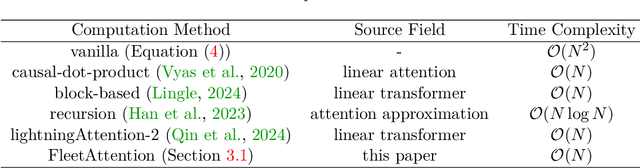
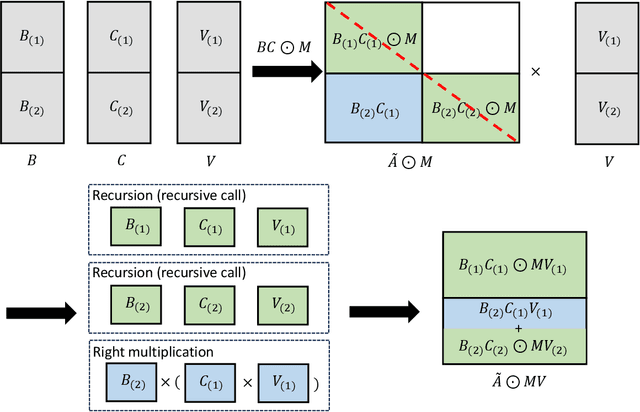
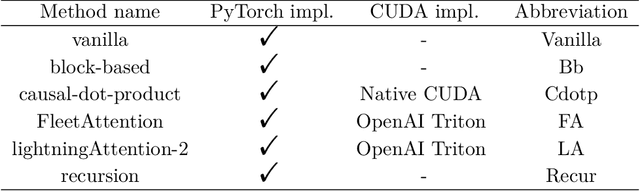
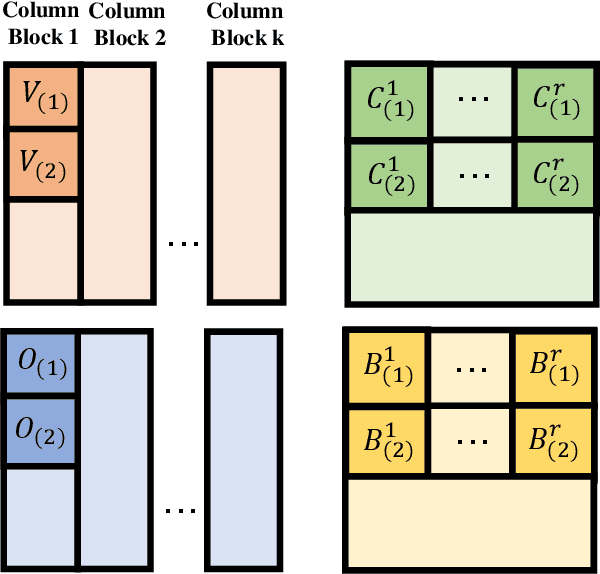
The machine learning and data science community has made significant while dispersive progress in accelerating transformer-based large language models (LLMs), and one promising approach is to replace the original causal attention in a generative pre-trained transformer (GPT) with \emph{exponentially decaying causal linear attention}. In this paper, we present LeetDecoding, which is the first Python package that provides a large set of computation routines for this fundamental operator. The launch of LeetDecoding was motivated by the current lack of (1) clear understanding of the complexity regarding this operator, (2) a comprehensive collection of existing computation methods (usually spread in seemingly unrelated fields), and (3) CUDA implementations for fast inference on GPU. LeetDecoding's design is easy to integrate with existing linear-attention LLMs, and allows for researchers to benchmark and evaluate new computation methods for exponentially decaying causal linear attention. The usage of LeetDecoding does not require any knowledge of GPU programming and the underlying complexity analysis, intentionally making LeetDecoding accessible to LLM practitioners. The source code of LeetDecoding is provided at \href{https://github.com/Computational-Machine-Intelligence/LeetDecoding}{this GitHub repository}, and users can simply install LeetDecoding by the command \texttt{pip install leet-decoding}.