 Add to Chrome
 Add to Firefox
 Add to Edge
3D Gaussian Map with Open-Set Semantic Grouping for Vision-Language Navigation
May 26, 2026
Vision-language navigation (VLN) requires an agent to traverse complex 3D environments based on natural language instructions, necessitating a thorough scene understanding. While existing works equip agents with various scene representations to enhance spatial awareness, they often neglect the complex 3D geometry and rich semantics in VLN scenarios, limiting the ability to generalize across diverse and unseen environments. To address these challenges, this work proposes a 3D Gaussian Map that represents the environment as a set of differentiable 3D Gaussians and accordingly develops a navigation strategy for VLN. Specifically, Egocentric Scene Map is constructed online by initializing 3D Gaussians from sparse pseudo-lidar point clouds, providing informative geometric priors for scene understanding. Each Gaussian primitive is further enriched through Open-Set Semantic Grouping operation, which groups 3D Gaussians based on their membership in object instances or stuff categories within the open world, resulting in a unified 3D Gaussian Map. Building on this map, Multi-Level Action Prediction strategy, which combines spatial-semantic cues at multiple granularities, is designed to assist agents in decision-making. Extensive experiments conducted on three public benchmarks (i.e., R2R, R4R, and REVERIE) validate the effectiveness of our method.

Uncertainty-Aware Gaussian Map for Vision-Language Navigation
May 26, 2026Vision-Language Navigation (VLN) requires an agent to navigate 3D environments following natural language instructions. During navigation, existing agents commonly encounter perceptual uncertainty, such as insufficient evidence for reliable grounding or ambiguity in interpreting spatial cues, yet they typically ignore such information when predicting actions. In this work, we explicitly model three forms of perceptual uncertainty (i.e., geometric, semantic, and appearance uncertainty) and integrate them into the agent's observation space to enable informed decision-making. Concretely, our agent first constructs a Semantic Gaussian Map (SGM), composed of differentiable 3D Gaussian primitives initialized from panoramic observations, that encodes both the geometric structure and semantic content of the environment. On top of SGM, geometric uncertainty is estimated through variational perturbations of Gaussian position and scale to assess structural reliability; semantic uncertainty is captured by perturbing Gaussian semantic attributes to reveal ambiguous interpretations; and appearance uncertainty is characterized by Fisher Information, which measures the sensitivity of rendered observations to Gaussian-level variations. These uncertainties are incorporated into SGM, extending it into a unified 3D Value Map, which grounds them as affordances and constraints that support reliable navigation. Comprehensive evaluations across multiple VLN benchmarks show the effectiveness of our agent.
Clinically-Grounded Counterfactual Reasoning for Medical Video Diagnosis
May 26, 2026Medical video diagnosis involves inferring clinical decisions from dynamic tissue responses throughout examination processes. Existing methods rely on an end-to-end learning paradigm that i) focuses on appearance rather than pathology, ii) lacks clinical priors, and iii) reasons solely from observations without counterfactual comparison. This work introduces MedVCR, a counterfactual reasoning framework that mimics clinical diagnostic thinking. MedVCR comprises three components: a Counterfactual Generator that synthesizes tissue evolution under specified pathological states via a diffusion-based manner; a Counterfactual Representation Learning module that encodes diagnostic knowledge through clinical rules (i.e., temporal consistency, pathological separability, and counterfactual alignment); and a Dual Diagnostic Prediction strategy that integrates video-level assessment with frame-level counterfactual analysis. MedVCR is evaluated under both fully supervised (e.g., colposcopy) and weakly supervised (e.g., colonoscopy) video diagnosis settings, yielding 2.6%-10.2% performance gains compared with leading baselines. Comprehensive ablation studies further validate the effectiveness of each component. The code will be released.
History-Enhanced Two-Stage Transformer for Aerial Vision-and-Language Navigation
Dec 17, 2025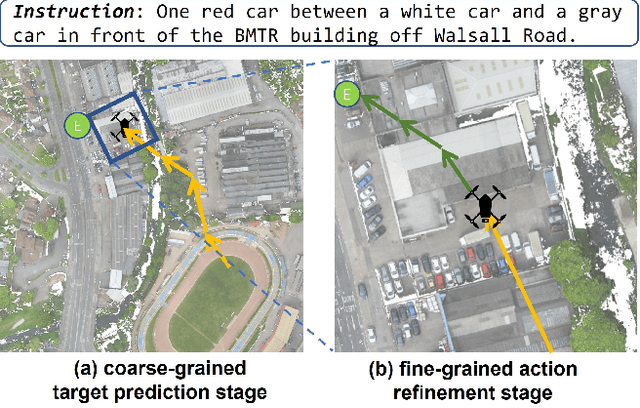
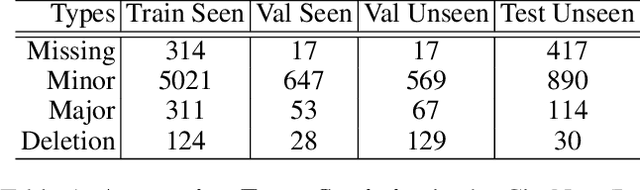
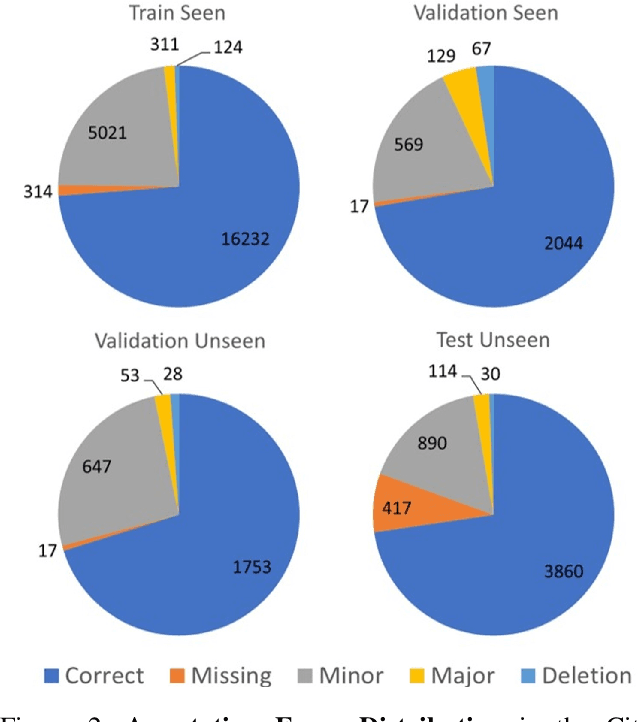
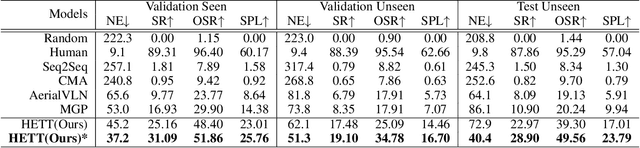
Aerial Vision-and-Language Navigation (AVLN) requires Unmanned Aerial Vehicle (UAV) agents to localize targets in large-scale urban environments based on linguistic instructions. While successful navigation demands both global environmental reasoning and local scene comprehension, existing UAV agents typically adopt mono-granularity frameworks that struggle to balance these two aspects. To address this limitation, this work proposes a History-Enhanced Two-Stage Transformer (HETT) framework, which integrates the two aspects through a coarse-to-fine navigation pipeline. Specifically, HETT first predicts coarse-grained target positions by fusing spatial landmarks and historical context, then refines actions via fine-grained visual analysis. In addition, a historical grid map is designed to dynamically aggregate visual features into a structured spatial memory, enhancing comprehensive scene awareness. Additionally, the CityNav dataset annotations are manually refined to enhance data quality. Experiments on the refined CityNav dataset show that HETT delivers significant performance gains, while extensive ablation studies further verify the effectiveness of each component.
A Multilevel Guidance-Exploration Network and Behavior-Scene Matching Method for Human Behavior Anomaly Detection
Dec 07, 2023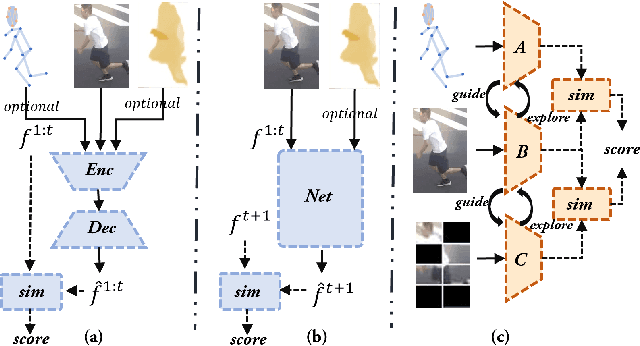
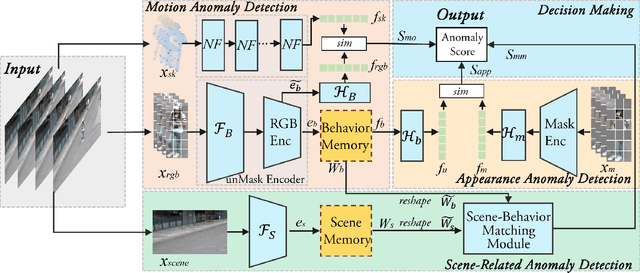
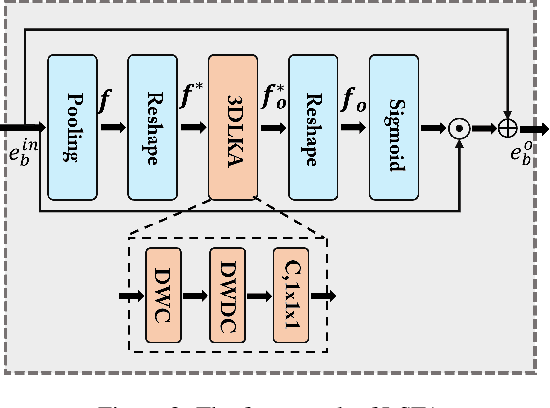
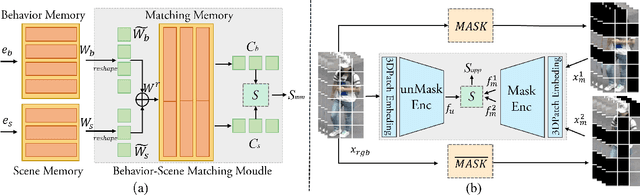
Human behavior anomaly detection aims to identify unusual human actions, playing a crucial role in intelligent surveillance and other areas. The current mainstream methods still adopt reconstruction or future frame prediction techniques. However, reconstructing or predicting low-level pixel features easily enables the network to achieve overly strong generalization ability, allowing anomalies to be reconstructed or predicted as effectively as normal data. Different from their methods, inspired by the Student-Teacher Network, we propose a novel framework called the Multilevel Guidance-Exploration Network(MGENet), which detects anomalies through the difference in high-level representation between the Guidance and Exploration network. Specifically, we first utilize the pre-trained Normalizing Flow that takes skeletal keypoints as input to guide an RGB encoder, which takes unmasked RGB frames as input, to explore motion latent features. Then, the RGB encoder guides the mask encoder, which takes masked RGB frames as input, to explore the latent appearance feature. Additionally, we design a Behavior-Scene Matching Module(BSMM) to detect scene-related behavioral anomalies. Extensive experiments demonstrate that our proposed method achieves state-of-the-art performance on ShanghaiTech and UBnormal datasets, with AUC of 86.9 % and 73.5 %, respectively. The code will be available on https://github.com/molu-ggg/GENet.