 Add to Chrome
 Add to Firefox
 Add to Edge
Generative Archetype-Grounded Item Representations for Sequential Recommendation
Jun 09, 2026
Sequential recommendation aims to predict users' next interaction with items by analyzing their historical behavior. However, the limited quality of item representations remains a critical bottleneck. While pre-trained large language models (LLMs) can provide rich semantic representations, existing approaches only rely on static encoding of fixed attributes, overlooking the crucial role of target audiences in defining item identity. Moreover, the semantic space struggles to reflect actual user behavior, resulting in a significant gap between semantic representations and behavioral patterns. To address these limitations, we propose GenAIR, a general framework that empowers sequential recommendation with Generative Archetype-grounded Item Representations. Specifically, we first leverage an LLM to analyze item metadata and infer textual description of the Archetype, which represents the conceptual profile of the item's ideal target audience. We then extract the corresponding embeddings in a single forward pass. Further, to ground these generative archetypes in real-world behavior, we introduce a behavioral calibration objective, which explicitly incorporates behavioral signals from actual interactions. This objective adjusts the structure of the embedding space to reflect empirical patterns. GenAIR enables seamless integration with most existing models while maintaining high efficiency. Comprehensive experiments conducted on three real-world datasets demonstrate that GenAIR significantly improves the performance of various sequential recommendation models and consistently outperforms state-of-the-art baseline approaches. Implementation codes are available at https://github.com/AI-Santiago/GenAIR.

Physics-integrated neural differentiable modeling for immersed boundary systems
Mar 17, 2026Accurately, efficiently, and stably computing complex fluid flows and their evolution near solid boundaries over long horizons remains challenging. Conventional numerical solvers require fine grids and small time steps to resolve near-wall dynamics, resulting in high computational costs, while purely data-driven surrogate models accumulate rollout errors and lack robustness under extrapolative conditions. To address these issues, this study extends existing neural PDE solvers by developing a physics-integrated differentiable framework for long-horizon prediction of immersed-boundary flows. A key design aspect of the framework includes an important improvement, namely the structural integration of physical principles into an end-to-end differentiable architecture incorporating a PDE-based intermediate velocity module and a multi-direct forcing immersed boundary module, both adhering to the pressure-projection procedure for incompressible flow computation. The computationally expensive pressure projection step is substituted with a learned implicit correction using ConvResNet blocks to reduce cost, and a sub-iteration strategy is introduced to separate the embedded physics module's stability requirement from the surrogate model's time step, enabling stable coarse-grid autoregressive rollouts with large effective time increments. The framework uses only single-step supervision for training, eliminating long-horizon backpropagation and reducing training time to under one hour on a single GPU. Evaluations on benchmark cases of flow past a stationary cylinder and a rotationally oscillating cylinder at Re=100 show the proposed model consistently outperforms purely data-driven, physics-loss-constrained, and coarse-grid numerical baselines in flow-field fidelity and long-horizon stability, while achieving an approximately 200-fold inference speedup over the high-resolution solver.
Domain Adversarial Active Learning for Domain Generalization Classification
Mar 10, 2024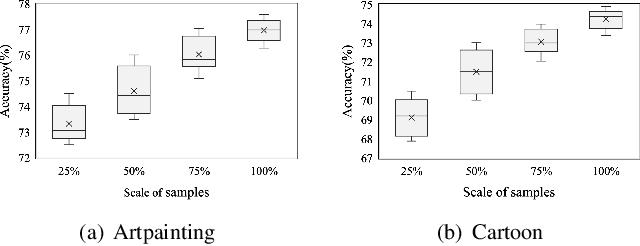
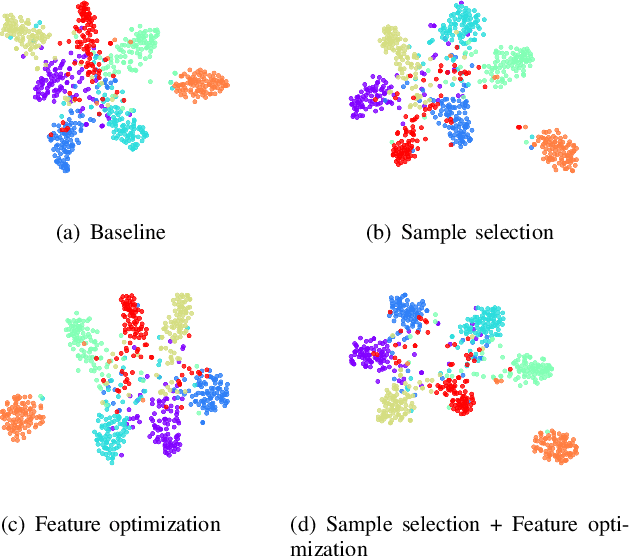
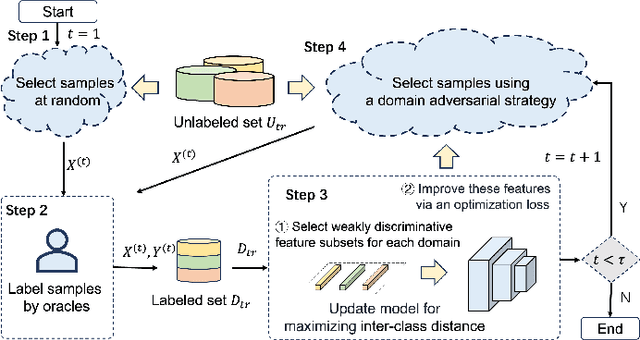
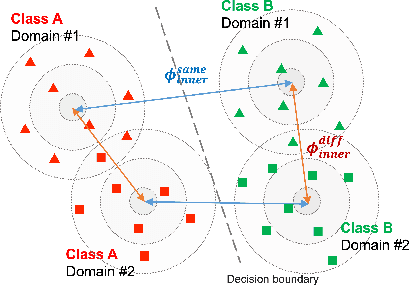
Domain generalization models aim to learn cross-domain knowledge from source domain data, to improve performance on unknown target domains. Recent research has demonstrated that diverse and rich source domain samples can enhance domain generalization capability. This paper argues that the impact of each sample on the model's generalization ability varies. Despite its small scale, a high-quality dataset can still attain a certain level of generalization ability. Motivated by this, we propose a domain-adversarial active learning (DAAL) algorithm for classification tasks in domain generalization. First, we analyze that the objective of tasks is to maximize the inter-class distance within the same domain and minimize the intra-class distance across different domains. To achieve this objective, we design a domain adversarial selection method that prioritizes challenging samples. Second, we posit that even in a converged model, there are subsets of features that lack discriminatory power within each domain. We attempt to identify these feature subsets and optimize them by a constraint loss. We validate and analyze our DAAL algorithm on multiple domain generalization datasets, comparing it with various domain generalization algorithms and active learning algorithms. Our results demonstrate that the DAAL algorithm can achieve strong generalization ability with fewer data resources, thereby reducing data annotation costs in domain generalization tasks.