 Add to Chrome
 Add to Firefox
 Add to Edge
UniPCB: A Generation-Assisted Detection Framework for PCB Defect Inspection
May 06, 2026
Printed Circuit Board (PCB) defect inspection faces two compounding challenges: scarce and imbalanced defect samples that limit model training, and insufficient feature representation under complex circuit backgrounds. Existing generation methods rely on single-modality conditions with coarse structural control, while detection methods improve architectures without addressing the data bottleneck. To resolve both challenges jointly, we propose a generation-assisted PCB defect inspection framework that integrates controlled defect synthesis with task-specific defect detection. On the generation side, a Multi-modal Condition Generator extracts complementary edge, depth, and text conditions in parallel. A ScaleEncoder then embeds these conditions into the diffusion U-Net at four resolutions, and a Condition Modulation applies FiLM-style spatially-adaptive modulation at each scale, enabling structurally aligned and defect-aware sample synthesis. On the detection side, an Inverted Residual Shift Attention couples self-attention with shift-wise convolution to jointly capture global context and local texture, and a Cross-level Complementary Fusion Block generates pixel-level gates for selective cross-level feature fusion. The synthesized samples directly enrich the detection training set, so that improvements in generation compound with improvements in detection. Extensive experiments on DsPCBSD+ demonstrate that UniPCB achieves mAP@0.5 of 98.0% and mAP@0.5:0.95 of 61.8% on defect detection, surpassing all compared methods, while the generation branch attains an FID of 129.61 and SSIM of 0.619, outperforming existing conditional generation approaches.

PatentNet: A Large-Scale Incomplete Multiview, Multimodal, Multilabel Industrial Goods Image Database
Jun 23, 2021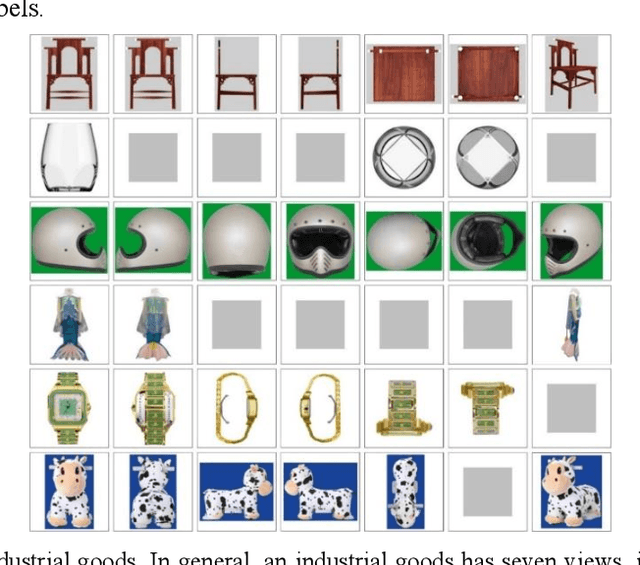
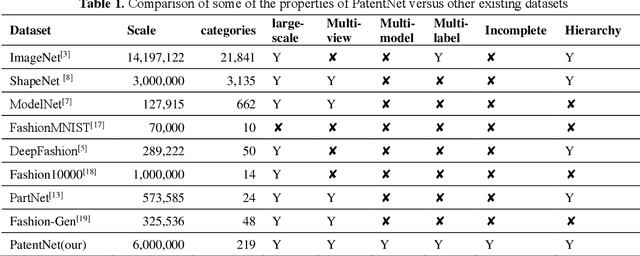
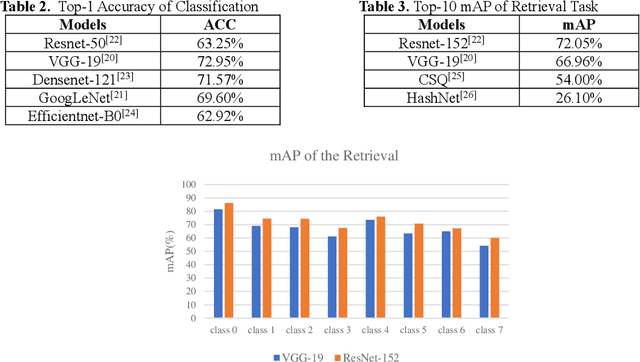
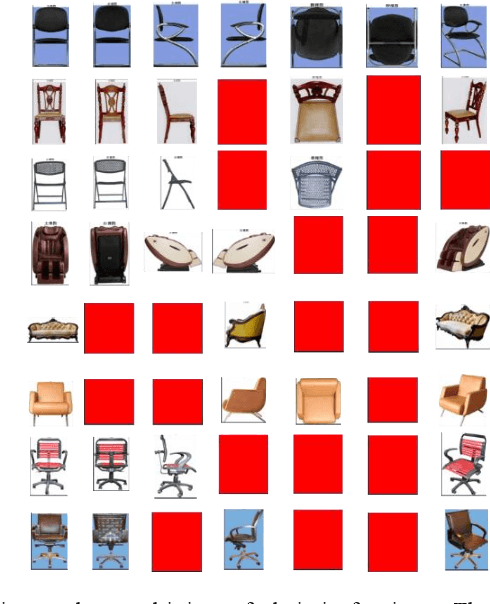
In deep learning area, large-scale image datasets bring a breakthrough in the success of object recognition and retrieval. Nowadays, as the embodiment of innovation, the diversity of the industrial goods is significantly larger, in which the incomplete multiview, multimodal and multilabel are different from the traditional dataset. In this paper, we introduce an industrial goods dataset, namely PatentNet, with numerous highly diverse, accurate and detailed annotations of industrial goods images, and corresponding texts. In PatentNet, the images and texts are sourced from design patent. Within over 6M images and corresponding texts of industrial goods labeled manually checked by professionals, PatentNet is the first ongoing industrial goods image database whose varieties are wider than industrial goods datasets used previously for benchmarking. PatentNet organizes millions of images into 32 classes and 219 subclasses based on the Locarno Classification Agreement. Through extensive experiments on image classification, image retrieval and incomplete multiview clustering, we demonstrate that our PatentNet is much more diverse, complex, and challenging, enjoying higher potentials than existing industrial image datasets. Furthermore, the characteristics of incomplete multiview, multimodal and multilabel in PatentNet are able to offer unparalleled opportunities in the artificial intelligence community and beyond.
Conditioning Optimization of Extreme Learning Machine by Multitask Beetle Antennae Swarm Algorithm
Nov 22, 2018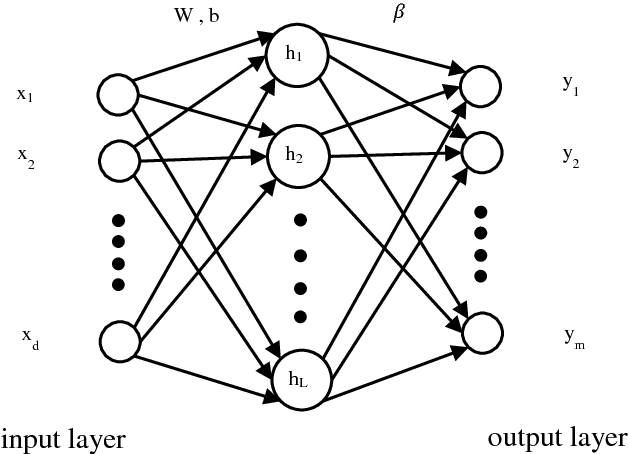

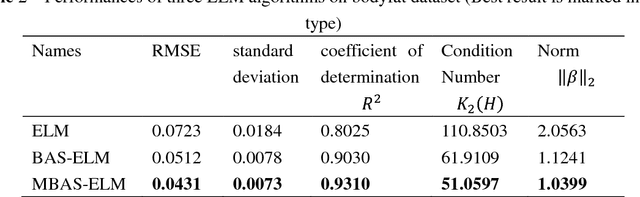
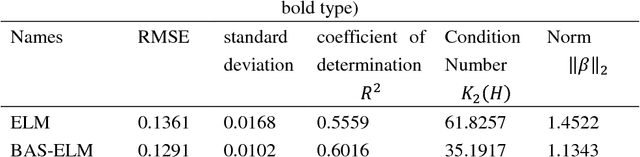
Extreme learning machine (ELM) as a simple and rapid neural network has been shown its good performance in various areas. Different from the general single hidden layer feedforward neural network (SLFN), the input weights and biases in hidden layer of ELM are generated randomly, so that it only takes a little computation overhead to train the model. However, the strategy of selecting input weights and biases at random may result in ill-posed problem. Aiming to optimize the conditioning of ELM, we propose an effective particle swarm heuristic algorithm called Multitask Beetle Antennae Swarm Algorithm (MBAS), which is inspired by the structures of artificial bee colony (ABS) algorithm and Beetle Antennae Search (BAS) algorithm. Then, the proposed MBAS is applied to optimize the input weights and biases of ELM. Experiment results show that the proposed method is capable of simultaneously reducing the condition number and regression error, and achieving good generalization performances.