 Add to Chrome
 Add to Firefox
 Add to Edge
AutoNumerics: An Autonomous, PDE-Agnostic Multi-Agent Pipeline for Scientific Computing
Feb 19, 2026
PDEs are central to scientific and engineering modeling, yet designing accurate numerical solvers typically requires substantial mathematical expertise and manual tuning. Recent neural network-based approaches improve flexibility but often demand high computational cost and suffer from limited interpretability. We introduce \texttt{AutoNumerics}, a multi-agent framework that autonomously designs, implements, debugs, and verifies numerical solvers for general PDEs directly from natural language descriptions. Unlike black-box neural solvers, our framework generates transparent solvers grounded in classical numerical analysis. We introduce a coarse-to-fine execution strategy and a residual-based self-verification mechanism. Experiments on 24 canonical and real-world PDE problems demonstrate that \texttt{AutoNumerics} achieves competitive or superior accuracy compared to existing neural and LLM-based baselines, and correctly selects numerical schemes based on PDE structural properties, suggesting its viability as an accessible paradigm for automated PDE solving.

Learning Epidemiological Dynamics via the Finite Expression Method
Dec 30, 2024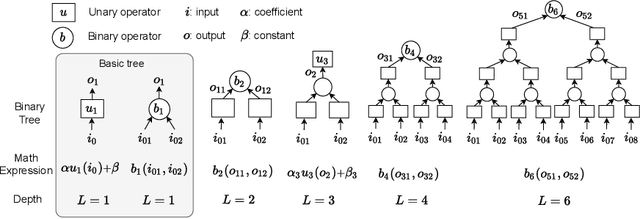
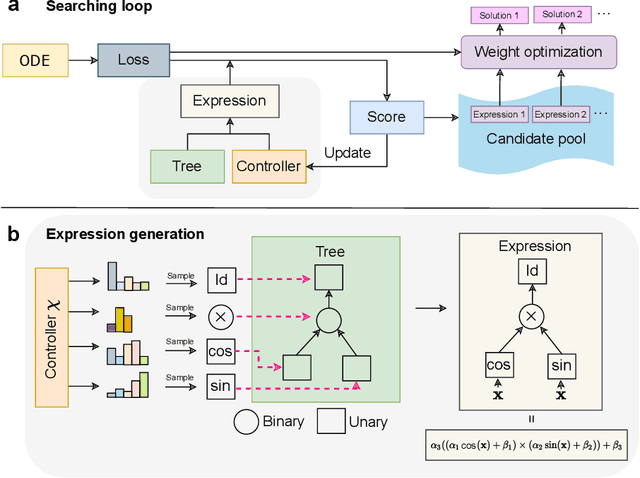
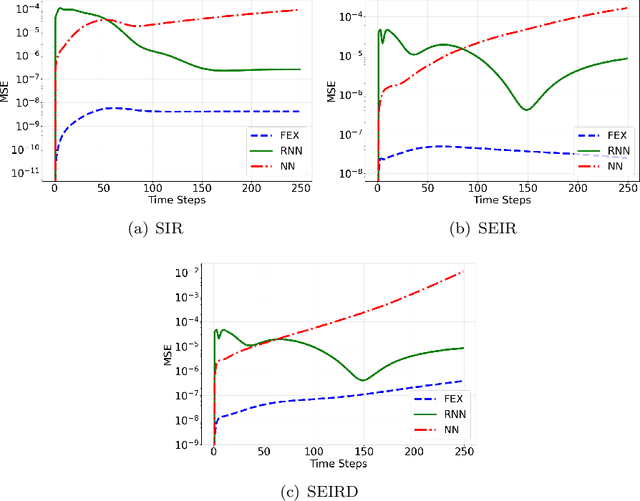
Modeling and forecasting the spread of infectious diseases is essential for effective public health decision-making. Traditional epidemiological models rely on expert-defined frameworks to describe complex dynamics, while neural networks, despite their predictive power, often lack interpretability due to their ``black-box" nature. This paper introduces the Finite Expression Method, a symbolic learning framework that leverages reinforcement learning to derive explicit mathematical expressions for epidemiological dynamics. Through numerical experiments on both synthetic and real-world datasets, FEX demonstrates high accuracy in modeling and predicting disease spread, while uncovering explicit relationships among epidemiological variables. These results highlight FEX as a powerful tool for infectious disease modeling, combining interpretability with strong predictive performance to support practical applications in public health.