 Add to Chrome
 Add to Firefox
 Add to Edge
Mem3R: Streaming 3D Reconstruction with Hybrid Memory via Test-Time Training
Apr 08, 2026
Streaming 3D perception is well suited to robotics and augmented reality, where long visual streams must be processed efficiently and consistently. Recent recurrent models offer a promising solution by maintaining fixed-size states and enabling linear-time inference, but they often suffer from drift accumulation and temporal forgetting over long sequences due to the limited capacity of compressed latent memories. We propose Mem3R, a streaming 3D reconstruction model with a hybrid memory design that decouples camera tracking from geometric mapping to improve temporal consistency over long sequences. For camera tracking, Mem3R employs an implicit fast-weight memory implemented as a lightweight Multi-Layer Perceptron updated via Test-Time Training. For geometric mapping, Mem3R maintains an explicit token-based fixed-size state. Compared with CUT3R, this design not only significantly improves long-sequence performance but also reduces the model size from 793M to 644M parameters. Mem3R supports existing improved plug-and-play state update strategies developed for CUT3R. Specifically, integrating it with TTT3R decreases Absolute Trajectory Error by up to 39% over the base implementation on 500 to 1000 frame sequences. The resulting improvements also extend to other downstream tasks, including video depth estimation and 3D reconstruction, while preserving constant GPU memory usage and comparable inference throughput. Project page: https://lck666666.github.io/Mem3R/

AlignDiff: Learning Physically-Grounded Camera Alignment via Diffusion
Mar 27, 2025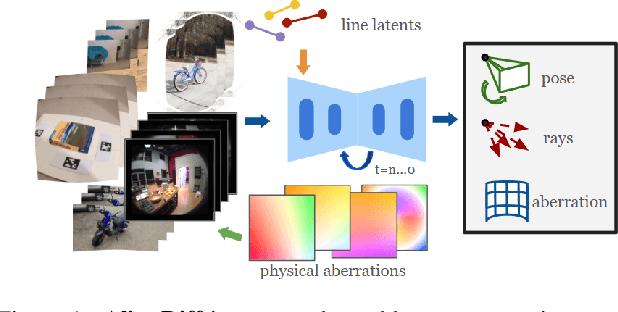
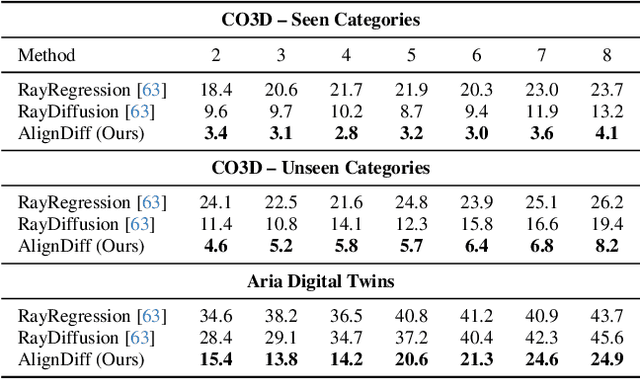
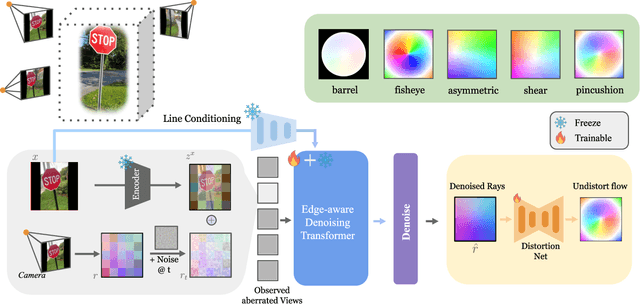
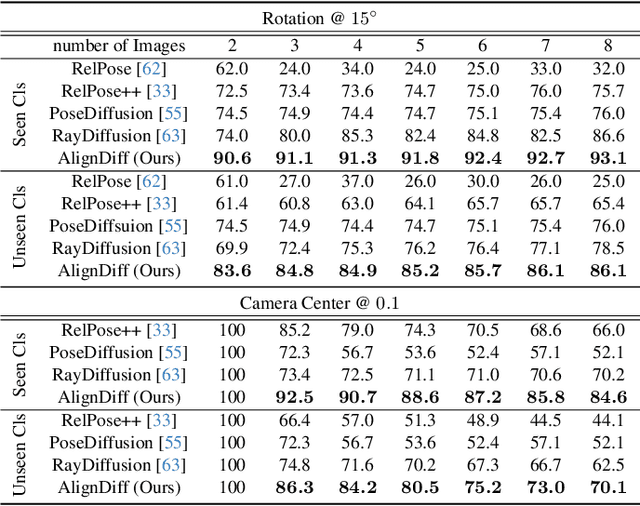
Accurate camera calibration is a fundamental task for 3D perception, especially when dealing with real-world, in-the-wild environments where complex optical distortions are common. Existing methods often rely on pre-rectified images or calibration patterns, which limits their applicability and flexibility. In this work, we introduce a novel framework that addresses these challenges by jointly modeling camera intrinsic and extrinsic parameters using a generic ray camera model. Unlike previous approaches, AlignDiff shifts focus from semantic to geometric features, enabling more accurate modeling of local distortions. We propose AlignDiff, a diffusion model conditioned on geometric priors, enabling the simultaneous estimation of camera distortions and scene geometry. To enhance distortion prediction, we incorporate edge-aware attention, focusing the model on geometric features around image edges, rather than semantic content. Furthermore, to enhance generalizability to real-world captures, we incorporate a large database of ray-traced lenses containing over three thousand samples. This database characterizes the distortion inherent in a diverse variety of lens forms. Our experiments demonstrate that the proposed method significantly reduces the angular error of estimated ray bundles by ~8.2 degrees and overall calibration accuracy, outperforming existing approaches on challenging, real-world datasets.
Through the Curved Cover: Synthesizing Cover Aberrated Scenes with Refractive Field
Nov 10, 2024
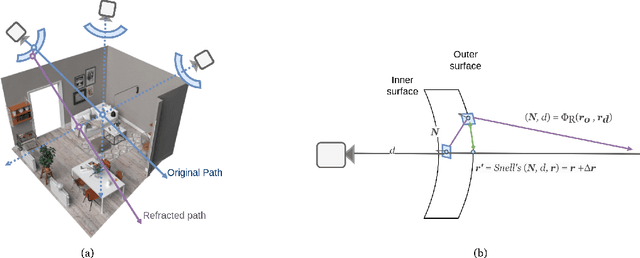

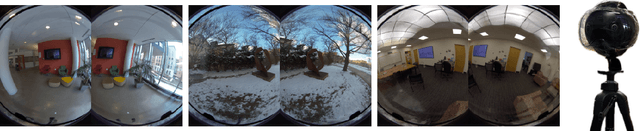
Recent extended reality headsets and field robots have adopted covers to protect the front-facing cameras from environmental hazards and falls. The surface irregularities on the cover can lead to optical aberrations like blurring and non-parametric distortions. Novel view synthesis methods like NeRF and 3D Gaussian Splatting are ill-equipped to synthesize from sequences with optical aberrations. To address this challenge, we introduce SynthCover to enable novel view synthesis through protective covers for downstream extended reality applications. SynthCover employs a Refractive Field that estimates the cover's geometry, enabling precise analytical calculation of refracted rays. Experiments on synthetic and real-world scenes demonstrate our method's ability to accurately model scenes viewed through protective covers, achieving a significant improvement in rendering quality compared to prior methods. We also show that the model can adjust well to various cover geometries with synthetic sequences captured with covers of different surface curvatures. To motivate further studies on this problem, we provide the benchmarked dataset containing real and synthetic walkable scenes captured with protective cover optical aberrations.