 Add to Chrome
 Add to Firefox
 Add to Edge
On Explicit Super-Expressive Approximation for Neural Networks
Jul 07, 2026
In this work, we investigate the fixed-architecture neural network approximation with explicit parameter bounds and elementary activations. While prior work demonstrated super-expressive approximation using fixed-size networks, they lack quantitative and non-asymptotic characterizations of parameter magnitude with respect to the approximation error. We resolve this issue by introducing the Chinese Remainder Theorem as a constructive encoding mechanism. For Lipschitz continuous functions on $[0,1]^D$, we construct a width-$\max\{D,4\}$, depth-$5$ network with explicit parameter-error trade-offs. For Hölder-smooth functions in $C^{r,γ}_A\left([0,1]^D\right)$, our fixed network of width $\max\{2D,\ D+5N+1\}$ and depth $r + 9$ achieves the parameter magnitude $\mathcal{P}$ bounded by $\log_2 \mathcal{P}=\mathcal{O}\bigl(\varepsilon^{-2D/(r+γ)}\log(1/\varepsilon)\bigr)$. This is the dual result compared to those in the parameter-bounded and architecture-unbounded paradigm.

A Fast and Robust TSVM for Pattern Classification
Nov 15, 2017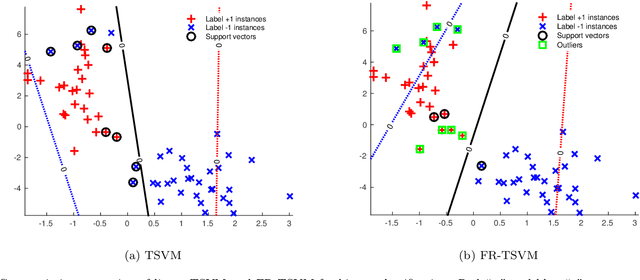
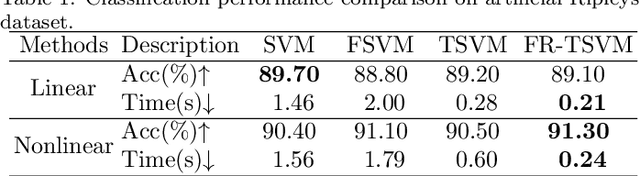
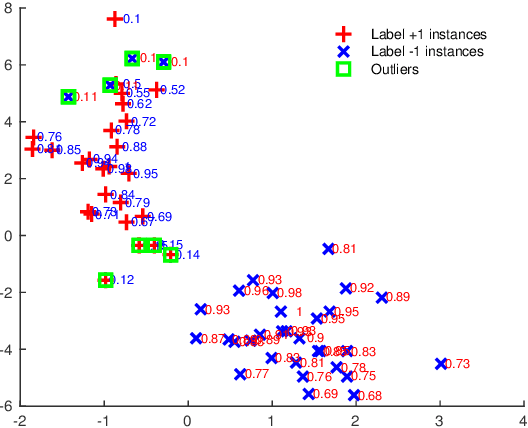
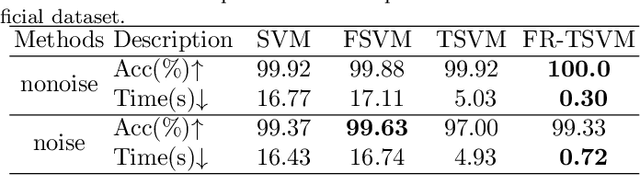
Twin support vector machine~(TSVM) is a powerful learning algorithm by solving a pair of smaller SVM-type problems. However, there are still some specific issues waiting to be solved when it faces with some real applications, \emph{e.g}, low efficiency and noise data. In this paper, we propose a Fast and Robust TSVM~(FR-TSVM) to deal with these issues above. In FR-TSVM, we propose an effective fuzzy membership function to ease the effects of noisy inputs. We apply the fuzzy membership to each input instance and reformulate the TSVMs such that different input instances can make different contributions to the learning of the separating hyperplanes. To further speed up the training procedure, we develop an efficient coordinate descent algorithm with shirking to solve the involved a pair of quadratic programming problems (QPPs) of FR-TSVM. Moreover, theoretical foundations of the proposed model are analyzed in details. The experimental results on several artificial and benchmark datasets indicate that the FR-TSVM not only obtains the fast learning speed but also shows the robust classification performance.