 Add to Chrome
 Add to Firefox
 Add to Edge
DTAMLP: Denoise Time-aware MLP for Session-based Recommendation
Aug 13, 2026
This paper reports two empirical findings on session-based recommendation (SBR), unified in a single model, DTAMLP. First, existing time-aware and GNN-based models (e.g., TiSASRec, SR-GNN) treat every click-time interval as equally informative, even though very short dwell times often reflect accidental clicks carrying little preference signal -- a phenomenon we call sporadic noise. We show that a lightweight, plug-and-play weight fusion module, blending a model's attention weight with a threshold-capped time-interval weight, can be inserted into such models with almost no architectural change and yields a consistent accuracy gain; we view this as the most directly verifiable contribution of this work. Second, we revisit an under-explained observation from FMLP-Rec, where a learnable frequency-domain filter on item embeddings improves accuracy, and offer a possible explanation: time-domain behavior mixes several entangled psychological preferences, and a frequency-domain view may let a model separate and down-weight such preference noise more naturally -- an interpretive conjecture rather than a proven mechanism. Building on both insights, DTAMLP, an all-MLP framework combining weight fusion and FFT-based filtering, is validated on Diginetica and RetailRocket. While this system-level design reflects the state of the field circa 2023 rather than a state-of-the-art claim, ablations confirm the two mechanisms contribute complementary, non-redundant improvements.

CollabEdit: Towards Non-destructive Collaborative Knowledge Editing
Oct 12, 2024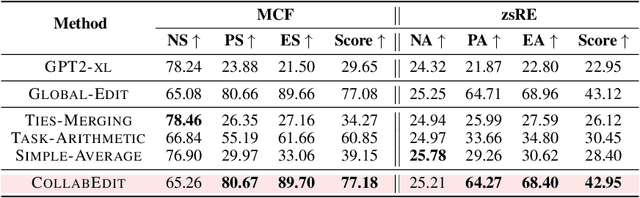
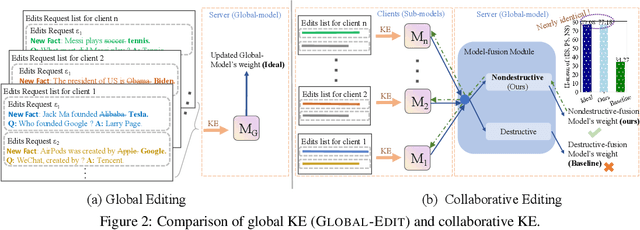
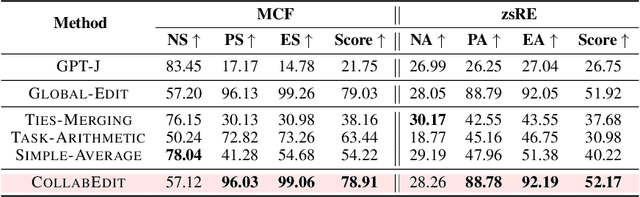
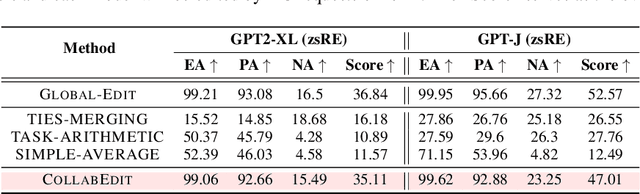
Collaborative learning of large language models (LLMs) has emerged as a new paradigm for utilizing private data from different parties to guarantee efficiency and privacy. Meanwhile, Knowledge Editing (KE) for LLMs has also garnered increased attention due to its ability to manipulate the behaviors of LLMs explicitly, yet leaves the collaborative KE case (in which knowledge edits of multiple parties are aggregated in a privacy-preserving and continual manner) unexamined. To this end, this manuscript dives into the first investigation of collaborative KE, in which we start by carefully identifying the unique three challenges therein, including knowledge overlap, knowledge conflict, and knowledge forgetting. We then propose a non-destructive collaborative KE framework, COLLABEDIT, which employs a novel model merging mechanism to mimic the global KE behavior while preventing the severe performance drop. Extensive experiments on two canonical datasets demonstrate the superiority of COLLABEDIT compared to other destructive baselines, and results shed light on addressing three collaborative KE challenges and future applications.