 Add to Chrome
 Add to Firefox
 Add to Edge
The Visual Bottleneck: Sparse-Frame Adaptation of MLLMs for Joint Spatial-Temporal Video Grounding
Jul 27, 2026
Large-scale video platforms process millions of uploads hourly, requiring moderation systems that can localize when and where policy violations occur within each video. Processing every frame is infeasible at scale, so systems are constrained to sparse inputs of 8 to 16 frames per video. Yet state-of-the-art multimodal large language models (MLLMs) are pretrained on dense sequences of hundreds of frames, creating a fundamental mismatch between training and deployment conditions. This mismatch causes severe performance collapse: the Qwen3-VL 8B model drops from 56.0% to 22.3% temporal mIoU when frames are reduced to 16, a 60.2% relative degradation. We present a systematic empirical study of training strategies to close this gap for spatial-temporal video grounding. Our results suggest that visual feature extraction is the dominant bottleneck under sparse-frame inputs. Adapting only the final three ViT layers, 4% of total parameters, achieves 68.8% temporal mIoU and surpasses a zero-shot 8B model using dense inputs by 12.8 points. Language model fine-tuning, by contrast, offers negligible or negative returns. A boundary-aware sampling strategy, Hybrid16, further improves temporal mIoU by 26 points over uniform sampling when temporal boundaries are available. We conclude that for sparse-frame video grounding, training strategy dominates model scale: a fine-tuned 2B model consistently outperforms a zero-shot 8B model, with or without dense frame access.

Towards Enhanced Immersion and Agency for LLM-based Interactive Drama
Feb 25, 2025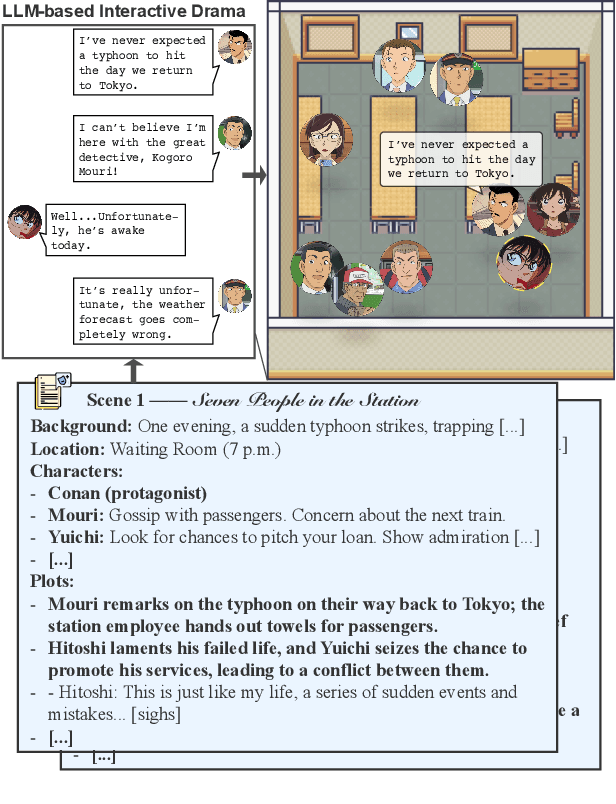
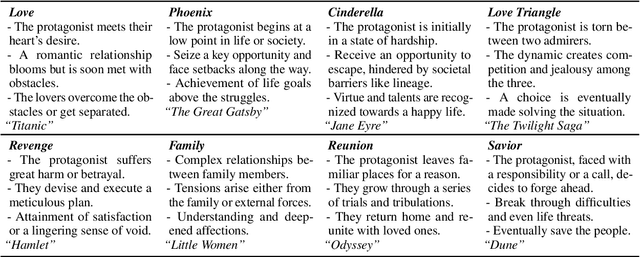
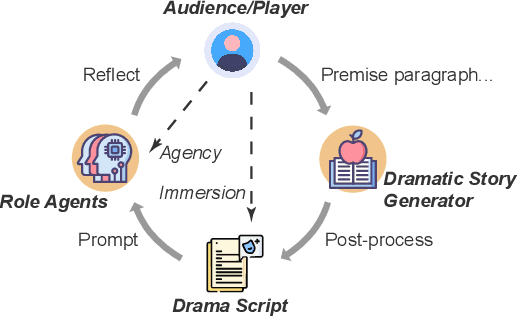
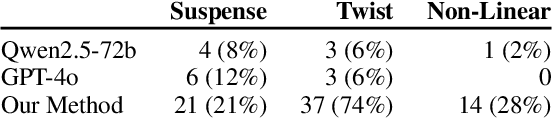
LLM-based Interactive Drama is a novel AI-based dialogue scenario, where the user (i.e. the player) plays the role of a character in the story, has conversations with characters played by LLM agents, and experiences an unfolding story. This paper begins with understanding interactive drama from two aspects: Immersion, the player's feeling of being present in the story, and Agency, the player's ability to influence the story world. Both are crucial to creating an enjoyable interactive experience, while they have been underexplored in previous work. To enhance these two aspects, we first propose Playwriting-guided Generation, a novel method that helps LLMs craft dramatic stories with substantially improved structures and narrative quality. Additionally, we introduce Plot-based Reflection for LLM agents to refine their reactions to align with the player's intentions. Our evaluation relies on human judgment to assess the gains of our methods in terms of immersion and agency.