 Add to Chrome
 Add to Firefox
 Add to Edge
When Surfaces Lie: Exploiting Wrinkle-Induced Attention Shift to Attack Vision-Language Models
Apr 02, 2026
Visual-Language Models (VLMs) have demonstrated exceptional cross-modal understanding across various tasks, including zero-shot classification, image captioning, and visual question answering. However, their robustness to physically plausible non-rigid deformations-such as wrinkles on flexible surfaces-remains poorly understood. In this work, we propose a parametric structural perturbation method inspired by the mechanics of three-dimensional fabric wrinkles. Specifically, our method generates photorealistic non-rigid perturbations by constructing multi-scale wrinkle fields and integrating displacement field distortion with surface-consistent appearance variations. To achieve an optimal balance between visual naturalness and adversarial effectiveness, we design a hierarchical fitness function in a low-dimensional parameter space and employ an optimization-based search strategy. We evaluate our approach using a two-stage framework: perturbations are first optimized on a zero-shot classification proxy task and subsequently assessed for transferability on generative tasks. Experimental results demonstrate that our method significantly degrades the performance of various state-of-the-art VLMs, consistently outperforming baselines in both image captioning and visual question-answering tasks.

Energy Storage Arbitrage in Two-settlement Markets: A Transformer-Based Approach
Apr 26, 2024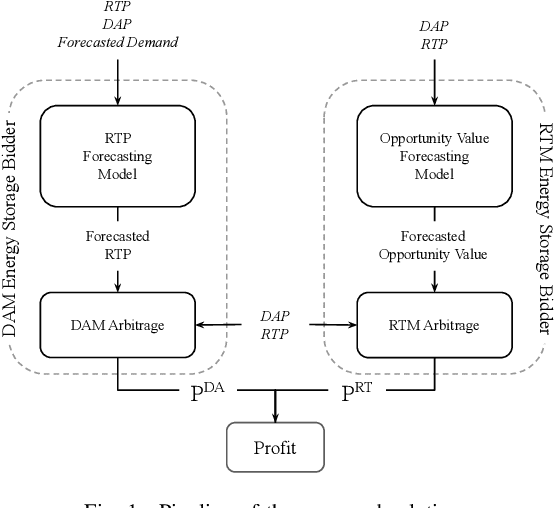
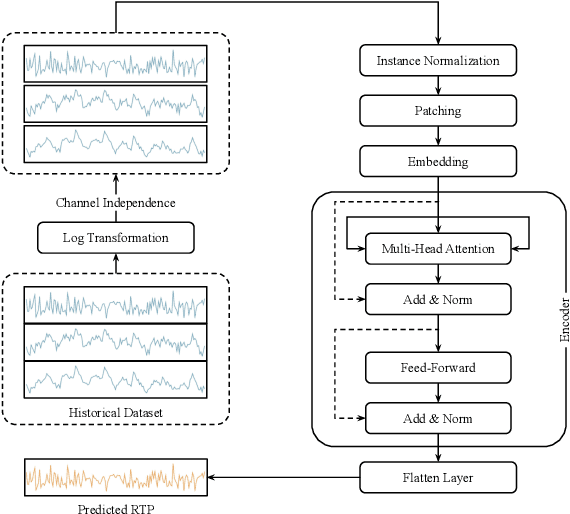
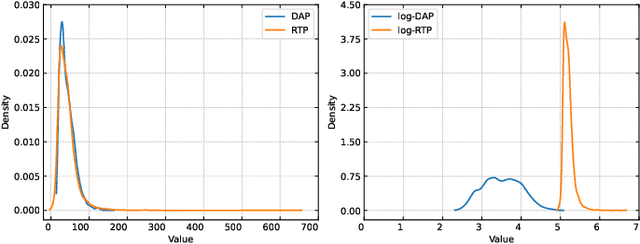
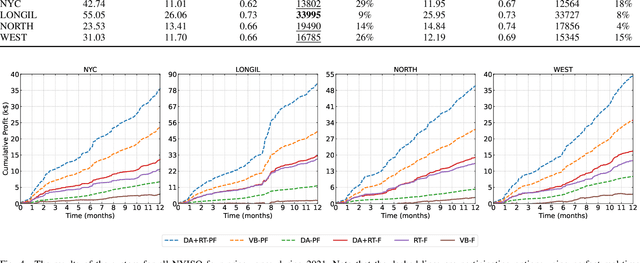
This paper presents an integrated model for bidding energy storage in day-ahead and real-time markets to maximize profits. We show that in integrated two-stage bidding, the real-time bids are independent of day-ahead settlements, while the day-ahead bids should be based on predicted real-time prices. We utilize a transformer-based model for real-time price prediction, which captures complex dynamical patterns of real-time prices, and use the result for day-ahead bidding design. For real-time bidding, we utilize a long short-term memory-dynamic programming hybrid real-time bidding model. We train and test our model with historical data from New York State, and our results showed that the integrated system achieved promising results of almost a 20\% increase in profit compared to only bidding in real-time markets, and at the same time reducing the risk in terms of the number of days with negative profits.