 Add to Chrome
 Add to Firefox
 Add to Edge
AutoAnchor: Stable Diffusion Unlearning Using Cross-Attention as a Manifold Surrogate
Jul 09, 2026
Diffusion unlearning is essential for mitigating the generation of harmful or copyrighted content in text-to-image models. Current diffusion unlearning techniques determine the model update direction by either using alternatives of the target concept as an anchor or using empty prompts. The anchor-based method relies on manually and semantically-chosen anchors that risk biased unlearning, while the anchor-free method inherently suffers from unrobust unlearning due to unconstrained latent updates. In this work, we theoretically formalize such unstable diffusion unlearning issues under the manifold hypothesis and prove that lacking a manifold-proximal anchor inevitably induces significant normal-space drift that degrades unlearning performance. To achieve stable unlearning, we propose \mysysn, a two-stage framework that automatically synthesizes manifold-proximal anchors. However, direct geometric manifold optimization is computationally intractable. To address this challenge, \mysys introduces a novel cross-attention consistency loss which serves as a highly efficient surrogate of manifold proximity. Experimental results demonstrate that \mysys effectively achieves robust and unbiased unlearning across various state-of-the-art baselines, significantly improving targeted concept removal (by up to 31.04\% in CLIP score) and non-target utility (by up to 4.18\% in CLIP score). Moreover, \mysys can also be easily integrated into existing diffusion unlearning methods to enhance their unlearning performance (by 6.30\% for concept removal and 6.65\% for utility on average).

Learning to Route LLMs from Implicit Cost-Performance Preferences via Meta-Learning
Jun 04, 2026Large language models (LLMs) present a trade-off between performance and cost, where more powerful models incur greater expense. LLM routing aims to mitigate expenses while maintaining performance by sending queries to the most suitable model. However, existing methods cannot perform well for different user cost-performance preferences. To address this gap, we introduce a novel perceptive LLM routing paradigm for personalized and user-centric cost-performance optimization, which efficiently learns users' implicit preferences through little interaction. To handle the challenge of heterogeneous user needs, we formulate preference profiles as a set of distinct tasks in contextual bandit and propose MetaRouter, a meta-learning framework designed for preference-aware LLM routing. Experimental results show that MetaRouter outperforms strong baselines on both in-distribution and out-of-distribution tasks. Furthermore, it exhibits high efficiency in learning user preferences, robustness to changes in the routable LLMs, and scalability to multi-model routing.
Clustering Algorithms and RAG Enhancing Semi-Supervised Text Classification with Large LLMs
Nov 09, 2024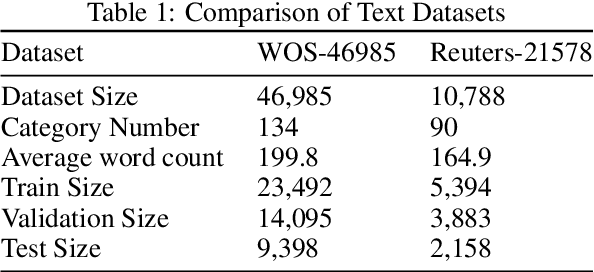
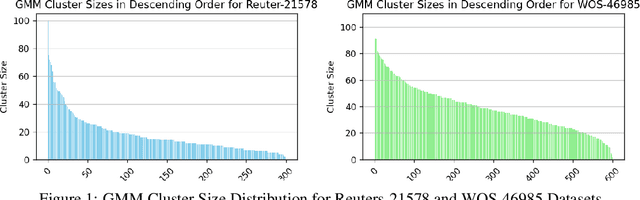
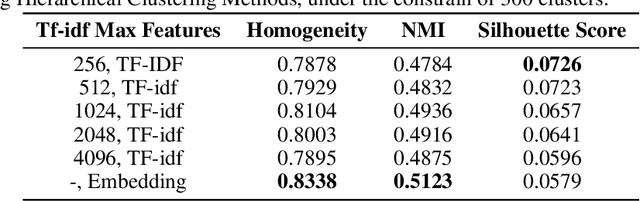
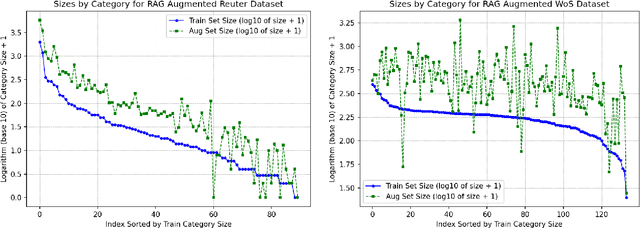
This paper introduces an innovative semi-supervised learning approach for text classification, addressing the challenge of abundant data but limited labeled examples. Our methodology integrates few-shot learning with retrieval-augmented generation (RAG) and conventional statistical clustering, enabling effective learning from a minimal number of labeled instances while generating high-quality labeled data. To the best of our knowledge, we are the first to incorporate RAG alongside clustering in text data generation. Our experiments on the Reuters and Web of Science datasets demonstrate state-of-the-art performance, with few-shot augmented data alone producing results nearly equivalent to those achieved with fully labeled datasets. Notably, accuracies of 95.41\% and 82.43\% were achieved for complex text document classification tasks, where the number of categories can exceed 100.