 Add to Chrome
 Add to Firefox
 Add to Edge
Binary Flow Matching: Prediction-Loss Space Alignment for Robust Learning
Feb 11, 2026
Flow matching has emerged as a powerful framework for generative modeling, with recent empirical successes highlighting the effectiveness of signal-space prediction ($x$-prediction). In this work, we investigate the transfer of this paradigm to binary manifolds, a fundamental setting for generative modeling of discrete data. While $x$-prediction remains effective, we identify a latent structural mismatch that arises when it is coupled with velocity-based objectives ($v$-loss), leading to a time-dependent singular weighting that amplifies gradient sensitivity to approximation errors. Motivated by this observation, we formalize prediction-loss alignment as a necessary condition for flow matching training. We prove that re-aligning the objective to the signal space ($x$-loss) eliminates the singular weighting, yielding uniformly bounded gradients and enabling robust training under uniform timestep sampling without reliance on heuristic schedules. Finally, with alignment secured, we examine design choices specific to binary data, revealing a topology-dependent distinction between probabilistic objectives (e.g., cross-entropy) and geometric losses (e.g., mean squared error). Together, these results provide theoretical foundations and practical guidelines for robust flow matching on binary -- and related discrete -- domains, positioning signal-space alignment as a key principle for robust diffusion learning.

Soft Graph Transformer for MIMO Detection
Sep 16, 2025

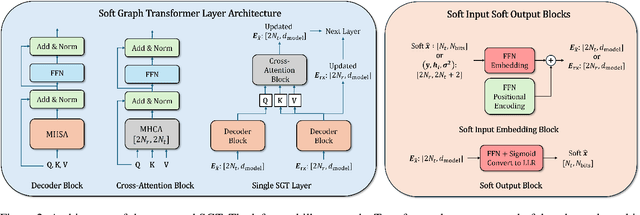
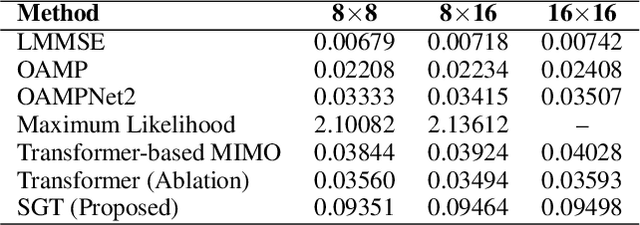
We propose the Soft Graph Transformer (SGT), a Soft-Input-Soft-Output neural architecture tailored for MIMO detection. While Maximum Likelihood (ML) detection achieves optimal accuracy, its prohibitive exponential complexity renders it impractical for real-world systems. Conventional message passing algorithms offer tractable alternatives but rely on large-system asymptotics and random matrix assumptions, both of which break down under practical implementations. Prior Transformer-based detectors, on the other hand, fail to incorporate the MIMO factor graph structure and cannot utilize decoder-side soft information, limiting their standalone performance and their applicability in iterative detection-decoding (IDD). To overcome these limitations, SGT integrates message passing directly into a graph-aware attention mechanism and supports decoder-informed updates through soft-input embeddings. This design enables effective soft-output generation while preserving computational efficiency. As a standalone detector, SGT closely approaches ML performance and surpasses prior Transformer-based approaches.