 Add to Chrome
 Add to Firefox
 Add to Edge
Fisher-R1: Training LLM Agents for Reliable Hypothesis Testing
Aug 07, 2026
Reliable hypothesis testing is the foundation of many empirical scientific claims. Large language model (LLM) agents are increasingly used to automate this process, as they can inspect datasets, generate code, and produce analyses end-to-end. However, we show that they frequently make subtle inferential errors that lead to incorrect conclusions despite correctly executed analyses. Existing benchmarks fail to capture this failure mode, as they rarely assess whether a reported p-value is statistically valid given the assumptions underlying the data. We address this gap by building P-Bench, a benchmark comprising 425 open-ended, realistic hypothesis-testing tasks spanning economics, biology, and medicine. Each task requires an agent to select a statistical method, compute a p-value, and draw a conclusion given only a scientific hypothesis and a dataset. We further introduce Fisher-R1, an open-weight LLM agent trained for rigorous hypothesis testing using synthetic tasks and reinforcement learning. On P-Bench, Fisher-R1-14B substantially improves over its backbone and outperforms strong proprietary and open-source baselines, including GPT-5.4 and DeepSeekV4-Pro, achieving a 21% average relative improvement in single-trial success over DeepSeek-V4-Pro, with gains up to 26% on the most challenging tasks. Our results demonstrate that current LLM agents lack reliable statistical reasoning for hypothesis testing and that reinforcement learning on tasks with verified statistical reward substantially improves reliability.

The Agentic Garden of Forking Paths
Jul 01, 2026Empirical research rarely admits a unique analysis. Different analytical choices can lead to different conclusions from the same data, yet these hidden forking paths are difficult to observe. We show that AI agents capture much of the analytical variation among human researchers while making these paths explicit. Across four high-stakes domains, assigning different personas is sufficient for AI agents to report divergent, often opposing, conclusions from the same data and question, with findings systematically aligned with those beliefs. In a study in which 42 human research teams analyzed the same immigration dataset, AI agents reproduced 72% of the human ideological gap in reported effect estimates. Despite reaching opposing conclusions, it is difficult to identify clear issues in each analysis based on the final AI reports: 86% passed independent AI review and 78% passed majority human expert review. These findings suggest that the central challenge is often not flawed analyses, but selective exploration and reporting from a large space of methodologically defensible analyses. AI agents may amplify this longstanding problem by making such exploration inexpensive and scalable. To address this, we introduce the m-value (multiverse value), the probability that an analysis path would produce a claim at least as extreme as the reported one. We further introduce Agentic Bootstrap, which estimates the m-value by using AI agents to sample plausible analysis paths. Applied to the human immigration study, 13.5% of reported human analyses fell in the most extreme 5% of the analysis space (m<0.05). Scientific evidence should therefore be evaluated not only by a single reported analysis but also by its position within the distribution of analyses that could reasonably have been reported. Agentic Bootstrap makes this distribution observable and turns it into a criterion for scientific credibility.
A Dynamic Toolkit for Transmission Characteristics of Precision Reducers with Explicit Contact Geometry
Apr 02, 2026Precision reducers are critical components in robotic systems, directly affecting the motion accuracy and dynamic performance of humanoid robots, quadruped robots, collaborative robots, industrial robots, and SCARA robots. This paper presents a dynamic toolkit for analyzing the transmission characteristics of precision reducers with explicit contact geometry. A unified framework is proposed to address the challenges in modeling accurate contact behaviors, evaluating gear stiffness, and predicting system vibrations. By integrating advanced contact theories and numerical solving methods, the proposed toolkit offers higher precision and computational efficiency compared to traditional dynamics software. The toolkit is designed with a modular, scriptable architecture that supports rapid reconfiguration across diverse reducer topologies. Numerical validation against published benchmarks confirms the accuracy of the proposed approach.
Paper2Agent: Reimagining Research Papers As Interactive and Reliable AI Agents
Sep 08, 2025We introduce Paper2Agent, an automated framework that converts research papers into AI agents. Paper2Agent transforms research output from passive artifacts into active systems that can accelerate downstream use, adoption, and discovery. Conventional research papers require readers to invest substantial effort to understand and adapt a paper's code, data, and methods to their own work, creating barriers to dissemination and reuse. Paper2Agent addresses this challenge by automatically converting a paper into an AI agent that acts as a knowledgeable research assistant. It systematically analyzes the paper and the associated codebase using multiple agents to construct a Model Context Protocol (MCP) server, then iteratively generates and runs tests to refine and robustify the resulting MCP. These paper MCPs can then be flexibly connected to a chat agent (e.g. Claude Code) to carry out complex scientific queries through natural language while invoking tools and workflows from the original paper. We demonstrate Paper2Agent's effectiveness in creating reliable and capable paper agents through in-depth case studies. Paper2Agent created an agent that leverages AlphaGenome to interpret genomic variants and agents based on ScanPy and TISSUE to carry out single-cell and spatial transcriptomics analyses. We validate that these paper agents can reproduce the original paper's results and can correctly carry out novel user queries. By turning static papers into dynamic, interactive AI agents, Paper2Agent introduces a new paradigm for knowledge dissemination and a foundation for the collaborative ecosystem of AI co-scientists.
Task-Agnostic Machine Learning-Assisted Inference
May 30, 2024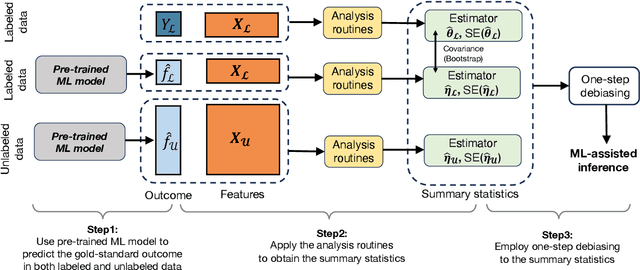
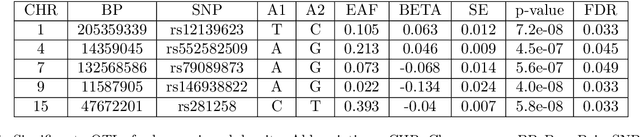
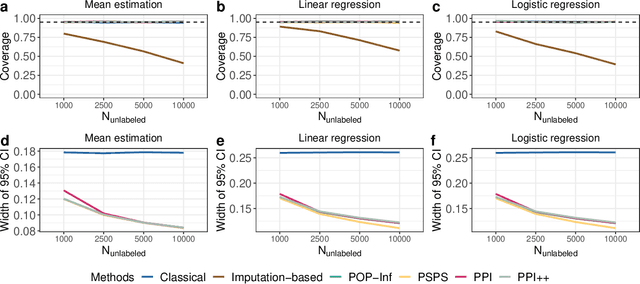

Machine learning (ML) is playing an increasingly important role in scientific research. In conjunction with classical statistical approaches, ML-assisted analytical strategies have shown great promise in accelerating research findings. This has also opened up a whole new field of methodological research focusing on integrative approaches that leverage both ML and statistics to tackle data science challenges. One type of study that has quickly gained popularity employs ML to predict unobserved outcomes in massive samples and then uses the predicted outcomes in downstream statistical inference. However, existing methods designed to ensure the validity of this type of post-prediction inference are limited to very basic tasks such as linear regression analysis. This is because any extension of these approaches to new, more sophisticated statistical tasks requires task-specific algebraic derivations and software implementations, which ignores the massive library of existing software tools already developed for complex inference tasks and severely constrains the scope of post-prediction inference in real applications. To address this challenge, we propose a novel statistical framework for task-agnostic ML-assisted inference. It provides a post-prediction inference solution that can be easily plugged into almost any established data analysis routine. It delivers valid and efficient inference that is robust to arbitrary choices of ML models, while allowing nearly all existing analytical frameworks to be incorporated into the analysis of ML-predicted outcomes. Through extensive experiments, we showcase the validity, versatility, and superiority of our method compared to existing approaches.
Mask-adaptive Gated Convolution and Bi-directional Progressive Fusion Network for Depth Completion
Jan 15, 2024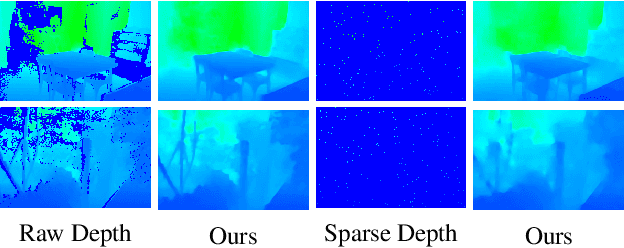

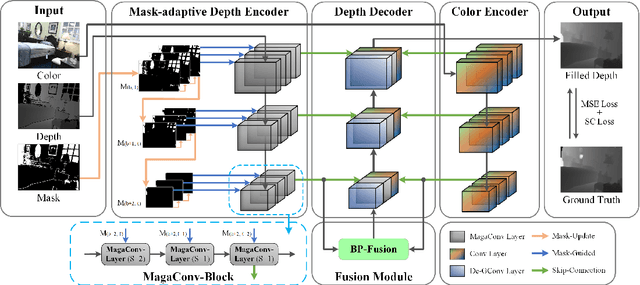
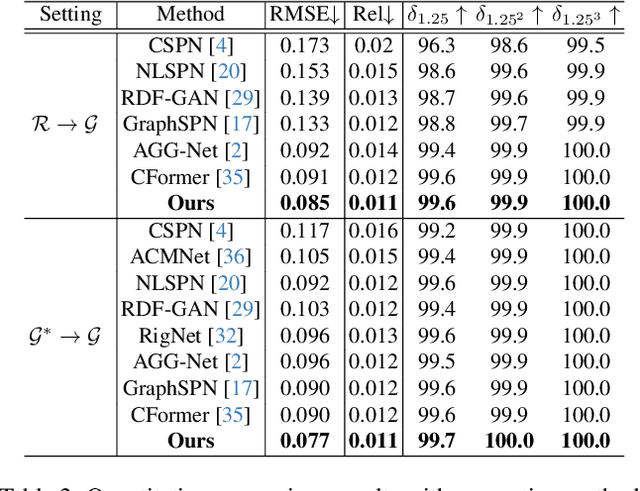
Depth completion is a critical task for handling depth images with missing pixels, which can negatively impact further applications. Recent approaches have utilized Convolutional Neural Networks (CNNs) to reconstruct depth images with the assistance of color images. However, vanilla convolution has non-negligible drawbacks in handling missing pixels. To solve this problem, we propose a new model for depth completion based on an encoder-decoder structure. Our model introduces two key components: the Mask-adaptive Gated Convolution (MagaConv) architecture and the Bi-directional Progressive Fusion (BP-Fusion) module. The MagaConv architecture is designed to acquire precise depth features by modulating convolution operations with iteratively updated masks, while the BP-Fusion module progressively integrates depth and color features, utilizing consecutive bi-directional fusion structures in a global perspective. Extensive experiments on popular benchmarks, including NYU-Depth V2, DIML, and SUN RGB-D, demonstrate the superiority of our model over state-of-the-art methods. We achieved remarkable performance in completing depth maps and outperformed existing approaches in terms of accuracy and reliability.
Assumption-lean and Data-adaptive Post-Prediction Inference
Nov 23, 2023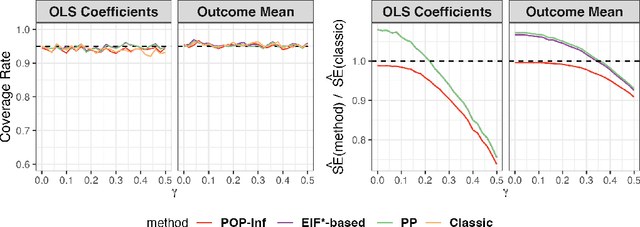
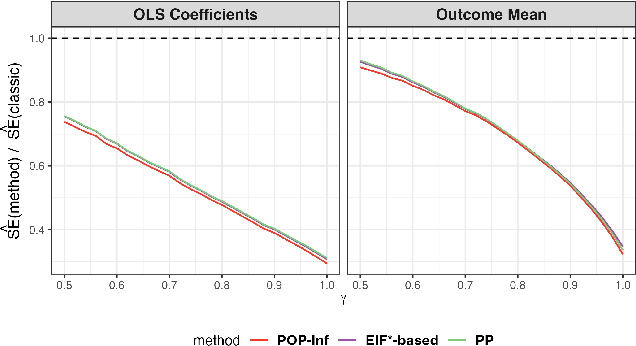
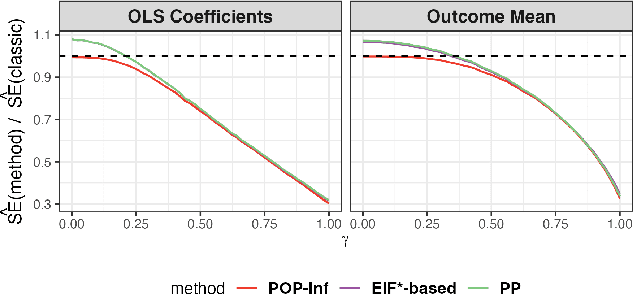
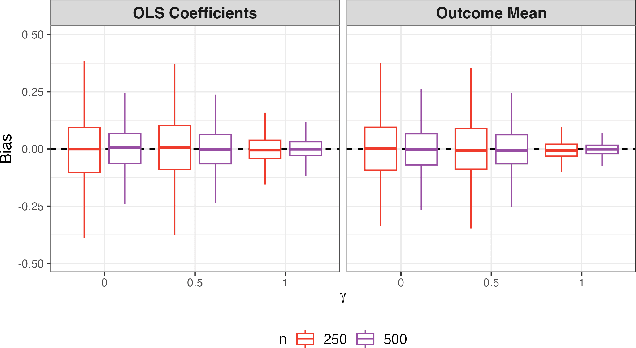
A primary challenge facing modern scientific research is the limited availability of gold-standard data which can be both costly and labor-intensive to obtain. With the rapid development of machine learning (ML), scientists have relied on ML algorithms to predict these gold-standard outcomes with easily obtained covariates. However, these predicted outcomes are often used directly in subsequent statistical analyses, ignoring imprecision and heterogeneity introduced by the prediction procedure. This will likely result in false positive findings and invalid scientific conclusions. In this work, we introduce an assumption-lean and data-adaptive Post-Prediction Inference (POP-Inf) procedure that allows valid and powerful inference based on ML-predicted outcomes. Its "assumption-lean" property guarantees reliable statistical inference without assumptions on the ML-prediction, for a wide range of statistical quantities. Its "data-adaptive'" feature guarantees an efficiency gain over existing post-prediction inference methods, regardless of the accuracy of ML-prediction. We demonstrate the superiority and applicability of our method through simulations and large-scale genomic data.