 Add to Chrome
 Add to Firefox
 Add to Edge
Redundant or Necessary? A Benchmark for Detecting Redundant Steps in Agent Trajectories
May 28, 2026
LLM-based agents have demonstrated strong capabilities in solving complex tasks through multi-step reasoning and tool use. However, existing evaluation protocols primarily focus on task success, overlooking a critical aspect of agent behavior: execution efficiency. In practice, agent trajectories often contain redundant steps that consume substantial resources while contributing little to task completion. In this work, we propose and formulate a new research area: \textbf{redundant step detection} for agent trajectories. To support this initiative, we introduce \textbf{RedundancyBench}, a new benchmark that contains diverse tasks with carefully annotated trajectories, where each step is labeled according to its contribution to task completion. Using RedundancyBench, we develop and evaluate 3 representative methods to answer whether a step within trajectory is redundant or necessary. Our results show that even the best-performing method achieves only 24.88\% score in detecting redundant steps, while some methods perform worse than random guessing. These results highlight the task's complexity and the need for further research in this area. \footnote{Code and dataset in this paper are both available in \href{https://anonymous.4open.science/r/RedundancyBench}{https://anonymous.4open.science/r/RedundancyBench}.}

UMFC: Unsupervised Multi-Domain Feature Calibration for Vision-Language Models
Nov 11, 2024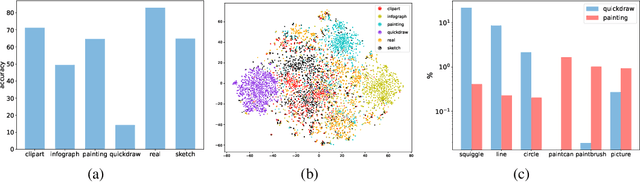
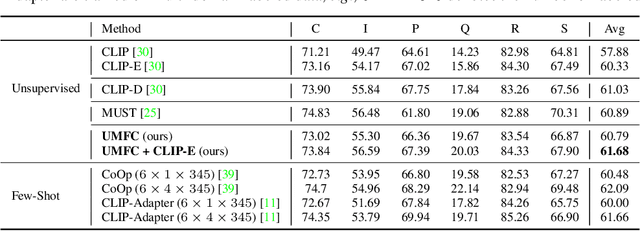
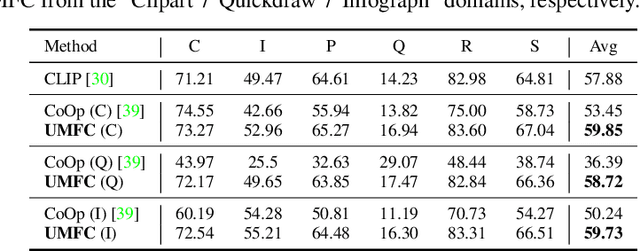
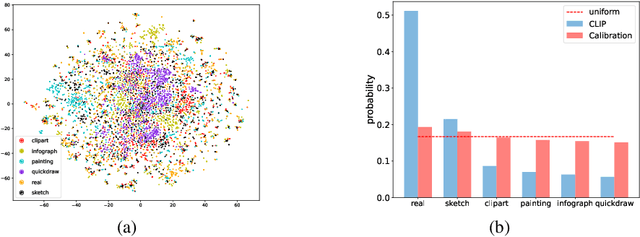
Pre-trained vision-language models (e.g., CLIP) have shown powerful zero-shot transfer capabilities. But they still struggle with domain shifts and typically require labeled data to adapt to downstream tasks, which could be costly. In this work, we aim to leverage unlabeled data that naturally spans multiple domains to enhance the transferability of vision-language models. Under this unsupervised multi-domain setting, we have identified inherent model bias within CLIP, notably in its visual and text encoders. Specifically, we observe that CLIP's visual encoder tends to prioritize encoding domain over discriminative category information, meanwhile its text encoder exhibits a preference for domain-relevant classes. To mitigate this model bias, we propose a training-free and label-free feature calibration method, Unsupervised Multi-domain Feature Calibration (UMFC). UMFC estimates image-level biases from domain-specific features and text-level biases from the direction of domain transition. These biases are subsequently subtracted from original image and text features separately, to render them domain-invariant. We evaluate our method on multiple settings including transductive learning and test-time adaptation. Extensive experiments show that our method outperforms CLIP and performs on par with the state-of-the-arts that need additional annotations or optimization. Our code is available at https://github.com/GIT-LJc/UMFC.
Generalized Semi-Supervised Learning via Self-Supervised Feature Adaptation
May 31, 2024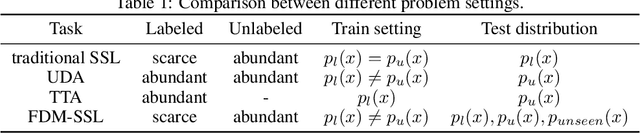
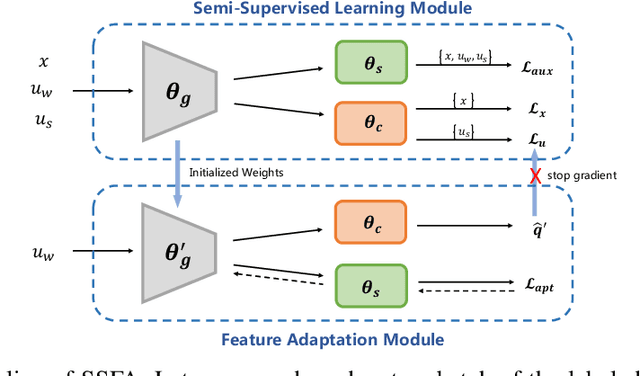

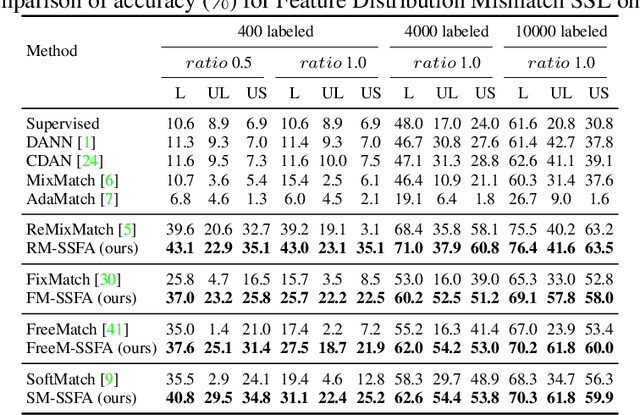
Traditional semi-supervised learning (SSL) assumes that the feature distributions of labeled and unlabeled data are consistent which rarely holds in realistic scenarios. In this paper, we propose a novel SSL setting, where unlabeled samples are drawn from a mixed distribution that deviates from the feature distribution of labeled samples. Under this setting, previous SSL methods tend to predict wrong pseudo-labels with the model fitted on labeled data, resulting in noise accumulation. To tackle this issue, we propose Self-Supervised Feature Adaptation (SSFA), a generic framework for improving SSL performance when labeled and unlabeled data come from different distributions. SSFA decouples the prediction of pseudo-labels from the current model to improve the quality of pseudo-labels. Particularly, SSFA incorporates a self-supervised task into the SSL framework and uses it to adapt the feature extractor of the model to the unlabeled data. In this way, the extracted features better fit the distribution of unlabeled data, thereby generating high-quality pseudo-labels. Extensive experiments show that our proposed SSFA is applicable to various pseudo-label-based SSL learners and significantly improves performance in labeled, unlabeled, and even unseen distributions.