 Add to Chrome
 Add to Firefox
 Add to Edge
From Tokens to Regions: CUDA-Sensitive Instruction Tuning for GPU Kernel Generation
Jun 15, 2026
High-performance CUDA kernels are essential for scalable AI systems, while Large Language Models (LLMs) still struggle to generate correct kernels due to strict and implicit execution constraints. Existing LLM-based approaches either rely on costly agentic or reinforcement-learning (RL) pipelines, or adopt supervised fine-tuning (SFT) objectives that fail to explicitly model CUDA sensitivity, namely code tokens or regions tightly coupled with execution constraints. In this work, we investigate CUDA sensitivity from the perspective of token confidence patterns, showing that CUDA sensitivity appears at both token and region levels, where most CUDA-sensitive tokens are predicted with high confidence, while a smaller low-confidence subset forms regions corresponding to execution-critical structures. These findings suggest that effective CUDA kernel generation should both leverage high-confidence CUDA-sensitive tokens and preserve low-confidence CUDA-sensitive regions. Building on these insights, we propose \textbf{\underline{CU}DA-\underline{Se}nsitive Instruction \underline{T}uning (CuSeT)}, a low-cost post-training method within a simple SFT framework. CuSeT follows the principle of ``from tokens to regions'' by combining \emph{adaptive token-level masking} with \emph{region-aware sample reweighting}. Experiments show that CuSeT consistently improves functional correctness across multiple model families and scales, outperforming standard SFT and advanced SFT variants, while achieving competitive performance against frontier CUDA kernel generation models with substantially lower inference cost.

CUDA-LLM: LLMs Can Write Efficient CUDA Kernels
Jun 10, 2025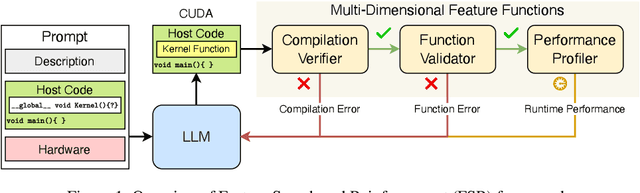

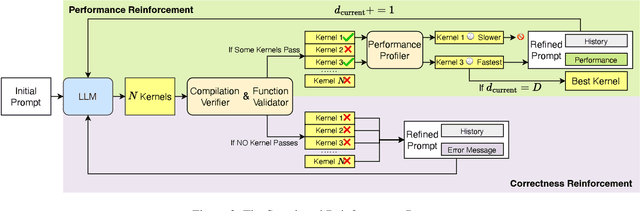
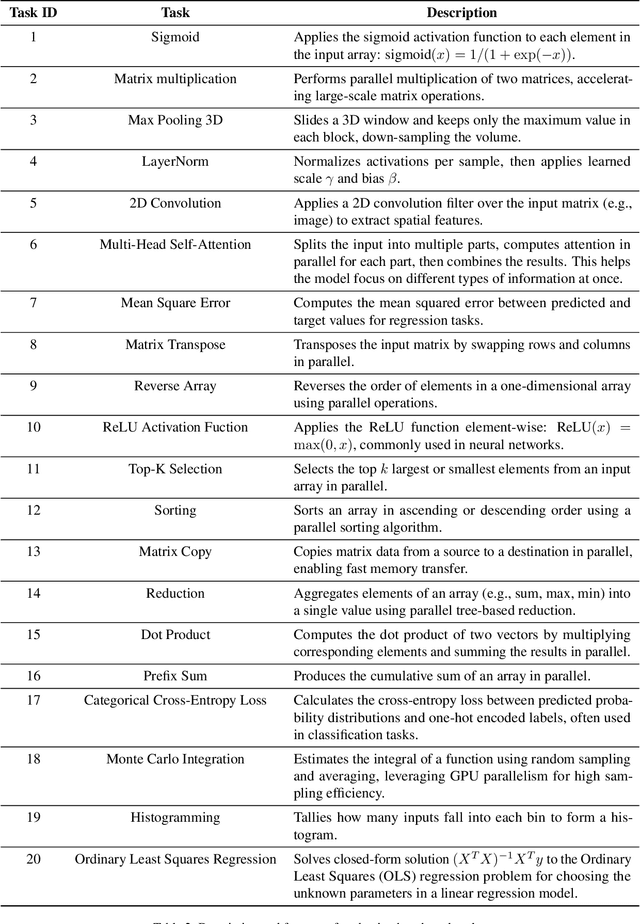
Large Language Models (LLMs) have demonstrated strong capabilities in general-purpose code generation. However, generating the code which is deeply hardware-specific, architecture-aware, and performance-critical, especially for massively parallel GPUs, remains a complex challenge. In this work, we explore the use of LLMs for the automated generation and optimization of CUDA programs, with the goal of producing high-performance GPU kernels that fully exploit the underlying hardware. To address this challenge, we propose a novel framework called \textbf{Feature Search and Reinforcement (FSR)}. FSR jointly optimizes compilation and functional correctness, as well as the runtime performance, which are validated through extensive and diverse test cases, and measured by actual kernel execution latency on the target GPU, respectively. This approach enables LLMs not only to generate syntactically and semantically correct CUDA code but also to iteratively refine it for efficiency, tailored to the characteristics of the GPU architecture. We evaluate FSR on representative CUDA kernels, covering AI workloads and computational intensive algorithms. Our results show that LLMs augmented with FSR consistently guarantee correctness rates. Meanwhile, the automatically generated kernels can outperform general human-written code by a factor of up to 179$\times$ in execution speeds. These findings highlight the potential of combining LLMs with performance reinforcement to automate GPU programming for hardware-specific, architecture-sensitive, and performance-critical applications.