 Add to Chrome
 Add to Firefox
 Add to Edge
ZNO: Stable Rational Neural Operators in the Z-Domain for Discrete-Time Dynamics
May 06, 2026
We introduce the Z-Domain Neural Operator (ZNO), a causal neural operator whose layers are stable low-rank multiple-input multiple-output (MIMO) rational filters parameterized directly in the $z$-plane. ZNO addresses a limitation of existing operator learning methods, many of which are primarily tailored for continuous-time problems, while a large class of system-identification problems is intrinsically discrete-time. The $z$-domain form expresses stability as a unit-disk pole constraint and makes learned discrete-time poles directly readable. The model combines low-rank channel mixing, smooth stable pole reparameterization, causal recurrence, and an optional short finite impulse response (FIR) branch in a single $z$-domain rational recurrent layer. Across controlled discrete system-identification experiments, ZNO's advantage is most evident when the target dynamics are stable rational systems with lightly damped poles near the unit circle. Under matched parameter budgets, ZNO is not uniformly dominant; however, with validation-selected configurations, the same architecture can achieve the lowest mean error across the controlled tasks. A five-bin difficulty sweep over near-unit-circle / long-memory dynamics shows that ZNO has the lowest mean error across memory regimes, from short (approximately 10 steps) to long (approximately 100-200 steps). On five public nonlinear system-identification benchmarks, ZNO is competitive with neural operator and state-space baselines, achieving the lowest mean error on benchmarks whose dynamics align with stable rational discrete-time filters, while classical or state-space baselines remain preferable on some systems. These results position ZNO as a strong model for stable rational discrete-time dynamics, especially in near-unit-circle and long-memory regimes, but not as a universal replacement for specialized system-identification methods.

Learning nonlinear integral operators via Recurrent Neural Networks and its application in solving Integro-Differential Equations
Oct 13, 2023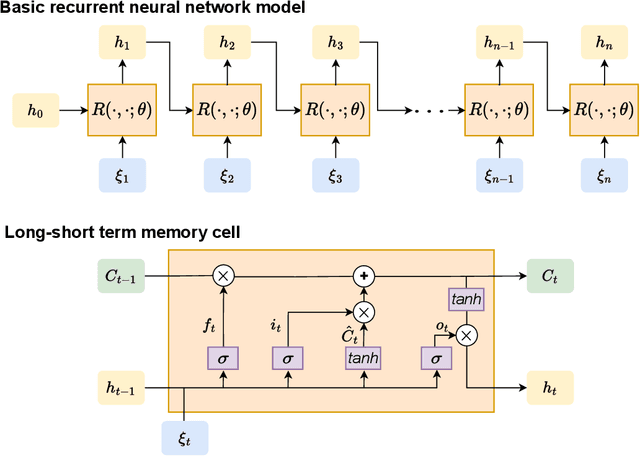

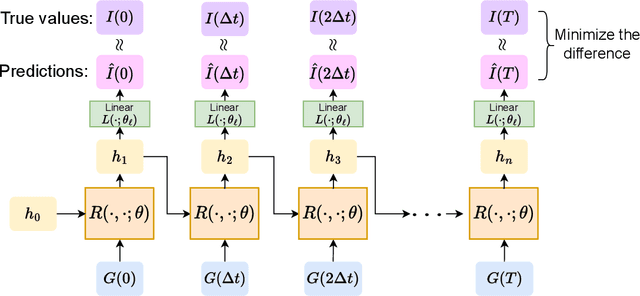
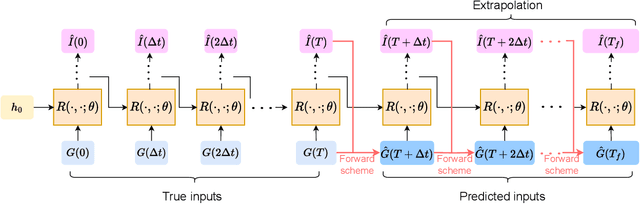
In this paper, we propose using LSTM-RNNs (Long Short-Term Memory-Recurrent Neural Networks) to learn and represent nonlinear integral operators that appear in nonlinear integro-differential equations (IDEs). The LSTM-RNN representation of the nonlinear integral operator allows us to turn a system of nonlinear integro-differential equations into a system of ordinary differential equations for which many efficient solvers are available. Furthermore, because the use of LSTM-RNN representation of the nonlinear integral operator in an IDE eliminates the need to perform a numerical integration in each numerical time evolution step, the overall temporal cost of the LSTM-RNN-based IDE solver can be reduced to $O(n_T)$ from $O(n_T^2)$ if a $n_T$-step trajectory is to be computed. We illustrate the efficiency and robustness of this LSTM-RNN-based numerical IDE solver with a model problem. Additionally, we highlight the generalizability of the learned integral operator by applying it to IDEs driven by different external forces. As a practical application, we show how this methodology can effectively solve the Dyson's equation for quantum many-body systems.