 Add to Chrome
 Add to Firefox
 Add to Edge
Agentic SABRE: An Uncertainty-Aware Neuro-Symbolic Multi-Agent Framework for Adaptive Ransomware Detection
Jul 05, 2026
Ransomware has evolved into a complex, adaptive, and fast-moving adversary category in which static signatures and monolithic classifiers fail to generalise under concept drift, evasion, and behavioural polymorphism. In this paper, we present Agentic SABRE (Semantic-Behavioural Arbitration for Ransomware Evaluation), an uncertainty-aware, neuro-symbolic, multi-agent framework for adaptive ransomware detection. SABRE fuses semantic, representation-based evidence with behavioural, time-window forensic telemetry and employs Monte Carlo Dropout inference to quantify epistemic uncertainty for each agent. We introduce a decision-layer orchestrator that performs risk- and uncertainty-aware triage using two interpretable thresholds: a risk score and an uncertainty budget. High-confidence, high-risk samples are automatically contained, while uncertain or borderline cases are escalated to human analysts, establishing a flexible computational contract between autonomous response and analyst oversight. To support auditability and trust, SABRE integrates post-hoc explainability mechanisms, including gradient saliency, permutation importance, and counterfactual analysis, enabling both local and global interpretation of agent decisions. Extensive evaluation on RDset and RanSMAP demonstrates that Agentic SABRE preserves perfect discrimination on saturated semantic datasets, with AUC equal to 1.0, while improving robustness under weak behavioural signals. It achieves up to a 4.9 percent relative reduction in false escalations at equal recall while maintaining calibrated predictive uncertainty. Counterfactual analysis further shows that semantic and behavioural decisions can be reversed with bounded perturbation cost, indicating stable and interpretable decision boundaries.

Private and Utility Enhanced Recommendations with Local Differential Privacy and Gaussian Mixture Model
Mar 06, 2021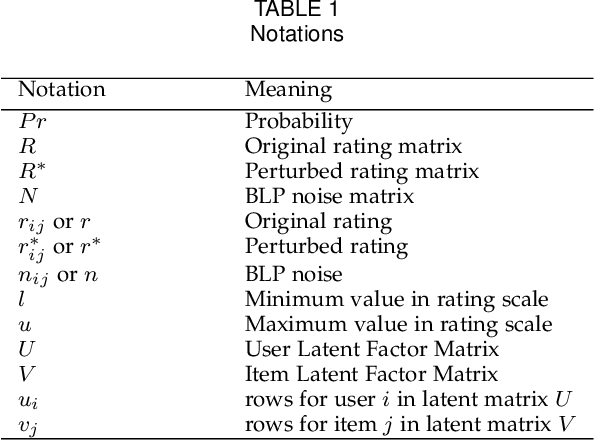
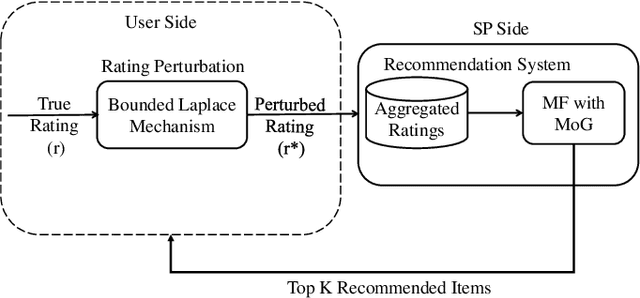
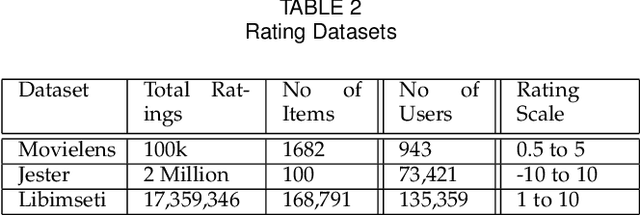
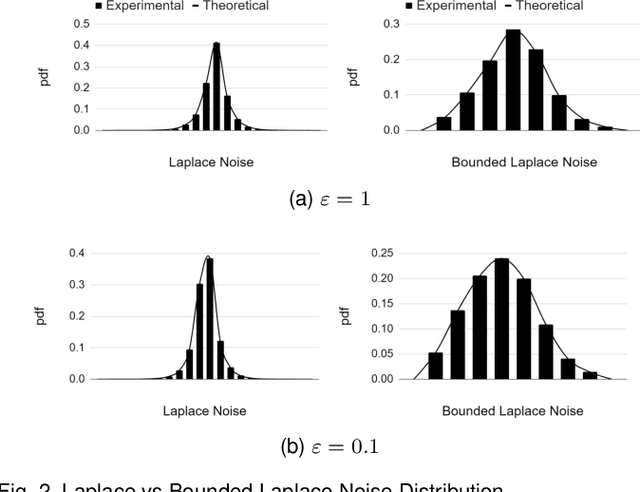
Recommendation systems rely heavily on users behavioural and preferential data (e.g. ratings, likes) to produce accurate recommendations. However, users experience privacy concerns due to unethical data aggregation and analytical practices carried out by the Service Providers (SP). Local differential privacy (LDP) based perturbation mechanisms add noise to users data at user side before sending it to the SP. The SP then uses the perturbed data to perform recommendations. Although LDP protects the privacy of users from SP, it causes a substantial decline in predictive accuracy. To address this issue, we propose an LDP-based Matrix Factorization (MF) with a Gaussian Mixture Model (MoG). The LDP perturbation mechanism, Bounded Laplace (BLP), regulates the effect of noise by confining the perturbed ratings to a predetermined domain. We derive a sufficient condition of the scale parameter for BLP to satisfy $\epsilon$ LDP. At the SP, The MoG model estimates the noise added to perturbed ratings and the MF algorithm predicts missing ratings. Our proposed LDP based recommendation system improves the recommendation accuracy without violating LDP principles. The empirical evaluations carried out on three real world datasets, i.e., Movielens, Libimseti and Jester, demonstrate that our method offers a substantial increase in predictive accuracy under strong privacy guarantee.