 Add to Chrome
 Add to Firefox
 Add to Edge
Cloud-Boosted Low-Compute Multi-Channel Speech Enhancement
Aug 07, 2026
Low-latency, low-compute speech enhancement is essential for wearable devices with real-time communication requirements, but strict computational constraints significantly limit on-device performance. Knowledge Boosting has been proposed as an effective approach to improve edge model performance by leveraging a more capable server-side model, but performance gains for speech enhancement have been limited. We propose a collaborative framework incorporating three techniques: (1) delayed server output as additional input, (2) layerwise feature boosting that transfers intermediate server representations to guide edge inference, and (3) collaborative multichannel Wiener filtering, which fuses weighted covariance matrices estimated from both server and edge models for improved beamforming. Experimental results demonstrate that the proposed collaborative framework significantly outperforms the edge-only baseline with minimal additional computational overhead.

Improving Resource-Efficient Speech Enhancement via Neural Differentiable DSP Vocoder Refinement
Aug 20, 2025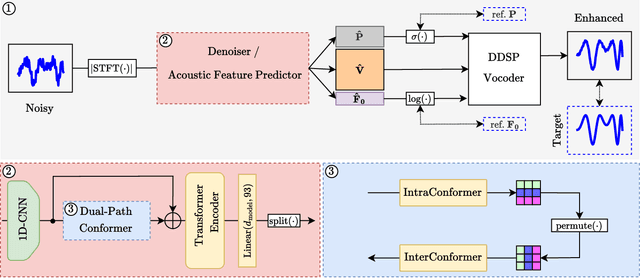
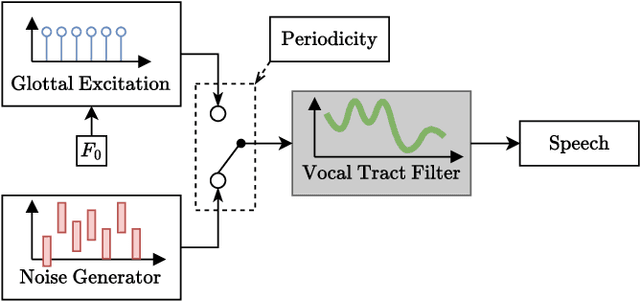
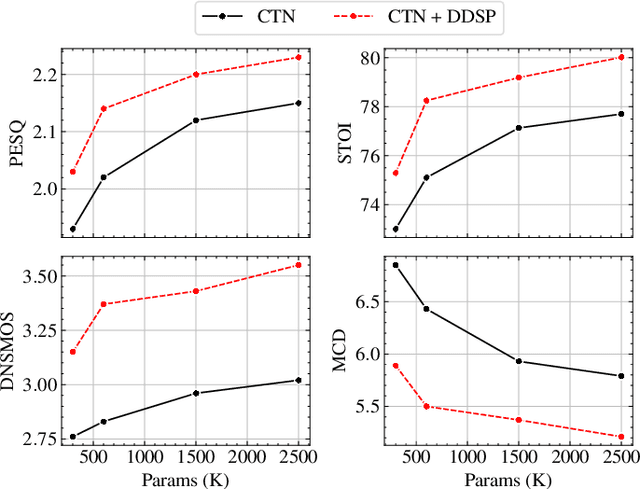
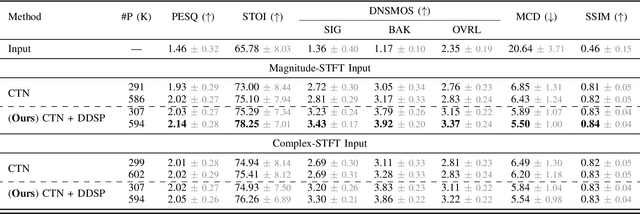
Deploying speech enhancement (SE) systems in wearable devices, such as smart glasses, is challenging due to the limited computational resources on the device. Although deep learning methods have achieved high-quality results, their computational cost limits their feasibility on embedded platforms. This work presents an efficient end-to-end SE framework that leverages a Differentiable Digital Signal Processing (DDSP) vocoder for high-quality speech synthesis. First, a compact neural network predicts enhanced acoustic features from noisy speech: spectral envelope, fundamental frequency (F0), and periodicity. These features are fed into the DDSP vocoder to synthesize the enhanced waveform. The system is trained end-to-end with STFT and adversarial losses, enabling direct optimization at the feature and waveform levels. Experimental results show that our method improves intelligibility and quality by 4% (STOI) and 19% (DNSMOS) over strong baselines without significantly increasing computation, making it well-suited for real-time applications.