 Add to Chrome
 Add to Firefox
 Add to Edge
Enhancing Binary Encoded Crime Linkage Analysis Using Siamese Network
Nov 10, 2025
Effective crime linkage analysis is crucial for identifying serial offenders and enhancing public safety. To address limitations of traditional crime linkage methods in handling high-dimensional, sparse, and heterogeneous data, we propose a Siamese Autoencoder framework that learns meaningful latent representations and uncovers correlations in complex crime data. Using data from the Violent Crime Linkage Analysis System (ViCLAS), maintained by the Serious Crime Analysis Section of the UK's National Crime Agency, our approach mitigates signal dilution in sparse feature spaces by integrating geographic-temporal features at the decoder stage. This design amplifies behavioral representations rather than allowing them to be overshadowed at the input level, yielding consistent improvements across multiple evaluation metrics. We further analyze how different domain-informed data reduction strategies influence model performance, providing practical guidance for preprocessing in crime linkage contexts. Our results show that advanced machine learning approaches can substantially enhance linkage accuracy, improving AUC by up to 9% over traditional methods while offering interpretable insights to support investigative decision-making.

Towards User-Centred Design of AI-Assisted Decision-Making in Law Enforcement
Apr 24, 2025
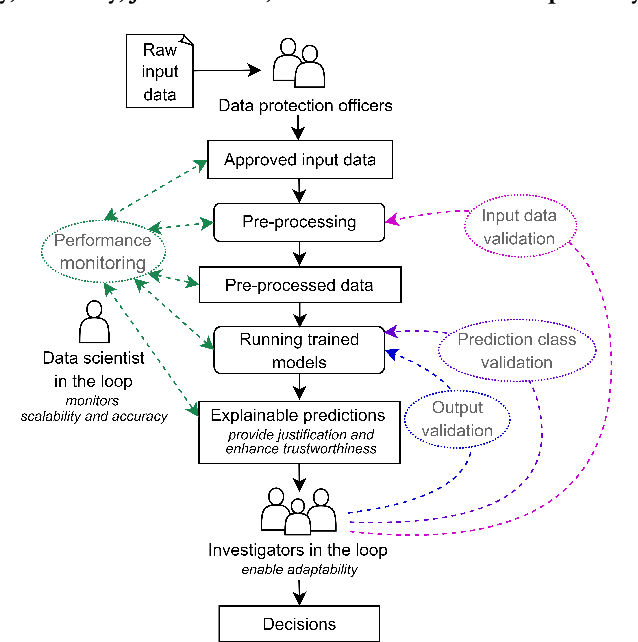
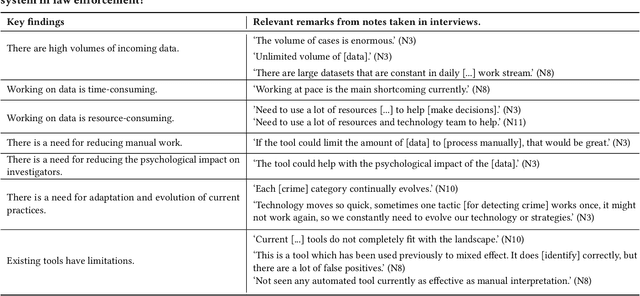
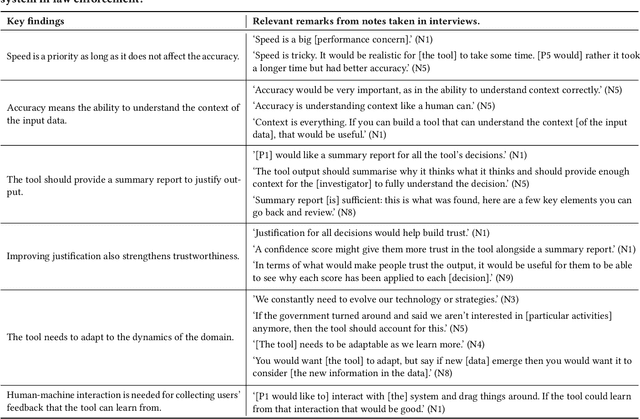
Artificial Intelligence (AI) has become an important part of our everyday lives, yet user requirements for designing AI-assisted systems in law enforcement remain unclear. To address this gap, we conducted qualitative research on decision-making within a law enforcement agency. Our study aimed to identify limitations of existing practices, explore user requirements and understand the responsibilities that humans expect to undertake in these systems. Participants in our study highlighted the need for a system capable of processing and analysing large volumes of data efficiently to help in crime detection and prevention. Additionally, the system should satisfy requirements for scalability, accuracy, justification, trustworthiness and adaptability to be adopted in this domain. Participants also emphasised the importance of having end users review the input data that might be challenging for AI to interpret, and validate the generated output to ensure the system's accuracy. To keep up with the evolving nature of the law enforcement domain, end users need to help the system adapt to the changes in criminal behaviour and government guidance, and technical experts need to regularly oversee and monitor the system. Furthermore, user-friendly human interaction with the system is essential for its adoption and some of the participants confirmed they would be happy to be in the loop and provide necessary feedback that the system can learn from. Finally, we argue that it is very unlikely that the system will ever achieve full automation due to the dynamic and complex nature of the law enforcement domain.