 Add to Chrome
 Add to Firefox
 Add to Edge
MPFlow: Learning Budgeted Max-Flow Optimization on the Lightning Network with Deep Graph Reinforcement Learning
Jul 09, 2026
We address liquidity placement in the Bitcoin Lightning Network (LN): given a fixed budget, which channels should a node open to maximize its routing capacity? We cast this as a budget-constrained combinatorial optimization problem on graphs, selecting $k$ edge additions that maximize $s$--$t$ max-flow, a theory-grounded measure of routing capacity, and solve it with graph reinforcement learning. Our lightweight agent combines a message-passing policy network with proximal policy optimization (PPO) and action masking, and is trained under a hub-exclusion curriculum: the network's top hubs are removed from training subgraphs, forcing the policy to learn capacity-aware placement rather than hub attachment. In extensive experiments on real Lightning Network snapshots, our method consistently outperforms strong heuristic baselines on the max-flow objective across multiple seeds and unseen graphs. The agent has been deployed in production for peer recommendations, executing 4640 channel-open decisions that cumulatively allocate 267.3 BTC over $16 million across 30 managed nodes.

Predicting Channel Closures in the Lightning Network with Machine Learning
May 12, 2026The Lightning Network (LN) is a second-layer protocol for Bitcoin designed to enable fast and cost-efficient off-chain transactions. Channels in the LN can be closed either by mutual agreement or unilaterally through a forced closure, which locks the involved capital for an extended period and degrades network reliability. In this paper, we study the problem of predicting channel closure types from publicly available gossip data, framing it as a temporal link classification task over the evolving channel graph. We construct a dataset spanning over two years of LN activity and benchmark a range of machine learning approaches, from MLPs to temporal graph neural networks and spectral encodings. Our experiments reveal that the dominant predictive signals are temporal and behavioural, namely how recently each endpoint was active and the per-node history of past closures, while the surrounding network topology provides no additional benefit. We find that a simple MLP operating on edge-level features, node-level event counts, and temporal patterns outperforms all graph-based approaches, and discuss how the inherent privacy of the LN, where critical information such as channel balances and payment flows remains hidden, fundamentally limits the predictability of closures from gossip data alone. We publicly release the dataset and code at https://github.com/AmbossTech/ln-channel-closure-prediction to encourage further research on this practically relevant task.
Bayesian Binary Search
Oct 02, 2024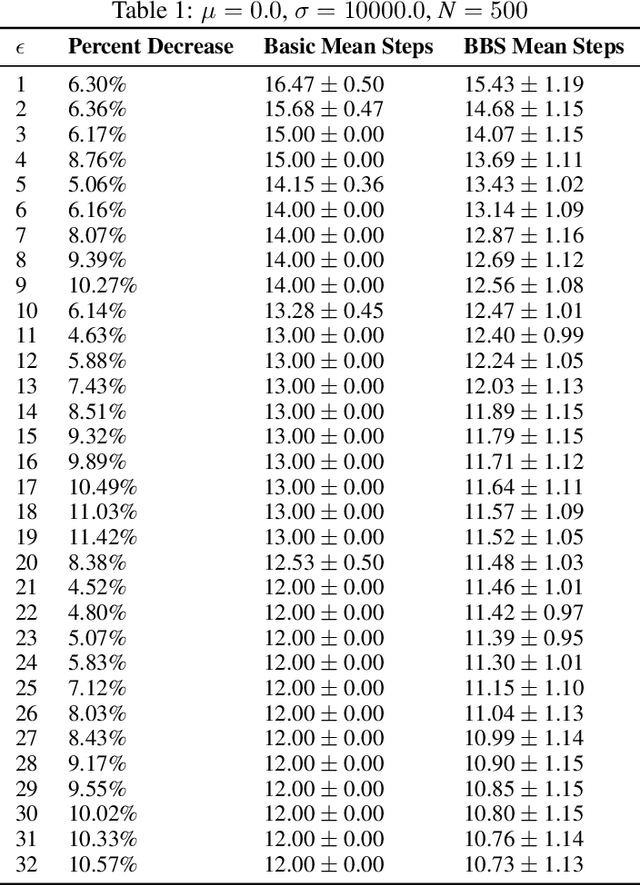
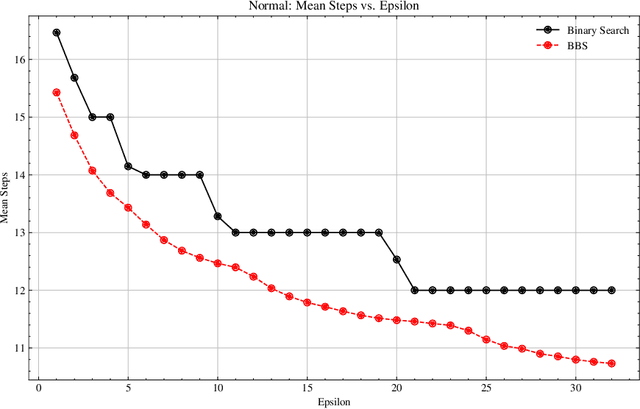
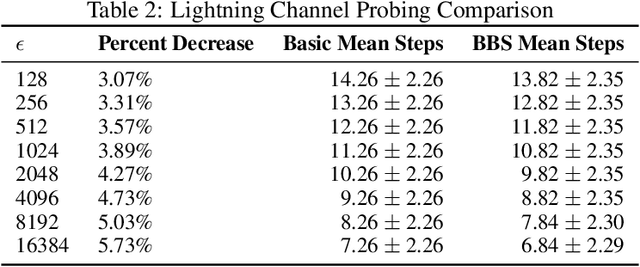
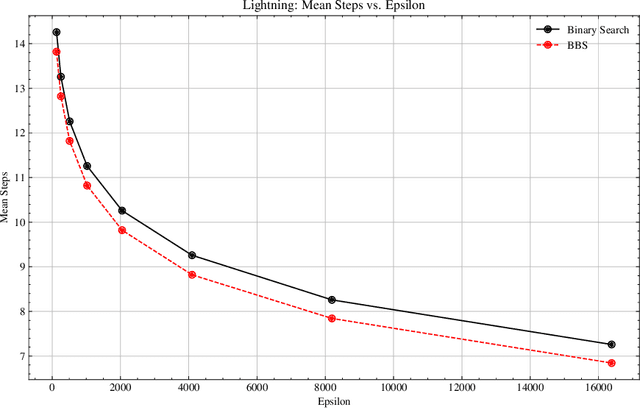
We present Bayesian Binary Search (BBS), a novel probabilistic variant of the classical binary search/bisection algorithm. BBS leverages machine learning/statistical techniques to estimate the probability density of the search space and modifies the bisection step to split based on probability density rather than the traditional midpoint, allowing for the learned distribution of the search space to guide the search algorithm. Search space density estimation can flexibly be performed using supervised probabilistic machine learning techniques (e.g., Gaussian process regression, Bayesian neural networks, quantile regression) or unsupervised learning algorithms (e.g., Gaussian mixture models, kernel density estimation (KDE), maximum likelihood estimation (MLE)). We demonstrate significant efficiency gains of using BBS on both simulated data across a variety of distributions and in a real-world binary search use case of probing channel balances in the Bitcoin Lightning Network, for which we have deployed the BBS algorithm in a production setting.