 Add to Chrome
 Add to Firefox
 Add to Edge
The Chandra-Gaia Catalog of Counterparts: Resolving ambiguous Gaia matches to X-ray sources in the Chandra Source Catalog using Machine Learning
Jun 17, 2026
We present a framework to cross-match sources from the Chandra Source Catalog (CSC v2.1) with optical sources from Gaia Data Release 3. Unlike purely spatial approaches, we use source properties such as magnitudes, colors, and distances to identify true counterparts, detect chance coincidences, and resolve ambiguities when multiple plausible candidates exist. We define a training set of high-confidence matches using NWAY, a Bayesian cross-matching framework that accounts for positional errors and source densities. We train a gradient-boosted classifier (LightGBM) on a variety of features from both catalogs. Of the ~$254$k unique X-ray sources, we find counterparts for ~$113$k sources, of which plausible multiple counterparts are found for ~$7$k. We find no counterparts for ~$20$k sources for which separation-based cross-matching does find a match, and attribute half of these to chance coincidences. We validate the pipeline on the Chandra Orion Ultradeep Project (COUP), where the machine-learning matches reproduce 95% of NWAY cross-matches without using any positional information. We release a catalog of the ~$113$k Chandra-Gaia counterparts, together with ~$7$k alternative matches and ~$20$k ambiguous NWAY associations, supporting future population studies of sources detectable by both Chandra and Gaia. We discuss limitations and provide a generalization of the framework that is applicable in other cross-matching scenarios.

Simulation-based Inference for Exoplanet Atmospheric Retrieval: Insights from winning the Ariel Data Challenge 2023 using Normalizing Flows
Sep 17, 2023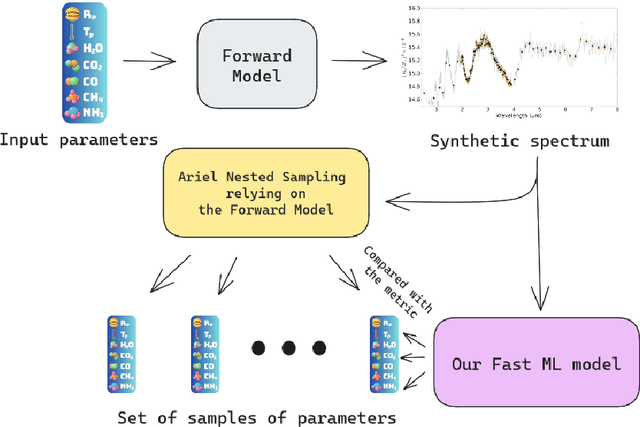
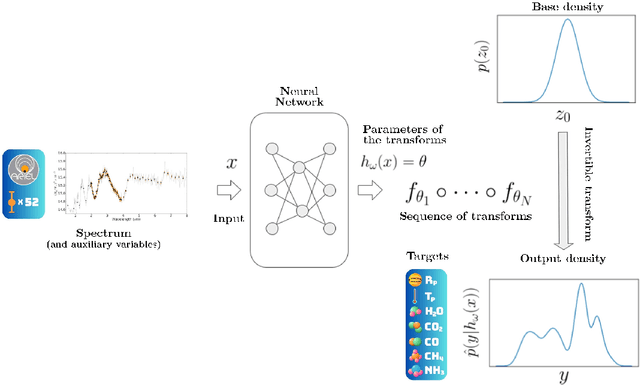
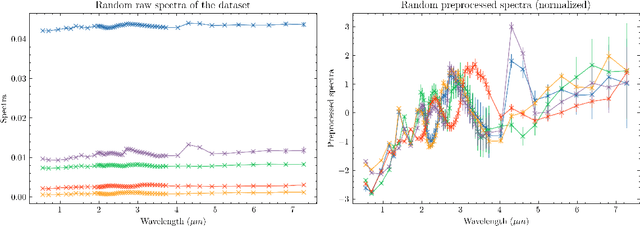
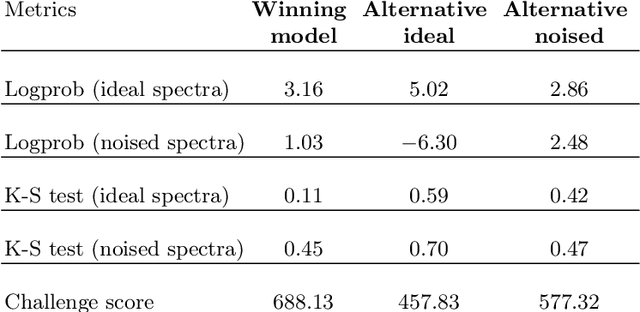
Advancements in space telescopes have opened new avenues for gathering vast amounts of data on exoplanet atmosphere spectra. However, accurately extracting chemical and physical properties from these spectra poses significant challenges due to the non-linear nature of the underlying physics. This paper presents novel machine learning models developed by the AstroAI team for the Ariel Data Challenge 2023, where one of the models secured the top position among 293 competitors. Leveraging Normalizing Flows, our models predict the posterior probability distribution of atmospheric parameters under different atmospheric assumptions. Moreover, we introduce an alternative model that exhibits higher performance potential than the winning model, despite scoring lower in the challenge. These findings highlight the need to reevaluate the evaluation metric and prompt further exploration of more efficient and accurate approaches for exoplanet atmosphere spectra analysis. Finally, we present recommendations to enhance the challenge and models, providing valuable insights for future applications on real observational data. These advancements pave the way for more effective and timely analysis of exoplanet atmospheric properties, advancing our understanding of these distant worlds.