 Add to Chrome
 Add to Firefox
 Add to Edge
Solar Open Technical Report
Jan 11, 2026
We introduce Solar Open, a 102B-parameter bilingual Mixture-of-Experts language model for underserved languages. Solar Open demonstrates a systematic methodology for building competitive LLMs by addressing three interconnected challenges. First, to train effectively despite data scarcity for underserved languages, we synthesize 4.5T tokens of high-quality, domain-specific, and RL-oriented data. Second, we coordinate this data through a progressive curriculum jointly optimizing composition, quality thresholds, and domain coverage across 20 trillion tokens. Third, to enable reasoning capabilities through scalable RL, we apply our proposed framework SnapPO for efficient optimization. Across benchmarks in English and Korean, Solar Open achieves competitive performance, demonstrating the effectiveness of this methodology for underserved language AI development.

FeRG-LLM : Feature Engineering by Reason Generation Large Language Models
Mar 30, 2025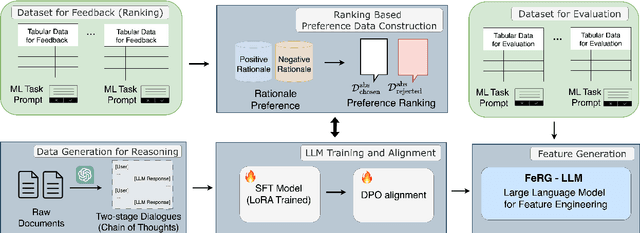
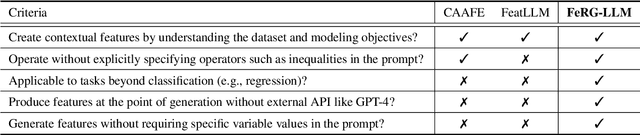
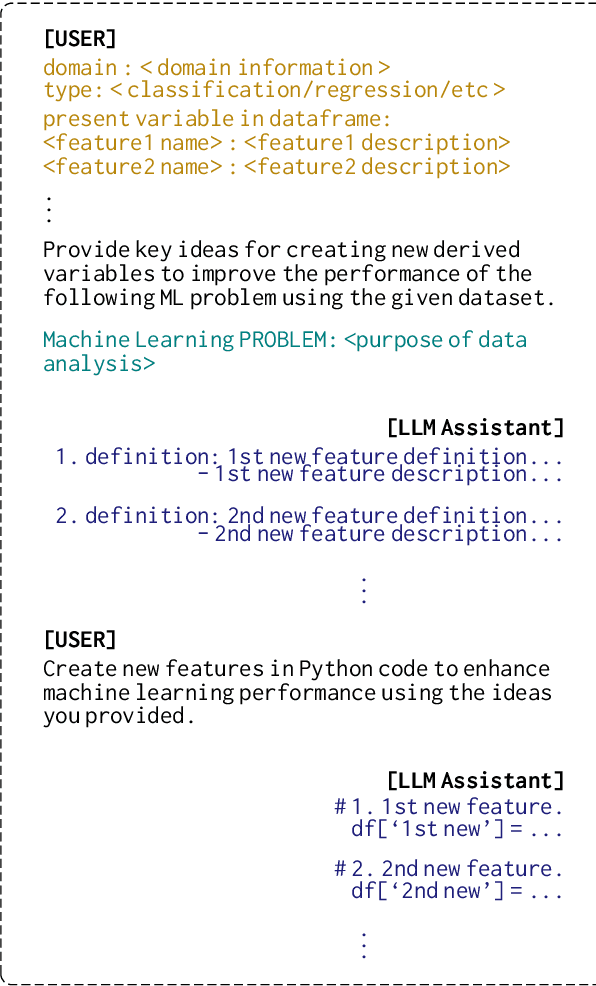
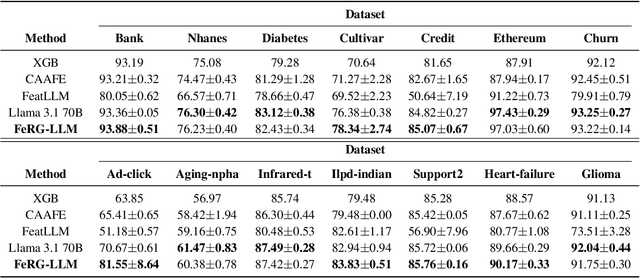
One of the key tasks in machine learning for tabular data is feature engineering. Although it is vital for improving the performance of models, it demands considerable human expertise and deep domain knowledge, making it labor-intensive endeavor. To address this issue, we propose a novel framework, \textbf{FeRG-LLM} (\textbf{Fe}ature engineering by \textbf{R}eason \textbf{G}eneration \textbf{L}arge \textbf{L}anguage \textbf{M}odels), a large language model designed to automatically perform feature engineering at an 8-billion-parameter scale. We have constructed two-stage conversational dialogues that enable language models to analyze machine learning tasks and discovering new features, exhibiting their Chain-of-Thought (CoT) capabilities. We use these dialogues to fine-tune Llama 3.1 8B model and integrate Direct Preference Optimization (DPO) to receive feedback improving quality of new features and the model's performance. Our experiments show that FeRG-LLM performs comparably to or better than Llama 3.1 70B on most datasets, while using fewer resources and achieving reduced inference time. It outperforms other studies in classification tasks and performs well in regression tasks. Moreover, since it does not rely on cloud-hosted LLMs like GPT-4 with extra API costs when generating features, it can be deployed locally, addressing security concerns.