 Add to Chrome
 Add to Firefox
 Add to Edge
Analysis of Mutual and Referential Human and Robot Gazes in a Collaborative Word Association Game
Jul 13, 2026
Robot gaze is a major component of human-robot dialogue coordination. Most studies of gaze in human-robot dialogue focus on face-to-face social conversations, but little is known about gaze in demanding task-focused interactions. In this paper, we investigate how the gaze of a robot game partner affects human visual attention and if humans tend to direct confirmation-seeking gazes towards the robot. In our study, we let participants play a collaborative word association game with a NAO robot acting as an embodied, LLM-driven conversational partner. Our experiments are conducted under two conditions, which implement mutual and referential gazes of the robot respectively. We record participants' gaze using eye tracking glasses and analyze the interactions using gaze coordinates, speech segments, key events and areas of interests. We find that robot gaze orientation does not affect the time to first fixation on words the robot proposed. We also find that participants gaze more often at the robot when their dialogue line contains confirmation requests, compared to when it does not. Our results indicate (likely also due to the cognitively demanding nature of the game) that the verbal aspect of this task overshadows the effects of referential robot gaze. These findings offer valuable insights for designing and validating robot gaze and turn-taking behavior in collaborative tasks which require coordination and efficient communication.

Legible and Intuitive Multi-modal Robot State and Intent Communication Validated in Online and Real-world Studies
Jun 23, 2026Effective robot-to-human communication can increase transparency and trust, reduce uncertainty, and contribute to safer collaboration in shared workspaces. Designing and validating an effective robot communication strategy is challenging due to the varying and often limited communication modalities across robots, differences in how diverse recipients interpret messages, and the underexplored virtual-to-real gap in studies of communication legibility. We present a systematic, large-scale comparative validation of existing communication strategies for a mobile non-humanoid robot across message types and settings (online and in-person). Based on the prescribed message types in the existing standards for industrial robots, we realize and compare a low-expressive, unimodal LED-based strategy with a highly expressive, multimodal one that leverages robotic gaze, gestures, and voice. For each strategy, we analyze the communication of a turning intention, an attention request, error status, whether the robot is stuck, and whether it is functioning normally. We evaluate these strategies in replicated online and in-person experiments. We find strong evidence that highly expressive multimodal communication is perceived as more legible and intuitive than unimodal LED-based communication. Comparing the online and real-world study findings, we observe a notable decrease in overall legibility, particularly for signaling with LEDs. Similarly, confidence in message interpretation decreases during the real-world evaluation.
Multimodal Interaction and Intention Communication for Industrial Robots
Feb 25, 2025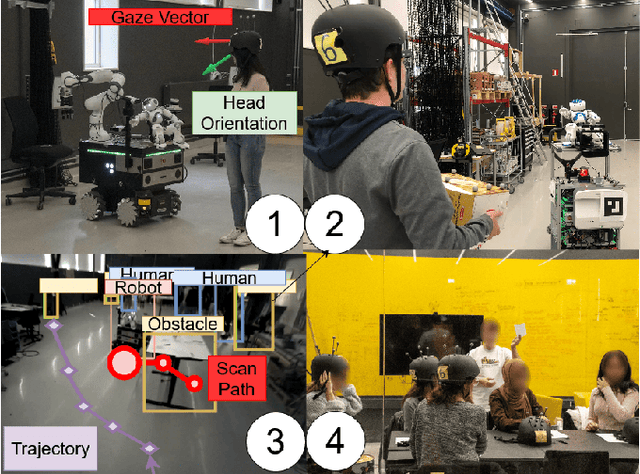
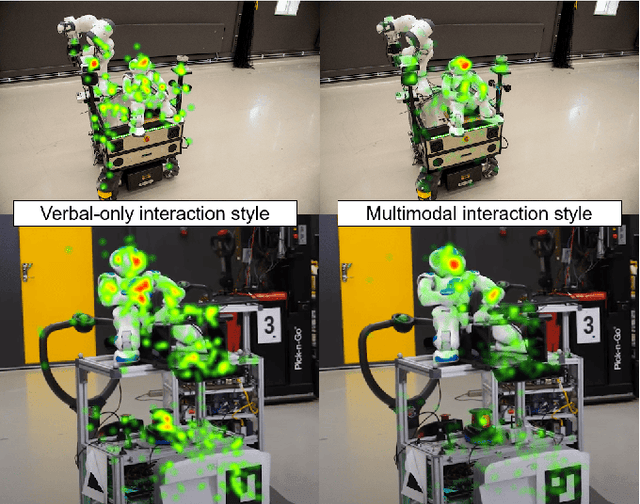
Successful adoption of industrial robots will strongly depend on their ability to safely and efficiently operate in human environments, engage in natural communication, understand their users, and express intentions intuitively while avoiding unnecessary distractions. To achieve this advanced level of Human-Robot Interaction (HRI), robots need to acquire and incorporate knowledge of their users' tasks and environment and adopt multimodal communication approaches with expressive cues that combine speech, movement, gazes, and other modalities. This paper presents several methods to design, enhance, and evaluate expressive HRI systems for non-humanoid industrial robots. We present the concept of a small anthropomorphic robot communicating as a proxy for its non-humanoid host, such as a forklift. We developed a multimodal and LLM-enhanced communication framework for this robot and evaluated it in several lab experiments, using gaze tracking and motion capture to quantify how users perceive the robot and measure the task progress.
Evaluating Efficiency and Engagement in Scripted and LLM-Enhanced Human-Robot Interactions
Jan 21, 2025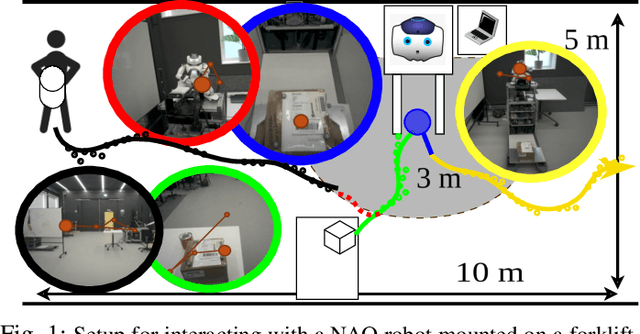
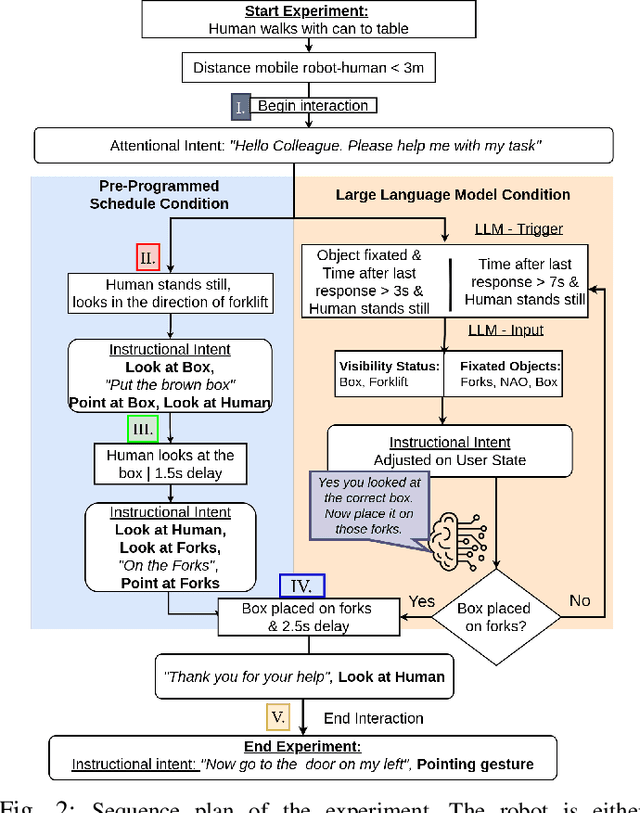

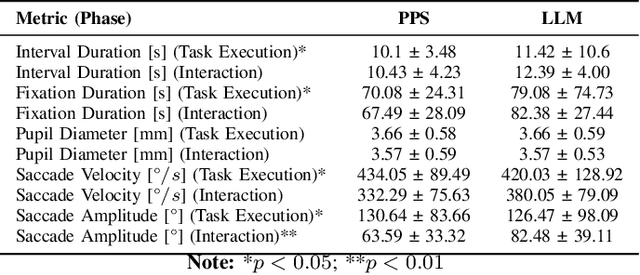
To achieve natural and intuitive interaction with people, HRI frameworks combine a wide array of methods for human perception, intention communication, human-aware navigation and collaborative action. In practice, when encountering unpredictable behavior of people or unexpected states of the environment, these frameworks may lack the ability to dynamically recognize such states, adapt and recover to resume the interaction. Large Language Models (LLMs), owing to their advanced reasoning capabilities and context retention, present a promising solution for enhancing robot adaptability. This potential, however, may not directly translate to improved interaction metrics. This paper considers a representative interaction with an industrial robot involving approach, instruction, and object manipulation, implemented in two conditions: (1) fully scripted and (2) including LLM-enhanced responses. We use gaze tracking and questionnaires to measure the participants' task efficiency, engagement, and robot perception. The results indicate higher subjective ratings for the LLM condition, but objective metrics show that the scripted condition performs comparably, particularly in efficiency and focus during simple tasks. We also note that the scripted condition may have an edge over LLM-enhanced responses in terms of response latency and energy consumption, especially for trivial and repetitive interactions.