 Add to Chrome
 Add to Firefox
 Add to Edge
Weighted Contrastive Learning for Anomaly-Aware Time-Series Forecasting
Dec 08, 2025
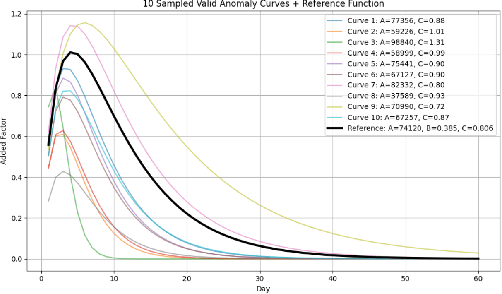
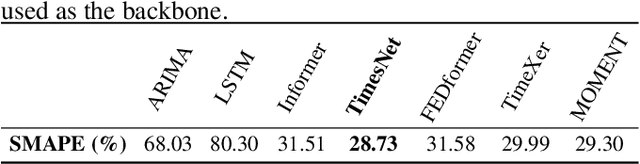
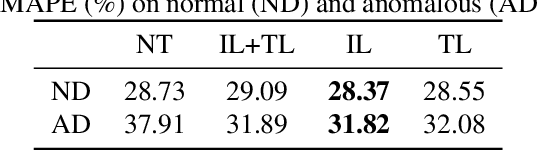
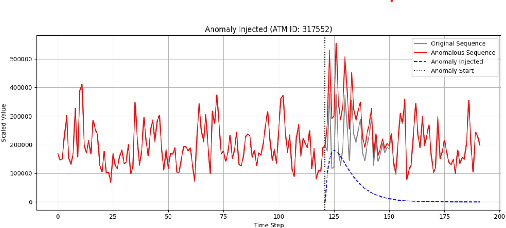
Reliable forecasting of multivariate time series under anomalous conditions is crucial in applications such as ATM cash logistics, where sudden demand shifts can disrupt operations. Modern deep forecasters achieve high accuracy on normal data but often fail when distribution shifts occur. We propose Weighted Contrastive Adaptation (WECA), a Weighted contrastive objective that aligns normal and anomaly-augmented representations, preserving anomaly-relevant information while maintaining consistency under benign variations. Evaluations on a nationwide ATM transaction dataset with domain-informed anomaly injection show that WECA improves SMAPE on anomaly-affected data by 6.1 percentage points compared to a normally trained baseline, with negligible degradation on normal data. These results demonstrate that WECA enhances forecasting reliability under anomalies without sacrificing performance during regular operations.

Latent Space Score-based Diffusion Model for Probabilistic Multivariate Time Series Imputation
Sep 13, 2024
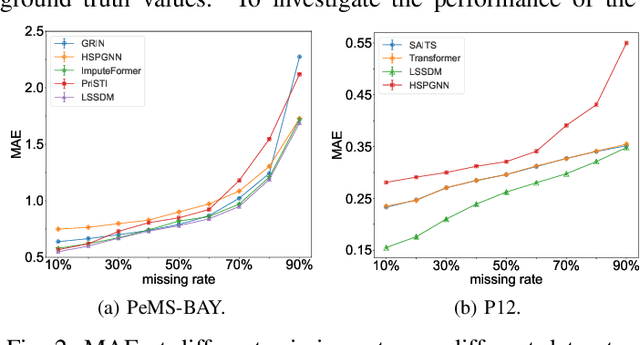
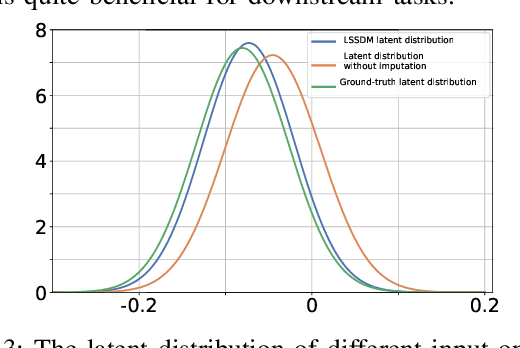

Accurate imputation is essential for the reliability and success of downstream tasks. Recently, diffusion models have attracted great attention in this field. However, these models neglect the latent distribution in a lower-dimensional space derived from the observed data, which limits the generative capacity of the diffusion model. Additionally, dealing with the original missing data without labels becomes particularly problematic. To address these issues, we propose the Latent Space Score-Based Diffusion Model (LSSDM) for probabilistic multivariate time series imputation. Observed values are projected onto low-dimensional latent space and coarse values of the missing data are reconstructed without knowing their ground truth values by this unsupervised learning approach. Finally, the reconstructed values are fed into a conditional diffusion model to obtain the precise imputed values of the time series. In this way, LSSDM not only possesses the power to identify the latent distribution but also seamlessly integrates the diffusion model to obtain the high-fidelity imputed values and assess the uncertainty of the dataset. Experimental results demonstrate that LSSDM achieves superior imputation performance while also providing a better explanation and uncertainty analysis of the imputation mechanism. The website of the code is \textit{https://github.com/gorgen2020/LSSDM\_imputation}.