 Add to Chrome
 Add to Firefox
 Add to Edge
A Deep Multi-Modal Method for Patient Wound Healing Assessment
Feb 10, 2026
Hospitalization of patients is one of the major factors for high wound care costs. Most patients do not acquire a wound which needs immediate hospitalization. However, due to factors such as delay in treatment, patient's non-compliance or existing co-morbid conditions, an injury can deteriorate and ultimately lead to patient hospitalization. In this paper, we propose a deep multi-modal method to predict the patient's risk of hospitalization. Our goal is to predict the risk confidently by collectively using the wound variables and wound images of the patient. Existing works in this domain have mainly focused on healing trajectories based on distinct wound types. We developed a transfer learning-based wound assessment solution, which can predict both wound variables from wound images and their healing trajectories, which is our primary contribution. We argue that the development of a novel model can help in early detection of the complexities in the wound, which might affect the healing process and also reduce the time spent by a clinician to diagnose the wound.
* 4 pages, 2 figures

Wound and episode level readmission risk or weeks to readmit: Why do patients get readmitted? How long does it take for a patient to get readmitted?
Oct 05, 2020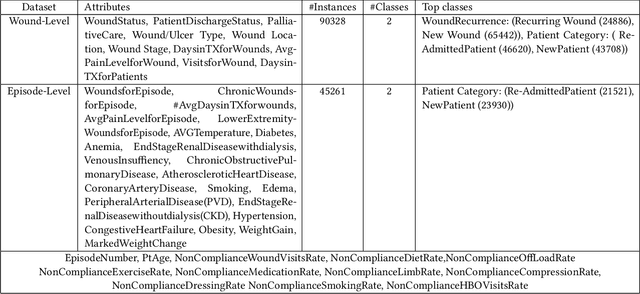
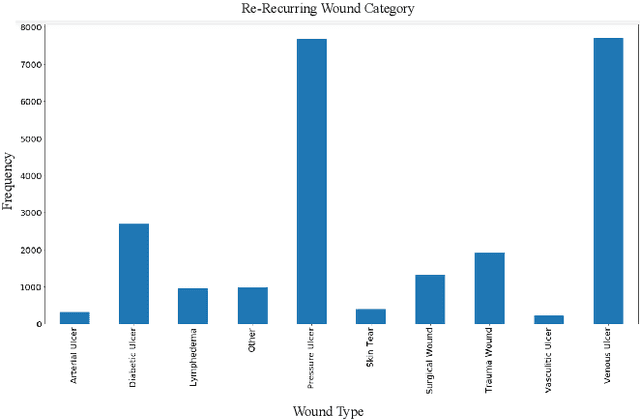
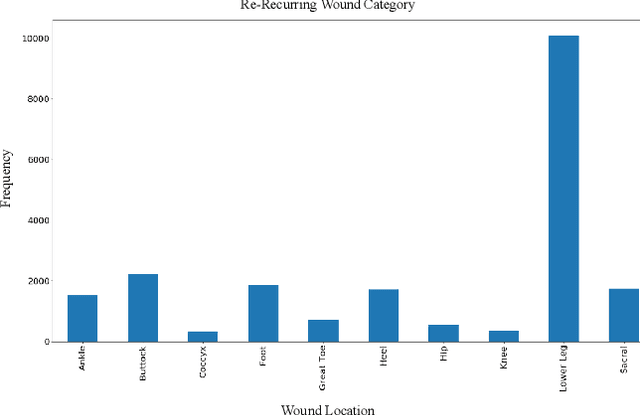

The Affordable care Act of 2010 had introduced Readmission reduction program in 2012 to reduce avoidable re-admissions to control rising healthcare costs. Wound care impacts 15 of medicare beneficiaries making it one of the major contributors of medicare health care cost. Health plans have been exploring proactive health care services that can focus on preventing wound recurrences and re-admissions to control the wound care costs. With rising costs of Wound care industry, it has become of paramount importance to reduce wound recurrences & patient re-admissions. What factors are responsible for a Wound to recur which ultimately lead to hospitalization or re-admission? Is there a way to identify the patients at risk of re-admission before the occurrence using data driven analysis? Patient re-admission risk management has become critical for patients suffering from chronic wounds such as diabetic ulcers, pressure ulcers, and vascular ulcers. Understanding the risk & the factors that cause patient readmission can help care providers and patients avoid wound recurrences. Our work focuses on identifying patients who are at high risk of re-admission & determining the time period with in which a patient might get re-admitted. Frequent re-admissions add financial stress to the patient & Health plan and deteriorate the quality of life of the patient. Having this information can allow a provider to set up preventive measures that can delay, if not prevent, patients' re-admission. On a combined wound & episode-level data set of patient's wound care information, our extended autoprognosis achieves a recall of 92 and a precision of 92 for the predicting a patient's re-admission risk. For new patient class, precision and recall are as high as 91 and 98, respectively. We are also able to predict the patient's discharge event for a re-admission event to occur through our model with a MAE of 2.3 weeks.