 Add to Chrome
 Add to Firefox
 Add to Edge
VoxSRC 2022: The Fourth VoxCeleb Speaker Recognition Challenge
Mar 06, 2023
This paper summarises the findings from the VoxCeleb Speaker Recognition Challenge 2022 (VoxSRC-22), which was held in conjunction with INTERSPEECH 2022. The goal of this challenge was to evaluate how well state-of-the-art speaker recognition systems can diarise and recognise speakers from speech obtained "in the wild". The challenge consisted of: (i) the provision of publicly available speaker recognition and diarisation data from YouTube videos together with ground truth annotation and standardised evaluation software; and (ii) a public challenge and hybrid workshop held at INTERSPEECH 2022. We describe the four tracks of our challenge along with the baselines, methods, and results. We conclude with a discussion on the new domain-transfer focus of VoxSRC-22, and on the progression of the challenge from the previous three editions.

Absolute decision corrupts absolutely: conservative online speaker diarisation
Nov 09, 2022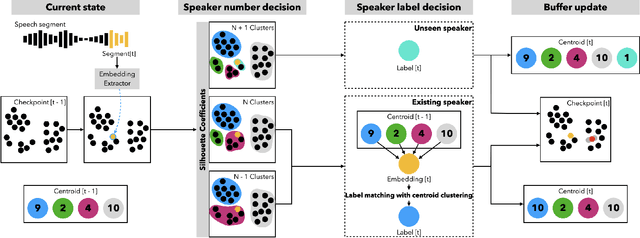
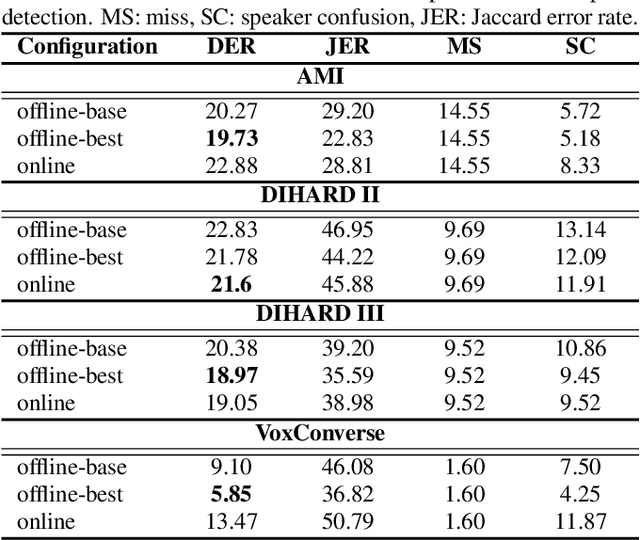
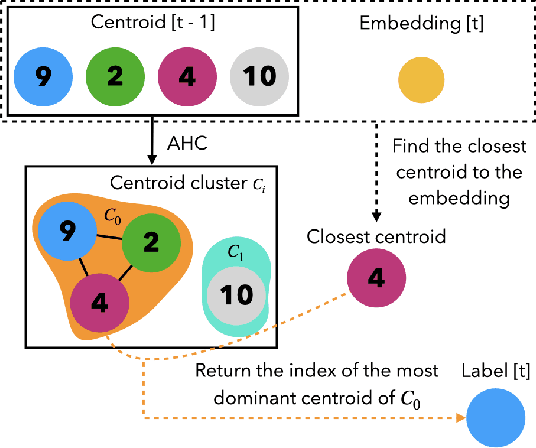
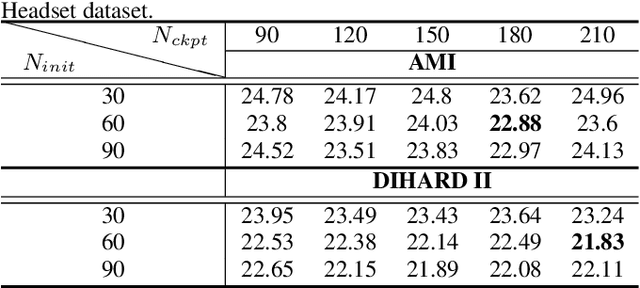
Our focus lies in developing an online speaker diarisation framework which demonstrates robust performance across diverse domains. In online speaker diarisation, outputs generated in real-time are irreversible, and a few misjudgements in the early phase of an input session can lead to catastrophic results. We hypothesise that cautiously increasing the number of estimated speakers is of paramount importance among many other factors. Thus, our proposed framework includes decreasing the number of speakers by one when the system judges that an increase in the past was faulty. We also adopt dual buffers, checkpoints and centroids, where checkpoints are combined with silhouette coefficients to estimate the number of speakers and centroids represent speakers. Again, we believe that more than one centroid can be generated from one speaker. Thus we design a clustering-based label matching technique to assign labels in real-time. The resulting system is lightweight yet surprisingly effective. The system demonstrates state-of-the-art performance on DIHARD 2 and 3 datasets, where it is also competitive in AMI and VoxConverse test sets.
High-resolution embedding extractor for speaker diarisation
Nov 08, 2022


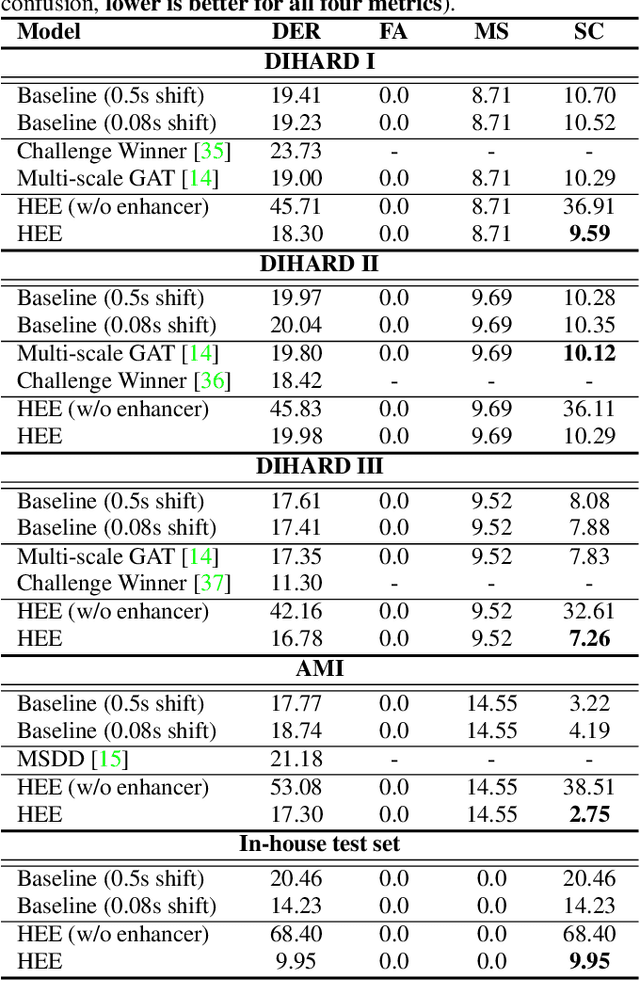
Speaker embedding extractors significantly influence the performance of clustering-based speaker diarisation systems. Conventionally, only one embedding is extracted from each speech segment. However, because of the sliding window approach, a segment easily includes two or more speakers owing to speaker change points. This study proposes a novel embedding extractor architecture, referred to as a high-resolution embedding extractor (HEE), which extracts multiple high-resolution embeddings from each speech segment. Hee consists of a feature-map extractor and an enhancer, where the enhancer with the self-attention mechanism is the key to success. The enhancer of HEE replaces the aggregation process; instead of a global pooling layer, the enhancer combines relative information to each frame via attention leveraging the global context. Extracted dense frame-level embeddings can each represent a speaker. Thus, multiple speakers can be represented by different frame-level features in each segment. We also propose an artificially generating mixture data training framework to train the proposed HEE. Through experiments on five evaluation sets, including four public datasets, the proposed HEE demonstrates at least 10% improvement on each evaluation set, except for one dataset, which we analyse that rapid speaker changes less exist.
Disentangled representation learning for multilingual speaker recognition
Nov 01, 2022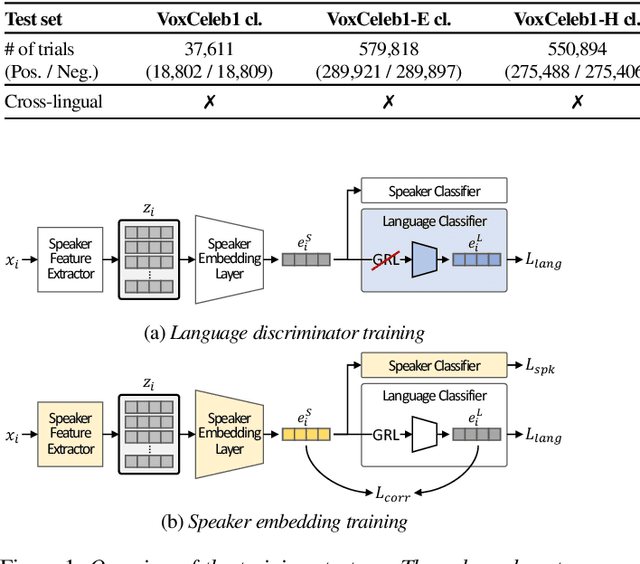

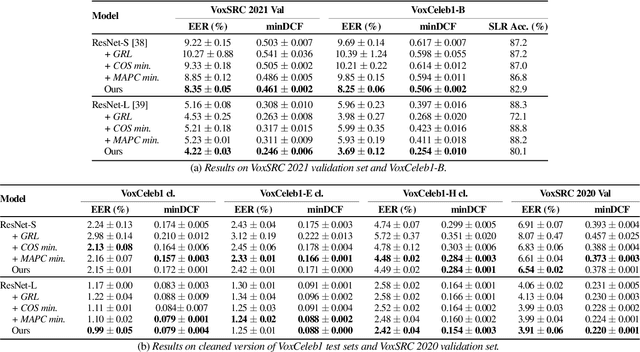
The goal of this paper is to train speaker embeddings that are robust to bilingual speaking scenario. The majority of the world's population speak at least two languages; however, most speaker recognition systems fail to recognise the same speaker when speaking in different languages. Popular speaker recognition evaluation sets do not consider the bilingual scenario, making it difficult to analyse the effect of bilingual speakers on speaker recognition performance. This paper proposes a new large-scale evaluation set derived from VoxCeleb that considers bilingual scenarios. We also introduce a representation learning strategy, which disentangles language information from speaker representation to account for the bilingual scenario. This language-disentangled representation learning strategy can be adapted to existing models with small changes to the training pipeline. Experimental results demonstrate that the baseline models suffer significant performance degradation when evaluated on the proposed bilingual test set. On the contrary, the model trained with the proposed disentanglement strategy shows significant improvement under the bilingual evaluation scenario while simultaneously retaining competitive performance on existing monolingual test sets.
In search of strong embedding extractors for speaker diarisation
Oct 26, 2022
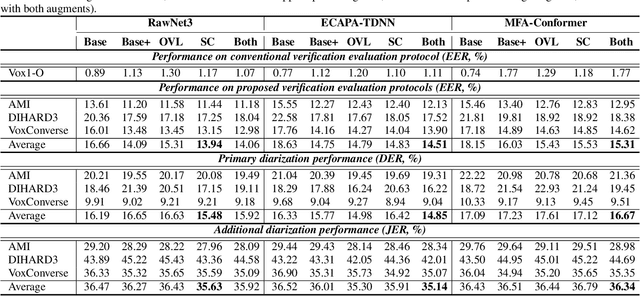
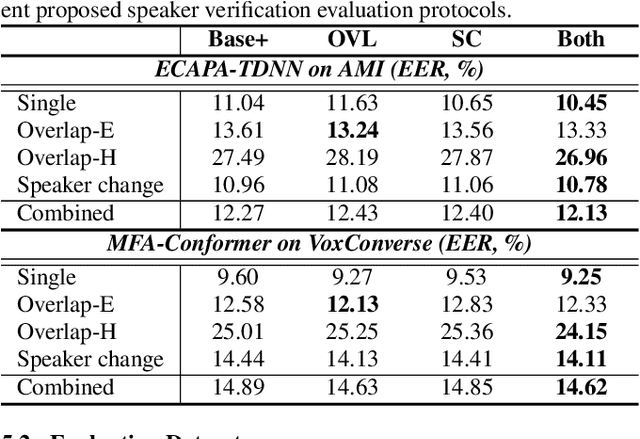
Speaker embedding extractors (EEs), which map input audio to a speaker discriminant latent space, are of paramount importance in speaker diarisation. However, there are several challenges when adopting EEs for diarisation, from which we tackle two key problems. First, the evaluation is not straightforward because the features required for better performance differ between speaker verification and diarisation. We show that better performance on widely adopted speaker verification evaluation protocols does not lead to better diarisation performance. Second, embedding extractors have not seen utterances in which multiple speakers exist. These inputs are inevitably present in speaker diarisation because of overlapped speech and speaker changes; they degrade the performance. To mitigate the first problem, we generate speaker verification evaluation protocols that mimic the diarisation scenario better. We propose two data augmentation techniques to alleviate the second problem, making embedding extractors aware of overlapped speech or speaker change input. One technique generates overlapped speech segments, and the other generates segments where two speakers utter sequentially. Extensive experimental results using three state-of-the-art speaker embedding extractors demonstrate that both proposed approaches are effective.
Baseline Systems for the First Spoofing-Aware Speaker Verification Challenge: Score and Embedding Fusion
Apr 21, 2022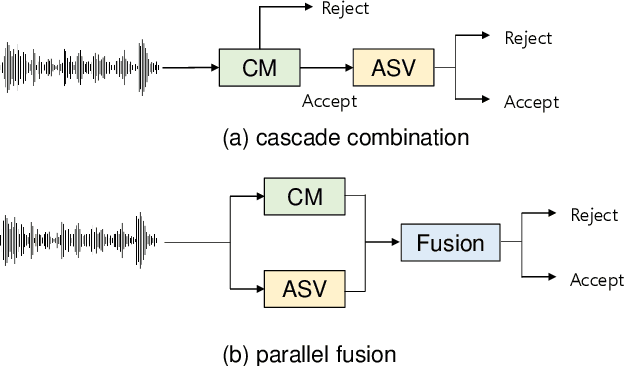
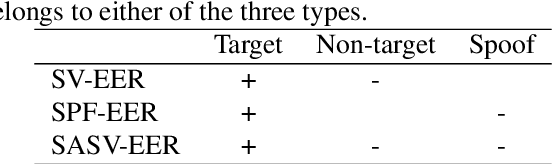
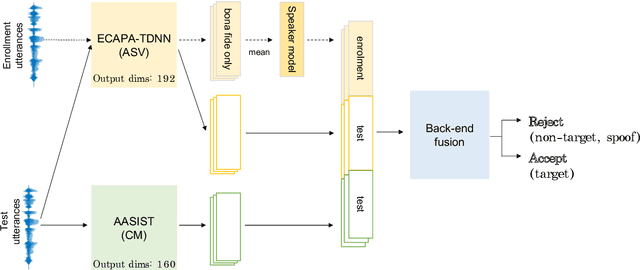
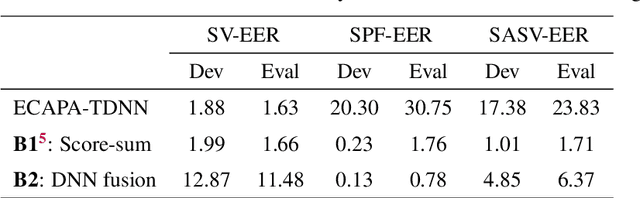
Deep learning has brought impressive progress in the study of both automatic speaker verification (ASV) and spoofing countermeasures (CM). Although solutions are mutually dependent, they have typically evolved as standalone sub-systems whereby CM solutions are usually designed for a fixed ASV system. The work reported in this paper aims to gauge the improvements in reliability that can be gained from their closer integration. Results derived using the popular ASVspoof2019 dataset indicate that the equal error rate (EER) of a state-of-the-art ASV system degrades from 1.63% to 23.83% when the evaluation protocol is extended with spoofed trials.%subjected to spoofing attacks. However, even the straightforward integration of ASV and CM systems in the form of score-sum and deep neural network-based fusion strategies reduce the EER to 1.71% and 6.37%, respectively. The new Spoofing-Aware Speaker Verification (SASV) challenge has been formed to encourage greater attention to the integration of ASV and CM systems as well as to provide a means to benchmark different solutions.
Self-supervised curriculum learning for speaker verification
Apr 05, 2022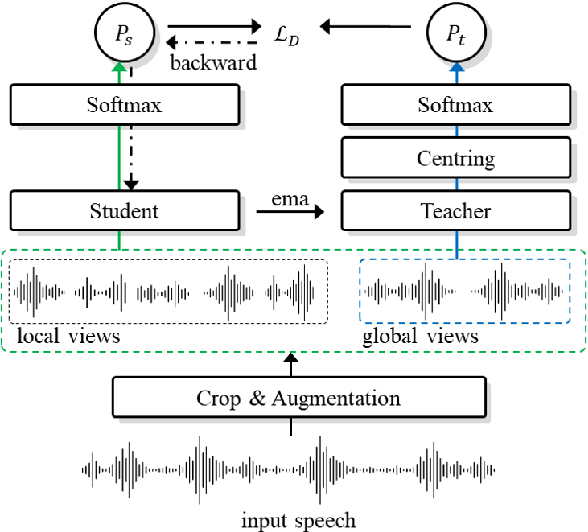
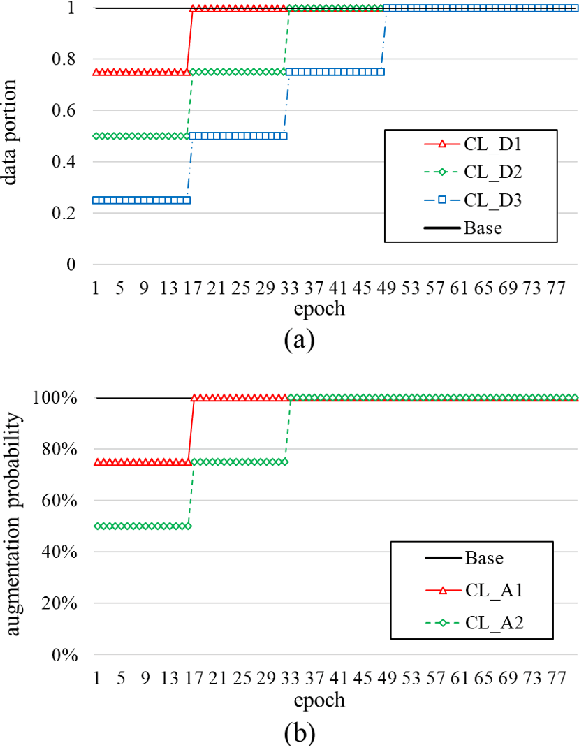
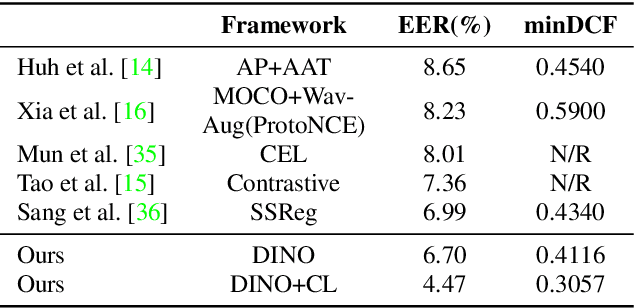
Self-supervised learning is one of the emerging approaches to machine learning today, and has been successfully applied to vision, speech and natural processing tasks. There is a range of frameworks within self-supervised learning literature, but the speaker recognition literature has particularly adopted self-supervision via contrastive loss functions. Our work adapts the DINO framework for speaker recognition, in which the model is trained without exploiting negative utterance pairs. We introduce a curriculum learning strategy to the self-supervised framework, which guides effective training of speaker recognition models. In particular, we propose two curriculum strategies where one gradually increases the number of speakers in training dataset, and the other gradually applies augmentations to more utterances within a mini-batch as the training proceeds. A range of experiments conducted on the VoxCeleb1 evaluation protocol demonstrate the effectiveness of both the DINO framework on speaker verification and our proposed curriculum learning strategies. We report the state-of-the-art equal error rate of 4.47% with a single-phase training.
Selective Kernel Attention for Robust Speaker Verification
Apr 03, 2022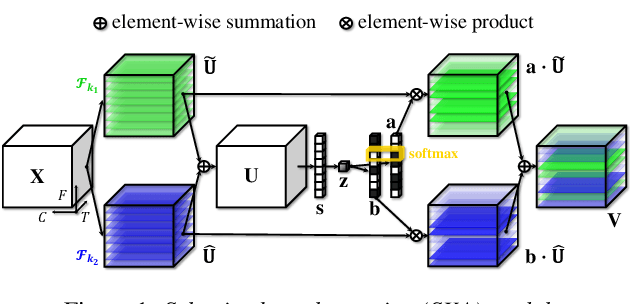
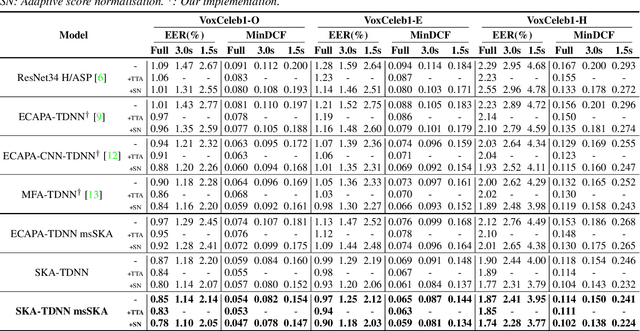
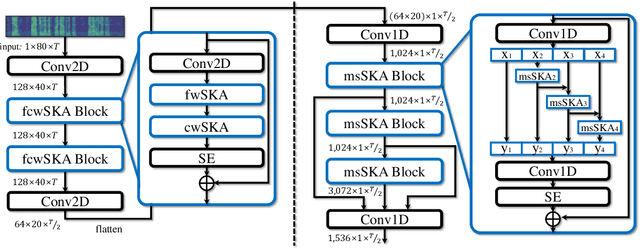
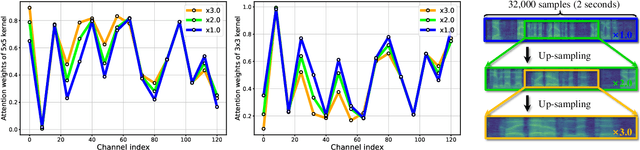
Recent state-of-the-art speaker verification architectures adopt multi-scale processing and frequency-channel attention techniques. However, their full potential may not have been exploited because these techniques' receptive fields are fixed where most convolutional layers operate with specified kernel sizes such as 1, 3 or 5. We aim to further improve this line of research by introducing a selective kernel attention (SKA) mechanism. The SKA mechanism allows each convolutional layer to adaptively select the kernel size in a data-driven fashion based on an attention mechanism that exploits both frequency and channel domain using the previous layer's output. We propose three module variants using the SKA mechanism whereby two modules are applied in front of an ECAPA-TDNN model, and the other is combined with the Res2Net backbone block. Experimental results demonstrate that our proposed model consistently outperforms the conventional counterpart on the three different evaluation protocols in terms of both equal error rate and minimum detection cost function. In addition, we present a detailed analysis that helps understand how the SKA module works.
Pushing the limits of raw waveform speaker recognition
Mar 29, 2022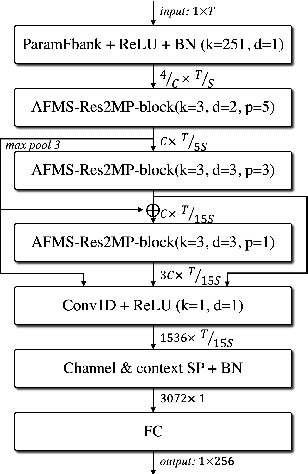
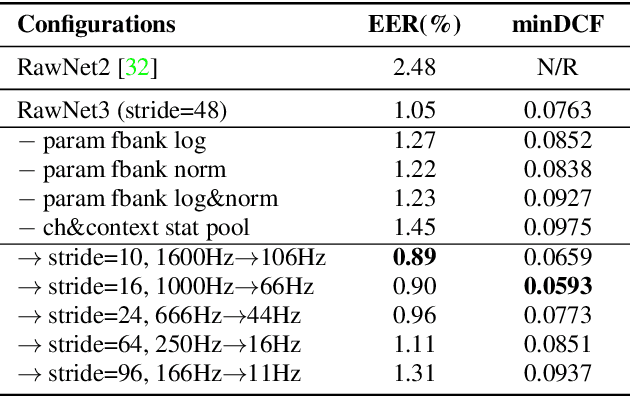
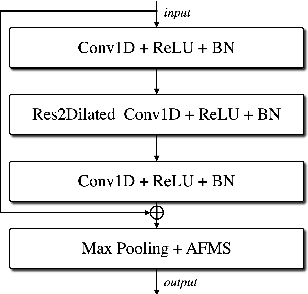
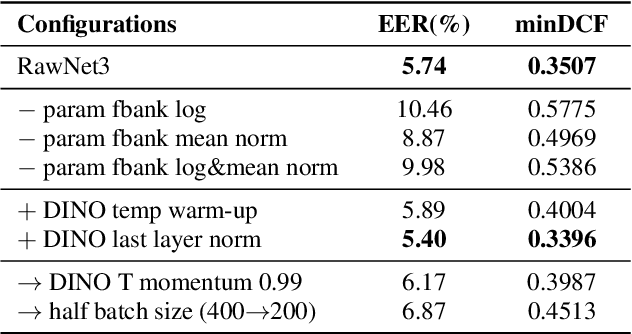
In recent years, speaker recognition systems based on raw waveform inputs have received increasing attention. However, the performance of such systems are typically inferior to the state-of-the-art handcrafted feature-based counterparts, which demonstrate equal error rates under 1% on the popular VoxCeleb1 test set. This paper proposes a novel speaker recognition model based on raw waveform inputs. The model incorporates recent advances in machine learning and speaker verification, including the Res2Net backbone module and multi-layer feature aggregation. Our best model achieves an equal error rate of 0.89%, which is competitive with the state-of-the-art models based on handcrafted features, and outperforms the best model based on raw waveform inputs by a large margin. We also explore the application of the proposed model in the context of self-supervised learning framework. Our self-supervised model outperforms single phase-based existing works in this line of research. Finally, we show that self-supervised pre-training is effective for the semi-supervised scenario where we only have a small set of labelled training data, along with a larger set of unlabelled examples.
SASV 2022: The First Spoofing-Aware Speaker Verification Challenge
Mar 28, 2022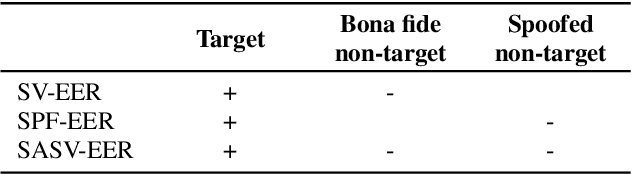
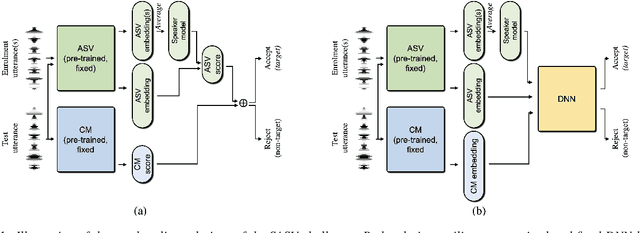
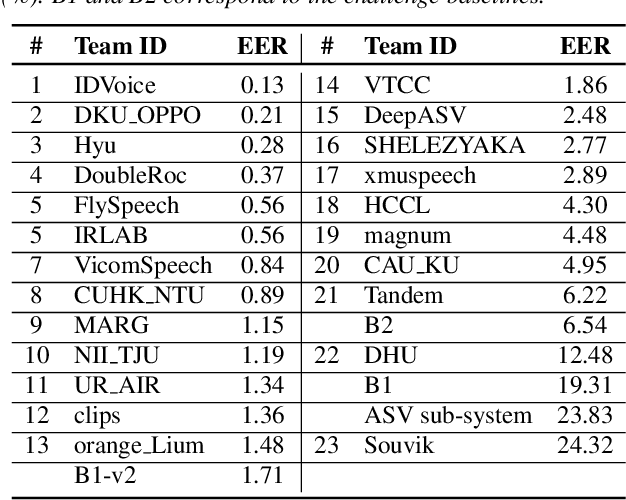
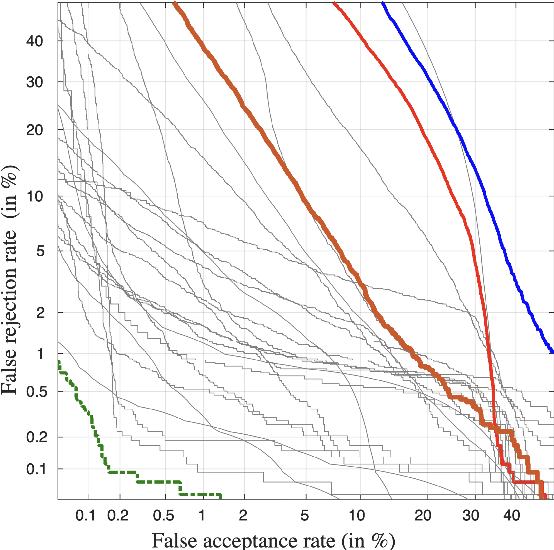
The first spoofing-aware speaker verification (SASV) challenge aims to integrate research efforts in speaker verification and anti-spoofing. We extend the speaker verification scenario by introducing spoofed trials to the usual set of target and impostor trials. In contrast to the established ASVspoof challenge where the focus is upon separate, independently optimised spoofing detection and speaker verification sub-systems, SASV targets the development of integrated and jointly optimised solutions. Pre-trained spoofing detection and speaker verification models are provided as open source and are used in two baseline SASV solutions. Both models and baselines are freely available to participants and can be used to develop back-end fusion approaches or end-to-end solutions. Using the provided common evaluation protocol, 23 teams submitted SASV solutions. When assessed with target, bona fide non-target and spoofed non-target trials, the top-performing system reduces the equal error rate of a conventional speaker verification system from 23.83% to 0.13%. SASV challenge results are a testament to the reliability of today's state-of-the-art approaches to spoofing detection and speaker verification.