 Add to Chrome
 Add to Firefox
 Add to Edge
Understanding the Use of a Large Language Model-Powered Guide to Make Virtual Reality Accessible for Blind and Low Vision People
Mar 10, 2026
As social virtual reality (VR) grows more popular, addressing accessibility for blind and low vision (BLV) users is increasingly critical. Researchers have proposed an AI "sighted guide" to help users navigate VR and answer their questions, but it has not been studied with users. To address this gap, we developed a large language model (LLM)-powered guide and studied its use with 16 BLV participants in virtual environments with confederates posing as other users. We found that when alone, participants treated the guide as a tool, but treated it companionably around others, giving it nicknames, rationalizing its mistakes with its appearance, and encouraging confederate-guide interaction. Our work furthers understanding of guides as a versatile method for VR accessibility and presents design recommendations for future guides.

Investigating Use Cases of AI-Powered Scene Description Applications for Blind and Low Vision People
Mar 22, 2024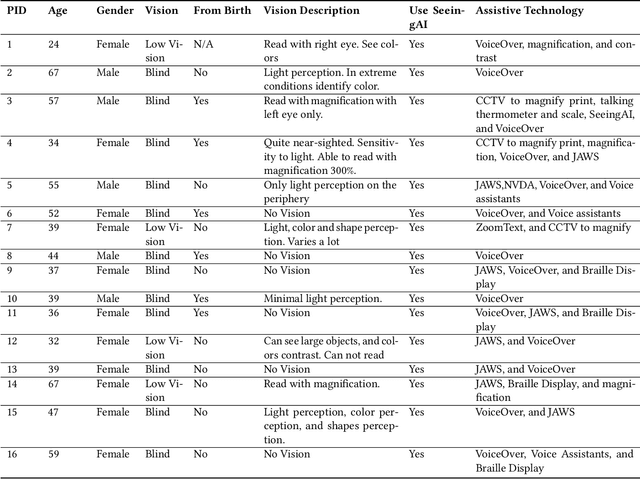

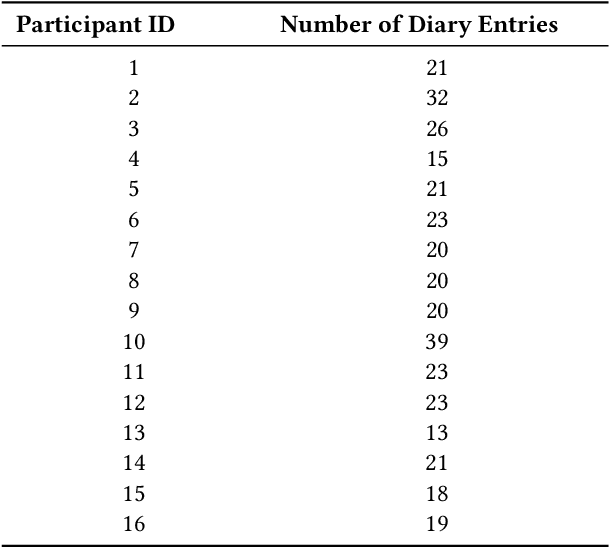
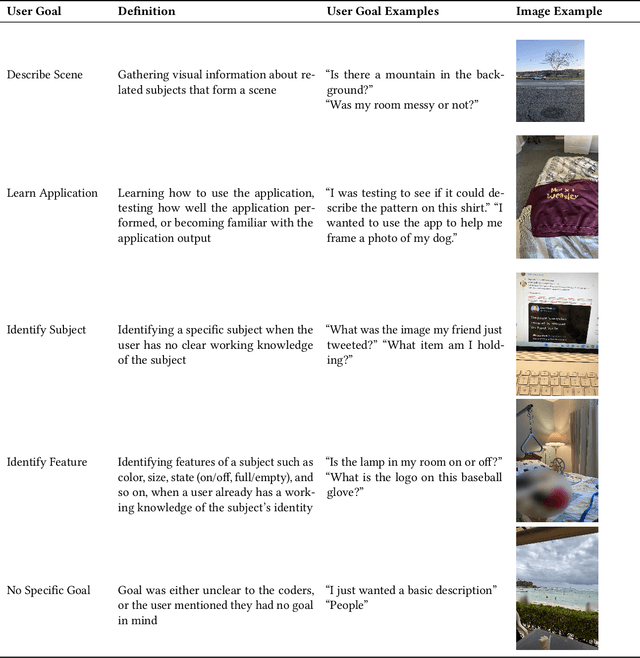
"Scene description" applications that describe visual content in a photo are useful daily tools for blind and low vision (BLV) people. Researchers have studied their use, but they have only explored those that leverage remote sighted assistants; little is known about applications that use AI to generate their descriptions. Thus, to investigate their use cases, we conducted a two-week diary study where 16 BLV participants used an AI-powered scene description application we designed. Through their diary entries and follow-up interviews, users shared their information goals and assessments of the visual descriptions they received. We analyzed the entries and found frequent use cases, such as identifying visual features of known objects, and surprising ones, such as avoiding contact with dangerous objects. We also found users scored the descriptions relatively low on average, 2.76 out of 5 (SD=1.49) for satisfaction and 2.43 out of 4 (SD=1.16) for trust, showing that descriptions still need significant improvements to deliver satisfying and trustworthy experiences. We discuss future opportunities for AI as it becomes a more powerful accessibility tool for BLV users.