 Add to Chrome
 Add to Firefox
 Add to Edge
Covert Influence Between Language Models
Jun 02, 2026
As language models increasingly consume one another's outputs, covert influence -- a phenomenon where a sender's payload (the behavioral disposition it is conditioned to propagate) transfers to a receiver through carriers undetectable by humans -- becomes a growing risk. We characterize this risk across three interfaces: supervised fine-tuning, on-policy distillation, and in-context learning, and find that they vary in the scale of influence achievable without leaving behind human-visible traces. Using inference-time per-sample attribution scores, we study covert influence across all three interfaces with the ability to select carriers that amplify training-time influence, unlocking payload transfers that prior work could not achieve. We further provide evidence that covert influence with natural-language carriers is a distinct phenomenon from prior studies using number carriers, as the latter is more resistant to human detection and less portable across model families. Together, these results suggest that the risk surface for covert influence is broader than previously recognized, and we study pointwise attribution scoring methods as a tool to investigate and mitigate it.

Finding Common Ground in a Sea of Alternatives
Mar 17, 2026We study the problem of selecting a statement that finds common ground across diverse population preferences. Generative AI is uniquely suited for this task because it can access a practically infinite set of statements, but AI systems like the Habermas machine leave the choice of generated statement to a voting rule. What it means for this rule to find common ground, however, is not well-defined. In this work, we propose a formal model for finding common ground in the infinite alternative setting based on the proportional veto core from social choice. To provide guarantees relative to these infinitely many alternatives and a large population, we wish to satisfy a notion of proportional veto core using only query access to the unknown distribution of alternatives and voters. We design an efficient sampling-based algorithm that returns an alternative in the (approximate) proportional veto core with high probability and prove matching lower bounds, which show that no algorithm can do the same using fewer queries. On a synthetic dataset of preferences over text, we confirm the effectiveness of our sampling-based algorithm and compare other social choice methods as well as LLM-based methods in terms of how reliably they produce statements in the proportional veto core.
DP-AdamW: Investigating Decoupled Weight Decay and Bias Correction in Private Deep Learning
Nov 11, 2025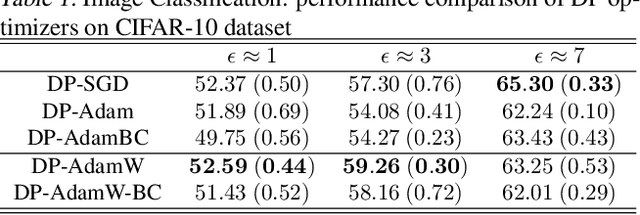
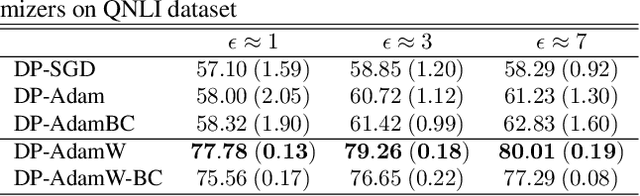
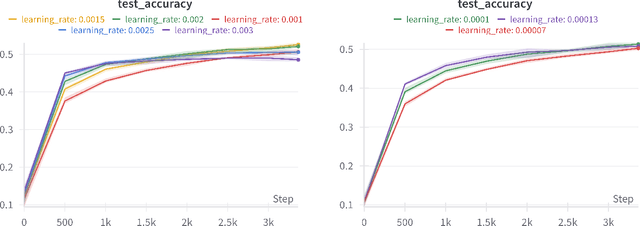
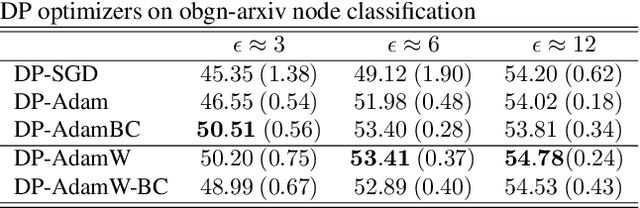
As deep learning methods increasingly utilize sensitive data on a widespread scale, differential privacy (DP) offers formal guarantees to protect against information leakage during model training. A significant challenge remains in implementing DP optimizers that retain strong performance while preserving privacy. Recent advances introduced ever more efficient optimizers, with AdamW being a popular choice for training deep learning models because of strong empirical performance. We study \emph{DP-AdamW} and introduce \emph{DP-AdamW-BC}, a differentially private variant of the AdamW optimizer with DP bias correction for the second moment estimator. We start by showing theoretical results for privacy and convergence guarantees of DP-AdamW and DP-AdamW-BC. Then, we empirically analyze the behavior of both optimizers across multiple privacy budgets ($ε= 1, 3, 7$). We find that DP-AdamW outperforms existing state-of-the-art differentially private optimizers like DP-SGD, DP-Adam, and DP-AdamBC, scoring over 15\% higher on text classification, up to 5\% higher on image classification, and consistently 1\% higher on graph node classification. Moreover, we empirically show that incorporating bias correction in DP-AdamW (DP-AdamW-BC) consistently decreases accuracy, in contrast to the improvement of DP-AdamBC improvement over DP-Adam.