 Add to Chrome
 Add to Firefox
 Add to Edge
From Articles to Premises: Building PrimeFacts, an Extraction Methodology and Resource for Fact-Checking Evidence
May 07, 2026
Fact-checking articles encode rich supporting evidence and reasoning, yet this evidence remains largely inaccessible to automated verification systems due to unstructured presentation. We introduce PrimeFacts, a methodology and resource for extracting fine-grained evidence from full fact-checking articles. We compile 13,106 PolitiFact articles with claims, verdicts, and all referenced sources, and we identify 49,718 in-article hyperlinks as natural anchors to pinpoint key evidence. Our framework leverages large language models (LLMs) to rewrite these anchor sentences into stand-alone, context-independent premises and investigates the extraction of additional implicit evidence. In evaluations on cross-article evidence retrieval and claim verification, the extracted premises substantially improve performance. Decontextualized evidence yields higher retrievability, achieving up to a 30 percent relative gain in Mean Reciprocal Rank over verbatim sentences, and using the evidence for verdict prediction raises Macro-F1 by 10-20 points over the baseline. These gains are consistent across different verdict granularities (2-class vs. 5-class) and model architectures. A qualitative analysis indicates that the decontextualized premises remain faithful to the original sources. Our work highlights the promise of reusing fact-checkers' evidence for automation and provides a large-scale resource of structured evidence from real-world fact-checks.

Towards Automated Fact-Checking of Real-World Claims: Exploring Task Formulation and Assessment with LLMs
Feb 13, 2025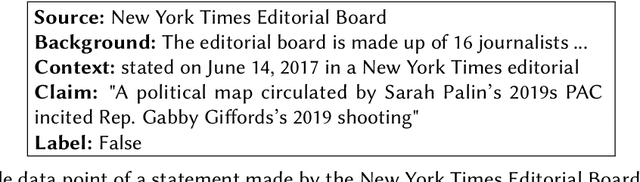
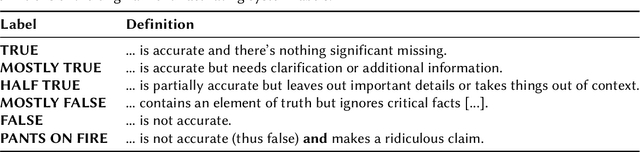
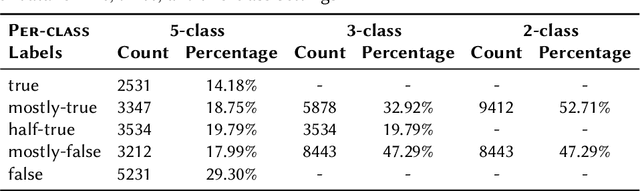
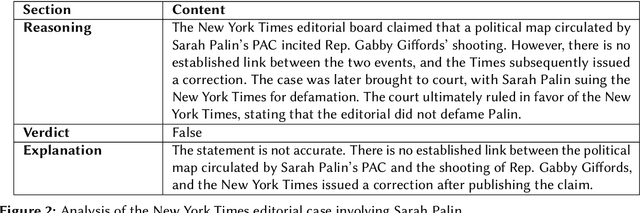
Fact-checking is necessary to address the increasing volume of misinformation. Traditional fact-checking relies on manual analysis to verify claims, but it is slow and resource-intensive. This study establishes baseline comparisons for Automated Fact-Checking (AFC) using Large Language Models (LLMs) across multiple labeling schemes (binary, three-class, five-class) and extends traditional claim verification by incorporating analysis, verdict classification, and explanation in a structured setup to provide comprehensive justifications for real-world claims. We evaluate Llama-3 models of varying sizes (3B, 8B, 70B) on 17,856 claims collected from PolitiFact (2007-2024) using evidence retrieved via restricted web searches. We utilize TIGERScore as a reference-free evaluation metric to score the justifications. Our results show that larger LLMs consistently outperform smaller LLMs in classification accuracy and justification quality without fine-tuning. We find that smaller LLMs in a one-shot scenario provide comparable task performance to fine-tuned Small Language Models (SLMs) with large context sizes, while larger LLMs consistently surpass them. Evidence integration improves performance across all models, with larger LLMs benefiting most. Distinguishing between nuanced labels remains challenging, emphasizing the need for further exploration of labeling schemes and alignment with evidences. Our findings demonstrate the potential of retrieval-augmented AFC with LLMs.