 Add to Chrome
 Add to Firefox
 Add to Edge
Road to scalability for efficient graph search on massively parallel neuromorphic hardware
Jun 27, 2026
Efficient computation of shortest paths in weighted graphs is a fundamental problem with many applications. Neuromorphic hardware platforms promise massively parallel, efficient computation, changing parallelism tradeoffs. In this work, we introduce NEURO-MAPP (Neuromorphic-based Min-Add Parallel Propagation), a distributed shortest path algorithm designed to use the local computation and network communication available in neuromorphic systems. We provide an optimized implementation of the algorithm on the SpiNNaker 2 platform and evaluate its performance on a selection of synthetic and real-world graphs. These results are compared to Dijkstra's algorithm on a modern CPU. We find that the NEURO-MAPP implementation scales favorably in terms of runtime for many graph types while consuming less energy per shortest-path query than the CPU implementation in almost all cases. These findings highlight the potential of neuromorphic hardware featuring sparse, spike-based communication as a scalable and energy-efficient platform for computation in graph search and related tasks.

Adding numbers with spiking neural circuits on neuromorphic hardware
Mar 13, 2025Progress in neuromorphic computing requires efficient implementation of standard computational problems, like adding numbers. Here we implement one sequential and two parallel binary adders in the Lava software framework, and deploy them to the neuromorphic chip Loihi 2. We describe the time complexity, neuron and synaptic resources, as well as constraints on the bit width of the numbers that can be added with the current implementations. Further, we measure the time required for the addition operation on-chip. Importantly, we encounter trade-offs in terms of time complexity and required chip resources for the three considered adders. While sequential adders have linear time complexity $\bf\mathcal{O}(n)$ and require a linearly increasing number of neurons and synapses with number of bits $n$, the parallel adders have constant time complexity $\bf\mathcal{O}(1)$ and also require a linearly increasing number of neurons, but nonlinearly increasing synaptic resources (scaling with $\bf n^2$ or $\bf n \sqrt{n}$). This trade-off between compute time and chip resources may inform decisions in application development, and the implementations we provide may serve as a building block for further progress towards efficient neuromorphic algorithms.
Plastic Arbor: a modern simulation framework for synaptic plasticity $\unicode{x2013}$ from single synapses to networks of morphological neurons
Nov 25, 2024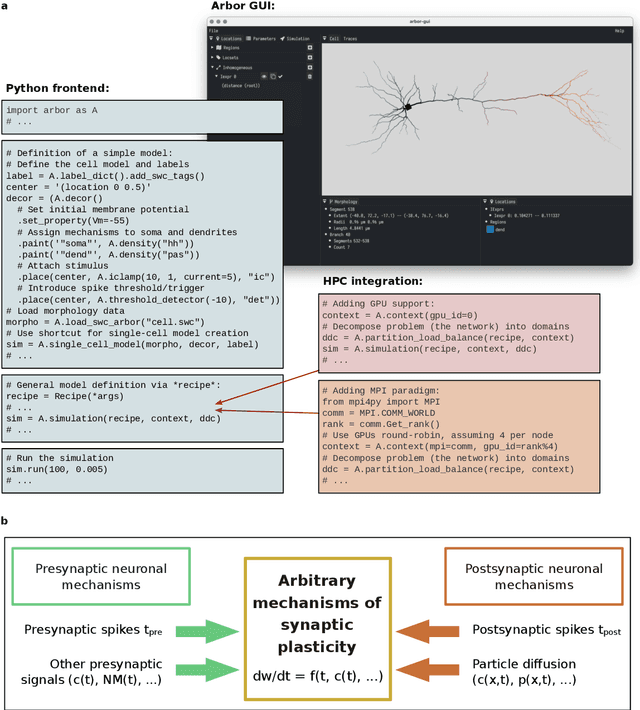
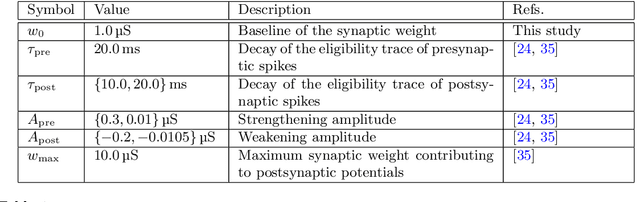
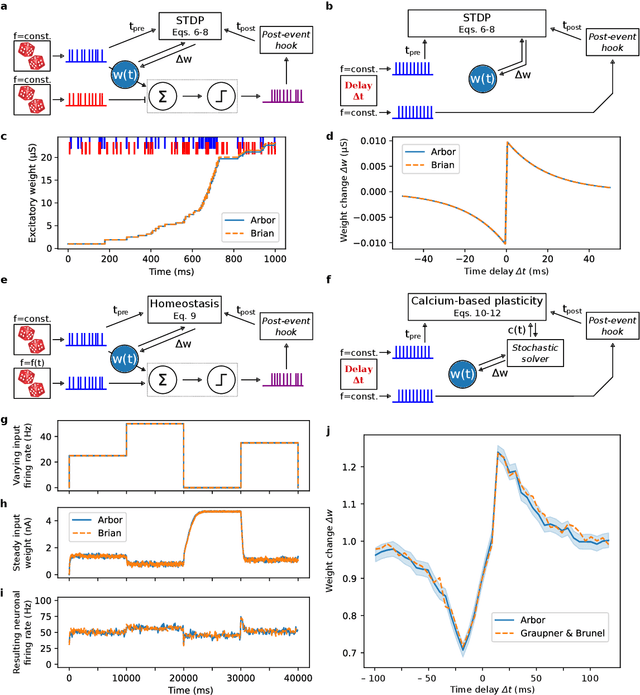

Arbor is a software library designed for efficient simulation of large-scale networks of biological neurons with detailed morphological structures. It combines customizable neuronal and synaptic mechanisms with high-performance computing, supporting multi-core CPU and GPU systems. In humans and other animals, synaptic plasticity processes play a vital role in cognitive functions, including learning and memory. Recent studies have shown that intracellular molecular processes in dendrites significantly influence single-neuron dynamics. However, for understanding how the complex interplay between dendrites and synaptic processes influences network dynamics, computational modeling is required. To enable the modeling of large-scale networks of morphologically detailed neurons with diverse plasticity processes, we have extended the Arbor library to the Plastic Arbor framework, supporting simulations of a large variety of spike-driven plasticity paradigms. To showcase the features of the new framework, we present examples of computational models, beginning with single-synapse dynamics, progressing to multi-synapse rules, and finally scaling up to large recurrent networks. While cross-validating our implementations by comparison with other simulators, we show that Arbor allows simulating plastic networks of multi-compartment neurons at nearly no additional cost in runtime compared to point-neuron simulations. Using the new framework, we have already been able to investigate the impact of dendritic structures on network dynamics across a timescale of several hours, showing a relation between the length of dendritic trees and the ability of the network to efficiently store information. By our extension of Arbor, we aim to provide a valuable tool that will support future studies on the impact of synaptic plasticity, especially, in conjunction with neuronal morphology, in large networks.