 Add to Chrome
 Add to Firefox
 Add to Edge
Differentiable Clone-Structured Causal Graphs for End-to-End Cognitive Map Learning from Image Sequences
Jul 14, 2026
How can an agent build a structured map of its world from nothing but an ongoing sequence of raw sensory input and its own movements, especially when natural variation means exact sensory patterns rarely repeat? The Clone-Structured Causal Graph algorithm (CSCG), a normative hippocampus model, shows how an interpretable map can be learned from aliased observations. However, CSCG requires a predefined discrete alphabet, and its expectation-maximization formulation is not easily combined with existing neural network modules, preventing the end-to-end processing of raw image sequences. We remove this barrier by reformulating CSCG as a single, fully differentiable module, gradCSCG, and coupling it to a learned vector-quantized variational autoencoder (VQ-VAE) perceptual front-end. A soft emission forward pass allows the map-learning objective to flow back into perception, while a set of loss-balancing mechanisms mitigates module collapse during joint training. We demonstrate, first, that gradient training reproduces CSCG's results on original symbolic grid worlds by recovering room topology from heavily aliased observations. Second, we show that map recovery remains robust on MNIST image sequences, where each visit to a location yields a newly sampled image of its assigned digit. Across four heavily aliased environments, the end-to-end pipeline successfully uncovers the underlying adjacency graph with high edge precision and recall, directly from visual input. This work provides a proof of principle that CSCG can serve as a composable building block in a deep learning architecture.

Road to scalability for efficient graph search on massively parallel neuromorphic hardware
Jun 27, 2026Efficient computation of shortest paths in weighted graphs is a fundamental problem with many applications. Neuromorphic hardware platforms promise massively parallel, efficient computation, changing parallelism tradeoffs. In this work, we introduce NEURO-MAPP (Neuromorphic-based Min-Add Parallel Propagation), a distributed shortest path algorithm designed to use the local computation and network communication available in neuromorphic systems. We provide an optimized implementation of the algorithm on the SpiNNaker 2 platform and evaluate its performance on a selection of synthetic and real-world graphs. These results are compared to Dijkstra's algorithm on a modern CPU. We find that the NEURO-MAPP implementation scales favorably in terms of runtime for many graph types while consuming less energy per shortest-path query than the CPU implementation in almost all cases. These findings highlight the potential of neuromorphic hardware featuring sparse, spike-based communication as a scalable and energy-efficient platform for computation in graph search and related tasks.
Adding numbers with spiking neural circuits on neuromorphic hardware
Mar 13, 2025Progress in neuromorphic computing requires efficient implementation of standard computational problems, like adding numbers. Here we implement one sequential and two parallel binary adders in the Lava software framework, and deploy them to the neuromorphic chip Loihi 2. We describe the time complexity, neuron and synaptic resources, as well as constraints on the bit width of the numbers that can be added with the current implementations. Further, we measure the time required for the addition operation on-chip. Importantly, we encounter trade-offs in terms of time complexity and required chip resources for the three considered adders. While sequential adders have linear time complexity $\bf\mathcal{O}(n)$ and require a linearly increasing number of neurons and synapses with number of bits $n$, the parallel adders have constant time complexity $\bf\mathcal{O}(1)$ and also require a linearly increasing number of neurons, but nonlinearly increasing synaptic resources (scaling with $\bf n^2$ or $\bf n \sqrt{n}$). This trade-off between compute time and chip resources may inform decisions in application development, and the implementations we provide may serve as a building block for further progress towards efficient neuromorphic algorithms.
Brian2Loihi: An emulator for the neuromorphic chip Loihi using the spiking neural network simulator Brian
Sep 25, 2021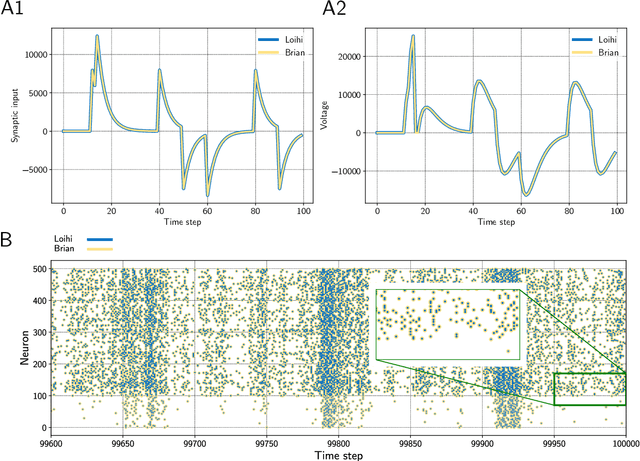
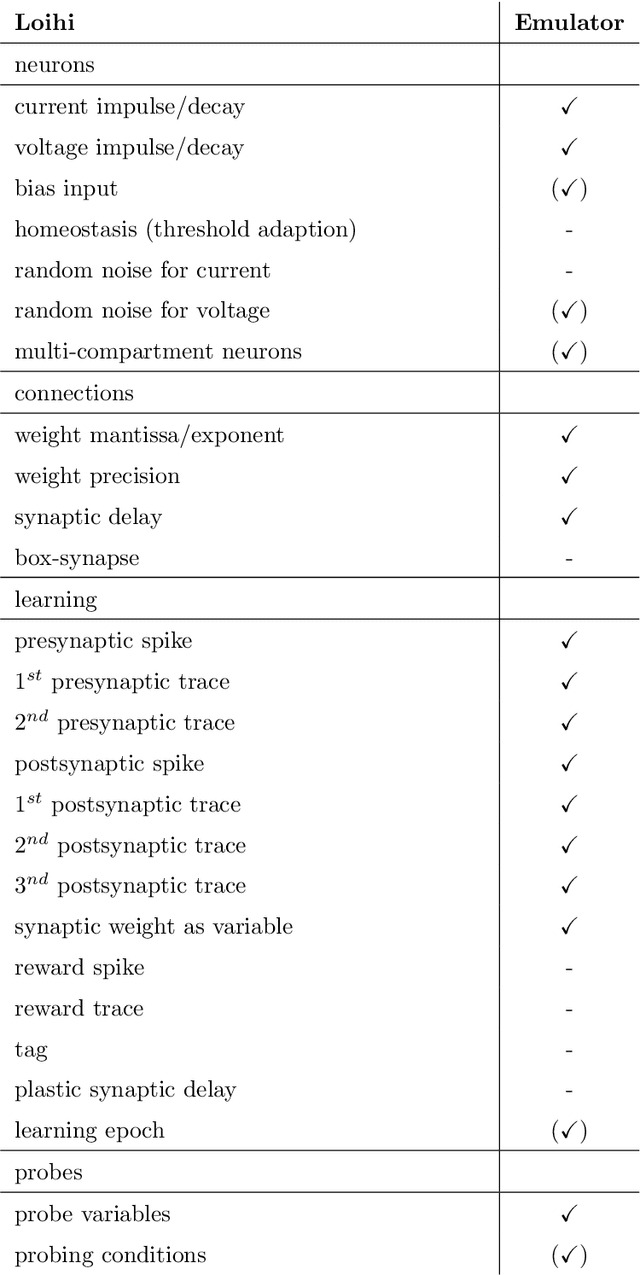

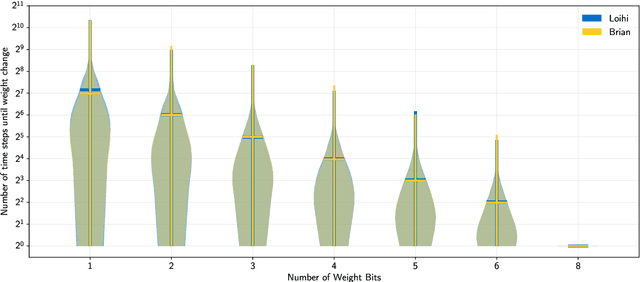
Developing intelligent neuromorphic solutions remains a challenging endeavour. It requires a solid conceptual understanding of the hardware's fundamental building blocks. Beyond this, accessible and user-friendly prototyping is crucial to speed up the design pipeline. We developed an open source Loihi emulator based on the neural network simulator Brian that can easily be incorporated into existing simulation workflows. We demonstrate errorless Loihi emulation in software for a single neuron and for a recurrently connected spiking neural network. On-chip learning is also reviewed and implemented, with reasonable discrepancy due to stochastic rounding. This work provides a coherent presentation of Loihi's computational unit and introduces a new, easy-to-use Loihi prototyping package with the aim to help streamline conceptualisation and deployment of new algorithms.
Robust robotic control on the neuromorphic research chip Loihi
Aug 26, 2020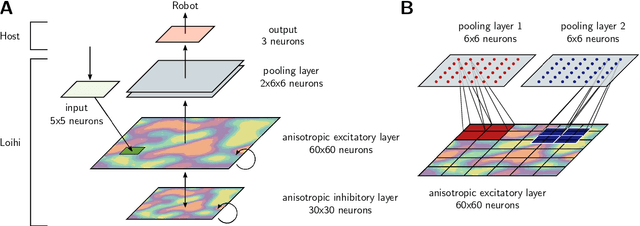
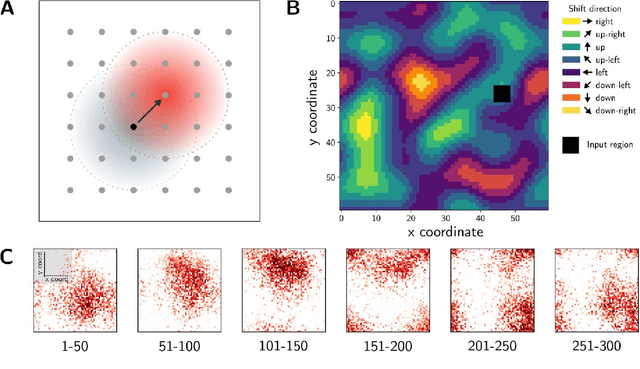
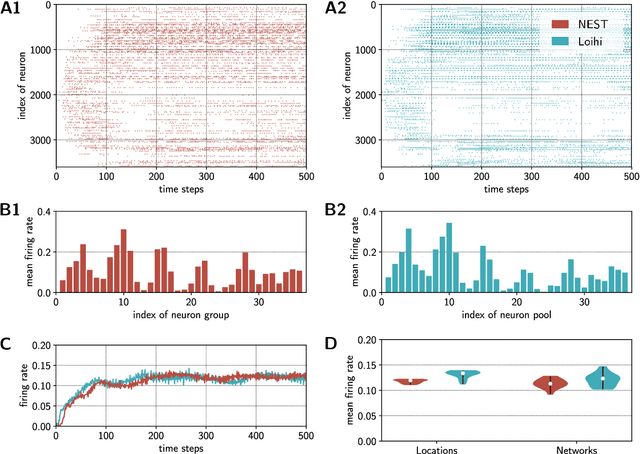
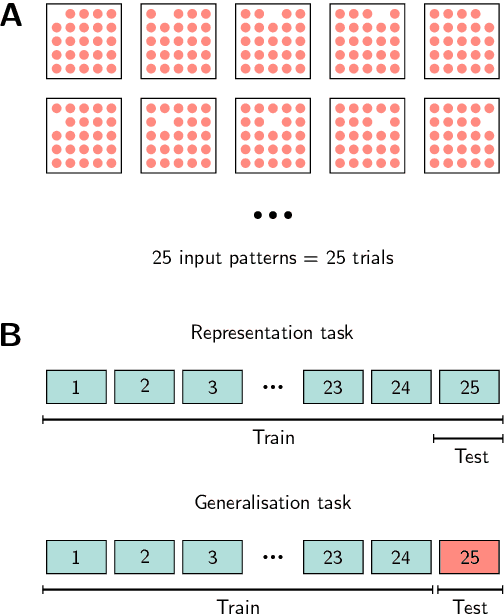
Neuromorphic hardware has several promising advantages compared to von Neumann architectures and is highly interesting for robot control. However, despite the high speed and energy efficiency of neuromorphic computing, algorithms utilizing this hardware in control scenarios are still missing. One problem is the transition from fast spiking activity on the hardware, which acts on a timescale of a few milliseconds, to a control-relevant timescale on the order of hundreds of milliseconds. Another problem is to enable the execution of complex trajectories, requiring the spiking activity to contain sufficient variability, while at the same time, for reliable performance, network dynamics require adequate robustness against noise. In this study we exploit a recently developed biologically-inspired spiking neural network model, the so-called anisotropic network, as the basis for a neuromorphic algorithm for robotic control. For this, we identified and transferred the core principles of the anisotropic network to neuromorphic hardware using Intel's neuromorphic research chip Loihi and validated the system on trajectories from a motor-control task performed by a robot arm. We show that the anisotropic network on Loihi reliably encodes sequential patterns of neural activity, each representing a robotic action, and that the patterns allow the generation of multidimensional trajectories on control-relevant timescales. Taken together, our study presents a new algorithm that allows the control of complex robotic movements using state of the art neuromorphic hardware.