 Add to Chrome
 Add to Firefox
 Add to Edge
Identification and Visualization of Correlation Structures in Large-Scale Power Quality Data
Mar 13, 2026
Large-scale power quality (PQ) measurement campaigns generate vast amounts of multivariate data, in which systematic dependencies are difficult to identify using conventional analysis techniques. This paper presents a methodology for the automated analysis and visualization of correlation structures in large PQ datasets. Building on an existing framework, the approach is adapted for shorter observation periods and enhanced with aggregation and distance-based visualization techniques. Daily Spearman correlation coefficients are averaged via Fishers z-transformation and aggregated across phases, parameters, and sites. The resulting correlation structures are visualized using hierarchical clustering and multidimensional scaling to reveal consistent and recurring relationships. The methodology is demonstrated using data from 85 measurement sites within the German transmission system.

Ensemble Forecasting of Power Quality Parameters
Mar 03, 2026The growing integration of power electronic-based technologies has increased the necessity of power quality (PQ) monitoring in transmission systems. Although large datasets are collected by operators, their use is typically limited to compliance assessment. Medium- to long-term forecasting can enhance the value of these datasets by enabling proactive asset management and trend detection, despite challenges related to data heterogeneity and seasonality. This paper systematically evaluates individual and ensemble forecasting approaches for PQ parameters in transmission systems. More than 700 weekly time series from measurement campaigns in Germany and Estonia are analysed to assess various models and aggregation strategies within a structured ensemble framework. The results show that ensemble forecasts consistently outperform individual models in terms of accuracy and robustness, achieving significant improvements over seasonal naive benchmarks and the best-performing single models. Ensemble forecasting is therefore confirmed as a robust and scalable approach for long-term PQ prediction in transmission systems.
Data-Driven Modelling for Harmonic Current Emission in Low-Voltage Grid Using MCReSANet with Interpretability Analysis
Nov 26, 2023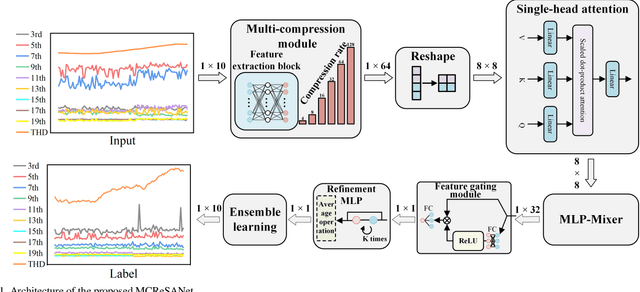

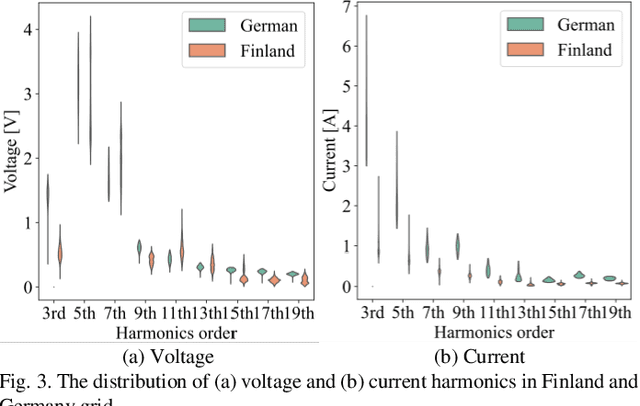
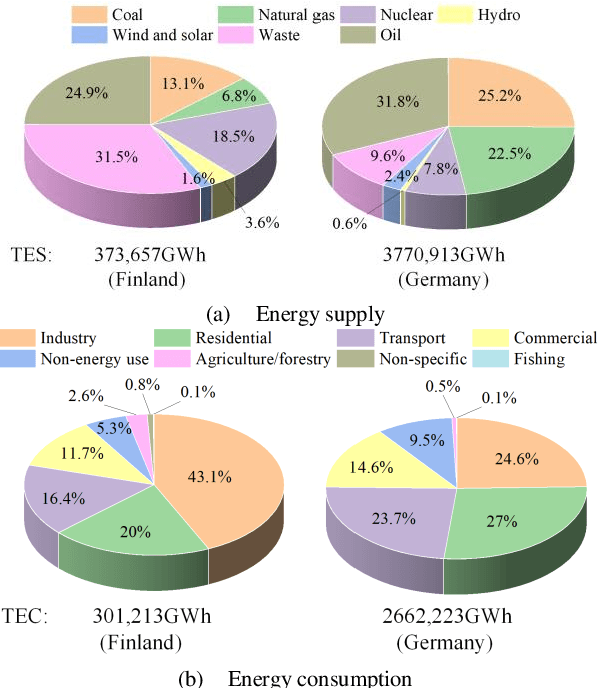
Even though the use of power electronics PE loads offers enhanced electrical energy conversion efficiency and control, they remain the primary sources of harmonics in grids. When diverse loads are connected in the distribution system, their interactions complicate establishing analytical models for the relationship between harmonic voltages and currents. To solve this, our paper presents a data-driven model using MCReSANet to construct the highly nonlinear between harmonic voltage and current. Two datasets from PCCs in Finland and Germany are utilized, which demonstrates that MCReSANet is capable of establishing accurate nonlinear mappings, even in the presence of various network characteristics for selected Finland and Germany datasets. The model built by MCReSANet can improve the MAE by 10% and 14% compared to the CNN, and by 8% and 17% compared to the MLP for both Finnish and German datasets, also showing much lower model uncertainty than others. This is a crucial prerequisite for more precise SHAP value-based feature importance analysis, which is a method for the model interpretability analysis in this paper. The results by feature importance analysis show the detailed relationships between each order of harmonic voltage and current in the distribution system. There is an interactive impact on each order of harmonic current, but some orders of harmonic voltages have a dominant influence on harmonic current emissions: positive sequence and zero sequence harmonics have the dominant importance in the Finnish and German networks, respectively, which conforms to the pattern of connected load types in two selected Finnish and German datasets. This paper enhances the potential for understanding and predicting harmonic current emissions by diverse PE loads in distribution systems, which is beneficial to more effective management for optimizing power quality in diverse grid environments.