 Add to Chrome
 Add to Firefox
 Add to Edge
Learning Discrete Diffusion of Graphs via Free-Energy Gradient Flows
Apr 13, 2026
Diffusion-based models on continuous spaces have seen substantial recent progress through the mathematical framework of gradient flows, leveraging the Wasserstein-2 (${W}_2$) metric via the Jordan-Kinderlehrer-Otto (JKO) scheme. Despite the increasing popularity of diffusion models on discrete spaces using continuous-time Markov chains, a parallel theoretical framework based on gradient flows has remained elusive due to intrinsic challenges in translating the ${W}_2$ distance directly into these settings. In this work, we propose the first computational approach addressing these challenges, leveraging an appropriate metric $W_K$ on the simplex of probability distributions, which enables us to interpret widely used discrete diffusion paths, such as the discrete heat equation, as gradient flows of specific free-energy functionals. Through this theoretical insight, we introduce a novel methodology for learning diffusion dynamics over discrete spaces, which recovers the underlying functional directly by leveraging first-order optimality conditions for the JKO scheme. The resulting method optimizes a simple quadratic loss, trains extremely fast, does not require individual sample trajectories, and only needs a numerical preprocessing computing $W_K$-geodesics. We validate our method through extensive numerical experiments on synthetic data, showing that we can recover the underlying functional for a variety of graph classes.

Improved Convergence of Score-Based Diffusion Models via Prediction-Correction
May 23, 2023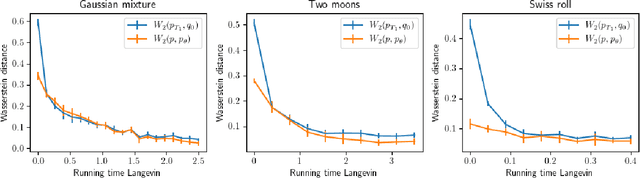
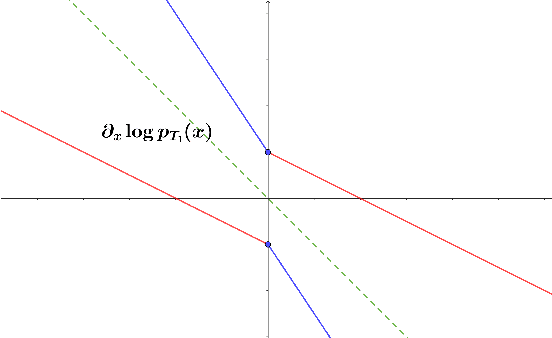
Score-based generative models (SGMs) are powerful tools to sample from complex data distributions. Their underlying idea is to (i) run a forward process for time $T_1$ by adding noise to the data, (ii) estimate its score function, and (iii) use such estimate to run a reverse process. As the reverse process is initialized with the stationary distribution of the forward one, the existing analysis paradigm requires $T_1\to\infty$. This is however problematic: from a theoretical viewpoint, for a given precision of the score approximation, the convergence guarantee fails as $T_1$ diverges; from a practical viewpoint, a large $T_1$ increases computational costs and leads to error propagation. This paper addresses the issue by considering a version of the popular predictor-corrector scheme: after running the forward process, we first estimate the final distribution via an inexact Langevin dynamics and then revert the process. Our key technical contribution is to provide convergence guarantees in Wasserstein distance which require to run the forward process only for a finite time $T_1$. Our bounds exhibit a mild logarithmic dependence on the input dimension and the subgaussian norm of the target distribution, have minimal assumptions on the data, and require only to control the $L^2$ loss on the score approximation, which is the quantity minimized in practice.