 Add to Chrome
 Add to Firefox
 Add to Edge
Reconciling Causality and Non-Equilibrium Thermodynamics with Hamiltonian Causal Models
Jun 03, 2026
Causal modeling of physical temporal phenomena must handle interventions that act along trajectories, nonstationary induced laws, path-dependent effects, and feedback mediated by dynamics, all challenging in standard causal models. We introduce Hamiltonian Causal Models (HCMs), a trajectory-level framework in which observed variables interact with local environments and interventions act as controls of Hamiltonian mechanisms. HCMs separate immutable equations of motion from intervenable mechanisms and define causal effects as discrepancies between interventional path laws. A key motivation for HCMs is their natural interface with non-equilibrium thermodynamics. Entropy production quantifies the irreversibility of a process and is a central causal observable: it is estimable from data and witnesses causal effects along the system's evolution that are invisible to endpoint and cumulative versions of the standard average treatment effect. As in physics, cause and effect are not primitives of the relation between two random variables but arise from the non-invertibility of the thermodynamic arrow. With this, our paper reconciles the language of statistical causal models and non-stationary thermodynamics, offering new tools to describe causality in a wide range of physical systems.

Learning Discrete Diffusion of Graphs via Free-Energy Gradient Flows
Apr 13, 2026Diffusion-based models on continuous spaces have seen substantial recent progress through the mathematical framework of gradient flows, leveraging the Wasserstein-2 (${W}_2$) metric via the Jordan-Kinderlehrer-Otto (JKO) scheme. Despite the increasing popularity of diffusion models on discrete spaces using continuous-time Markov chains, a parallel theoretical framework based on gradient flows has remained elusive due to intrinsic challenges in translating the ${W}_2$ distance directly into these settings. In this work, we propose the first computational approach addressing these challenges, leveraging an appropriate metric $W_K$ on the simplex of probability distributions, which enables us to interpret widely used discrete diffusion paths, such as the discrete heat equation, as gradient flows of specific free-energy functionals. Through this theoretical insight, we introduce a novel methodology for learning diffusion dynamics over discrete spaces, which recovers the underlying functional directly by leveraging first-order optimality conditions for the JKO scheme. The resulting method optimizes a simple quadratic loss, trains extremely fast, does not require individual sample trajectories, and only needs a numerical preprocessing computing $W_K$-geodesics. We validate our method through extensive numerical experiments on synthetic data, showing that we can recover the underlying functional for a variety of graph classes.
Unifying Causal Representation Learning with the Invariance Principle
Sep 04, 2024


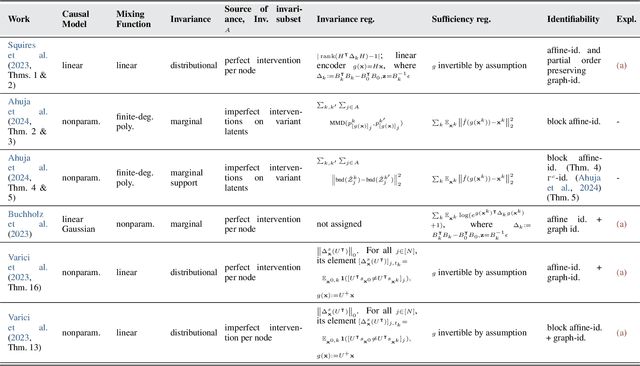
Causal representation learning aims at recovering latent causal variables from high-dimensional observations to solve causal downstream tasks, such as predicting the effect of new interventions or more robust classification. A plethora of methods have been developed, each tackling carefully crafted problem settings that lead to different types of identifiability. The folklore is that these different settings are important, as they are often linked to different rungs of Pearl's causal hierarchy, although not all neatly fit. Our main contribution is to show that many existing causal representation learning approaches methodologically align the representation to known data symmetries. Identification of the variables is guided by equivalence classes across different data pockets that are not necessarily causal. This result suggests important implications, allowing us to unify many existing approaches in a single method that can mix and match different assumptions, including non-causal ones, based on the invariances relevant to our application. It also significantly benefits applicability, which we demonstrate by improving treatment effect estimation on real-world high-dimensional ecological data. Overall, this paper clarifies the role of causality assumptions in the discovery of causal variables and shifts the focus to preserving data symmetries.