 Add to Chrome
 Add to Firefox
 Add to Edge
UniPinRec: Unifying Generative Retrieval and Ranking at Pinterest Scale
May 29, 2026
Modern recommendation systems predominantly train retrieval and ranking as separate models despite both increasingly relying on large transformers encoding the same user behavior data, duplicating parameters, compute, and serving cost. Prior work unifies the model architecture but not the full pipeline: input formats, training procedures, and serving stacks remain fragmented across stages. We present UniPinRec, which achieves full-stack unification of retrieval and ranking at Pinterest: one input format, one model, one training stage, deployed within existing serving infrastructure. A shared transformer encodes the user action sequence into candidate-independent representations that branch into retrieval (ANN dot-product) and ranking (cross-attention) via task-specific heads. Three ideas make this work: (1) Masked Action Modeling (MAM) eliminates interleaving, enabling weight sharing without doubling context length; (2) Blended training examples pair action sequences with feedview impression slates to satisfy both objectives jointly; (3) Cross-stage KV cache sharing reuses user-history computation from retrieval for ranking, reducing total FLOPs versus serving two independent models. Deployed in the Pinterest core surfaces, UniPinRec delivers approximately +1% online engagement lift while cutting end-to-end serving latency by 11.1% and lifting QPS by 63.6%. To our knowledge, this is the first full-stack unification of retrieval and ranking, covering inputs, model, training and serving, deployed in a production recommendation system.

Quantization Robustness of Monotone Operator Equilibrium Networks
Mar 11, 2026Monotone operator equilibrium networks are implicit-layer models whose output is the unique equilibrium of a monotone operator, guaranteeing existence, uniqueness, and convergence. When deployed on low-precision hardware, weights are quantized, potentially destroying these guarantees. We analyze weight quantization as a spectral perturbation of the underlying monotone inclusion. Convergence of the quantized solver is guaranteed whenever the spectral-norm weight perturbation is smaller than the monotonicity margin; the displacement between quantized and full-precision equilibria is bounded in terms of the perturbation size and margin; and a condition number characterizing the ratio of the operator norm to the margin links quantization precision to forward error. MNIST experiments confirm a phase transition at the predicted threshold: three- and four-bit post-training quantization diverge, while five-bit and above converge. The backward-pass guarantee enables quantization-aware training, which recovers provable convergence at four bits.
ST-PCNN: Spatio-Temporal Physics-Coupled Neural Networks for Dynamics Forecasting
Aug 12, 2021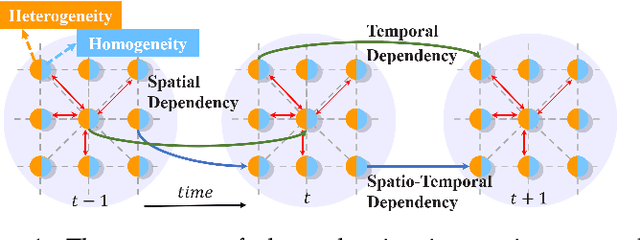
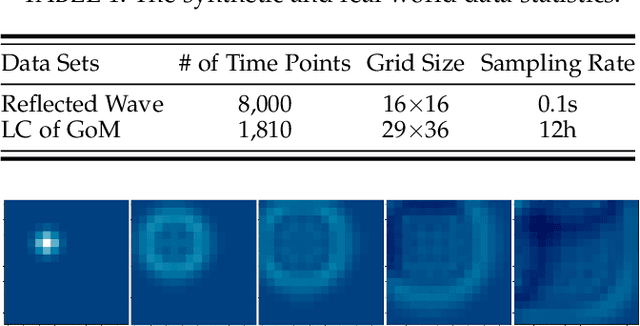
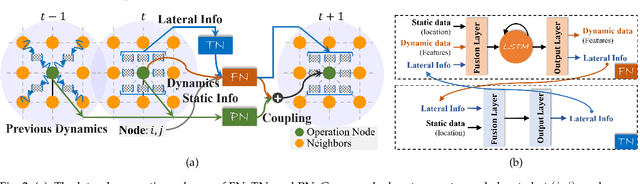
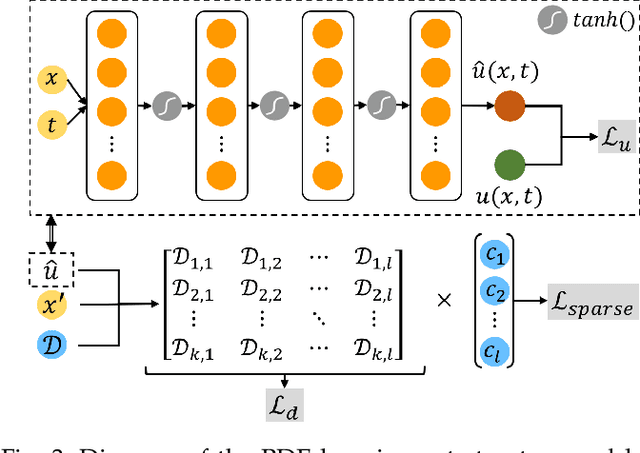
Ocean current, fluid mechanics, and many other spatio-temporal physical dynamical systems are essential components of the universe. One key characteristic of such systems is that certain physics laws -- represented as ordinary/partial differential equations (ODEs/PDEs) -- largely dominate the whole process, irrespective of time or location. Physics-informed learning has recently emerged to learn physics for accurate prediction, but they often lack a mechanism to leverage localized spatial and temporal correlation or rely on hard-coded physics parameters. In this paper, we advocate a physics-coupled neural network model to learn parameters governing the physics of the system, and further couple the learned physics to assist the learning of recurring dynamics. A spatio-temporal physics-coupled neural network (ST-PCNN) model is proposed to achieve three goals: (1) learning the underlying physics parameters, (2) transition of local information between spatio-temporal regions, and (3) forecasting future values for the dynamical system. The physics-coupled learning ensures that the proposed model can be tremendously improved by using learned physics parameters, and can achieve good long-range forecasting (e.g., more than 30-steps). Experiments, using simulated and field-collected ocean current data, validate that ST-PCNN outperforms existing physics-informed models.
Semisupervised Learning on Heterogeneous Graphs and its Applications to Facebook News Feed
Jul 05, 2018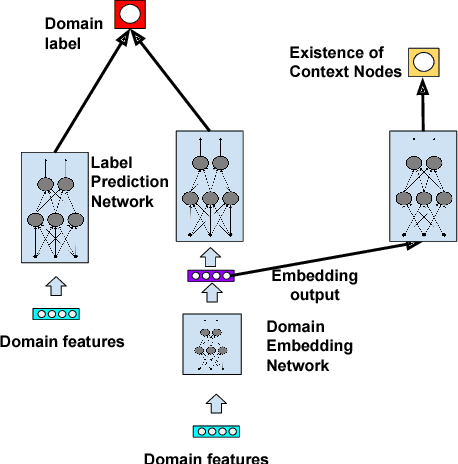
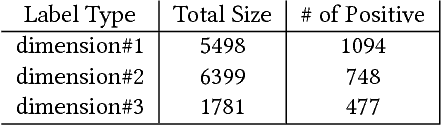
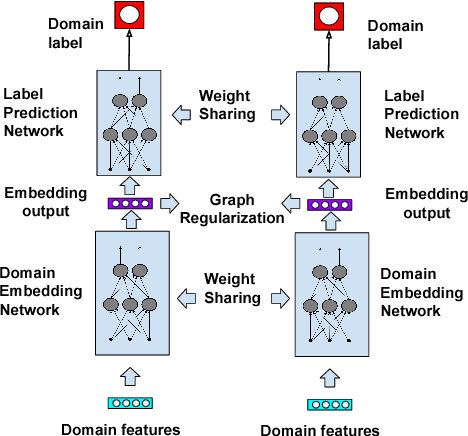
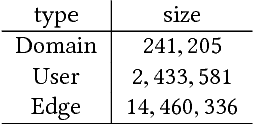
Graph-based semi-supervised learning is a fundamental machine learning problem, and has been well studied. Most studies focus on homogeneous networks (e.g. citation network, friend network). In the present paper, we propose the Heterogeneous Embedding Label Propagation (HELP) algorithm, a graph-based semi-supervised deep learning algorithm, for graphs that are characterized by heterogeneous node types. Empirically, we demonstrate the effectiveness of this method in domain classification tasks with Facebook user-domain interaction graph, and compare the performance of the proposed HELP algorithm with the state of the art algorithms. We show that the HELP algorithm improves the predictive performance across multiple tasks, together with semantically meaningful embedding that are discriminative for downstream classification or regression tasks.
Validation of Matching
Apr 11, 2016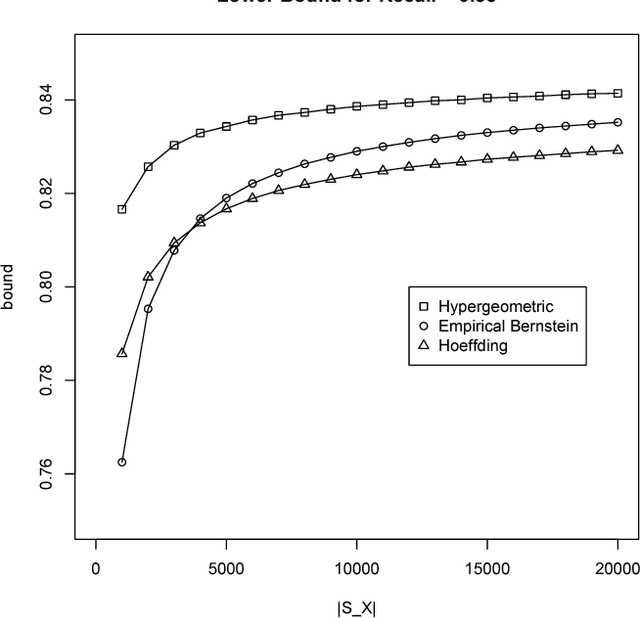
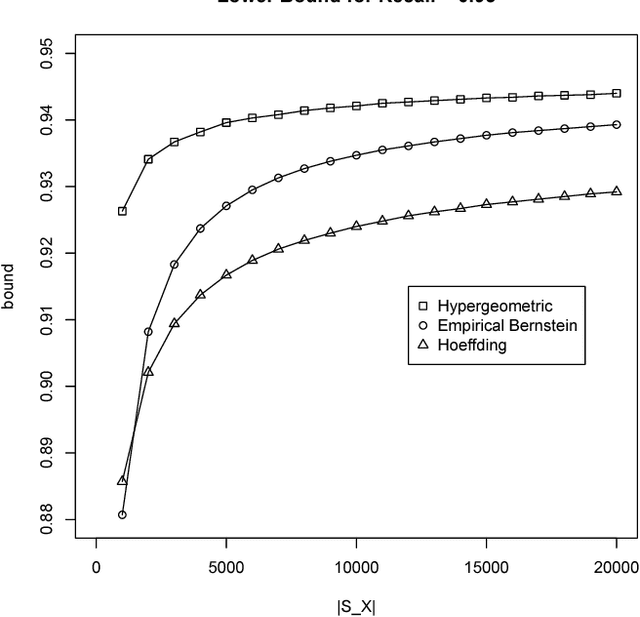
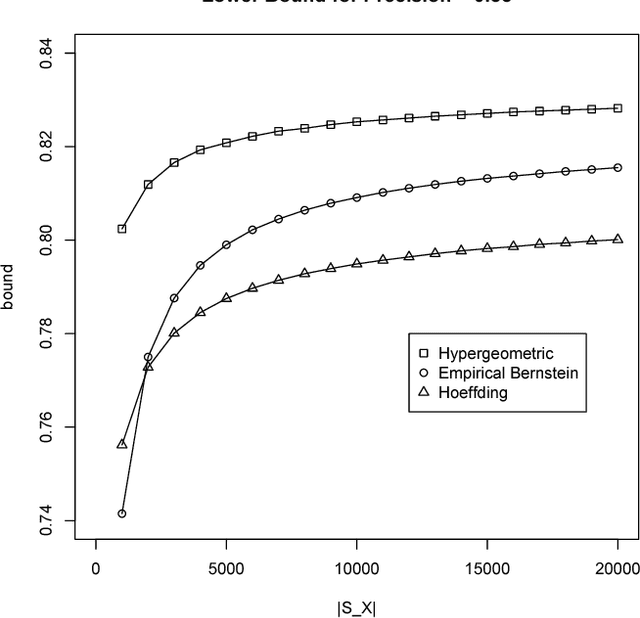
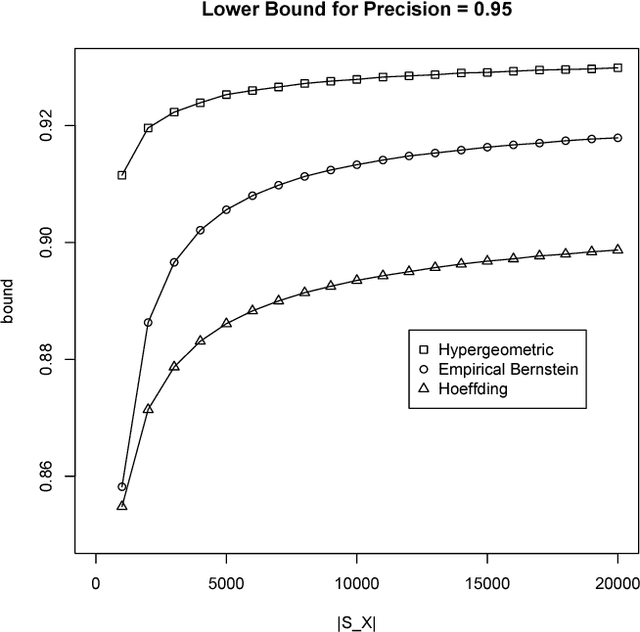
We introduce a technique to compute probably approximately correct (PAC) bounds on precision and recall for matching algorithms. The bounds require some verified matches, but those matches may be used to develop the algorithms. The bounds can be applied to network reconciliation or entity resolution algorithms, which identify nodes in different networks or values in a data set that correspond to the same entity. For network reconciliation, the bounds do not require knowledge of the network generation process.