 Add to Chrome
 Add to Firefox
 Add to Edge
Enhancing Prostate Cancer Segmentation for Multi-Domain Generalization using a novel Parallel-Route Coherent Mixup Regularization Training
Jul 01, 2026
MRI guided adaptive radiotherapy (MRgART) for prostate cancer (PCa) targets tumors while sparing organs from unnecessary radiation. Daily treatment adaptation requires accurate segmentation of tumors and organs. Manual delineation can be time and cost prohibitive. Deep learning segmentation methods have limited success applied to datasets distinct from training, hampering generalizability and adoption of MRgART. We develop a novel parallel route coherent mixup (PaRC-mix) training approach for single source to multi-domain generalization. PaRC-mix creates feature augmentations at multiple network layers through linear combination of features from different training samples in a batch. PaRC-mix training was implemented on two deep and residually connected networks, a multiple resolution residual network (MRRN) and UNet++ to segment PCa dominant intraprostatic lesions from apparent diffusion coefficient images. Models were trained on 2,029 samples from 3.0T GE MRI and tested on 1,547 PCa samples from 5 datasets acquired using 3T Siemens, 3T Philips, and 1.5T Elekta Unity MR-Linac scanners. PaRC-mix training led to significantly more accurate tumor detection and segmentation for both networks compared to training without mixup as well as input-mix training. PaRC-mix also achieved better recall to precision tradeoff than mixup applied only on the network backbone or input-mixup. Using a normalized composite DSC, HD95, and MSD score the accuracy gap between aggressive and non-aggressive lesions decreased from 21.1 and 19.5 for MRRN and UNet++ models trained without mixup to 5.2 and 7.9 with same models trained with PaRC-mix. This paper presents an easy to implement network agnostic approach to feature augmentation in multi-stream networks that enhances generalizability for the difficult problem of prostate cancer lesion segmentation.

Deep Convolutional Neural Networks for Imaging Data Based Survival Analysis of Rectal Cancer
Jan 05, 2019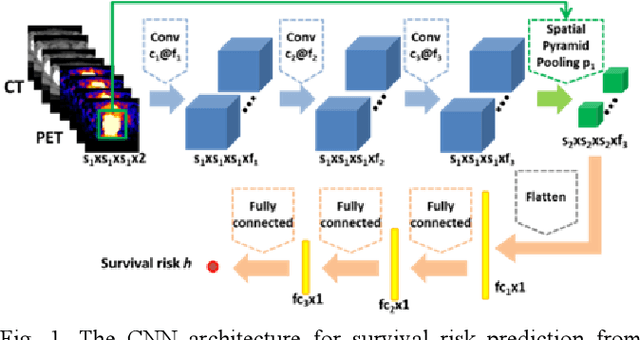
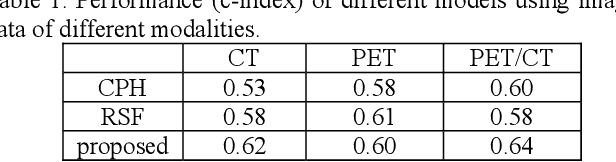
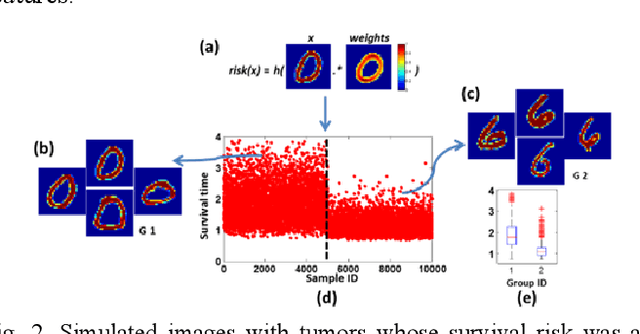
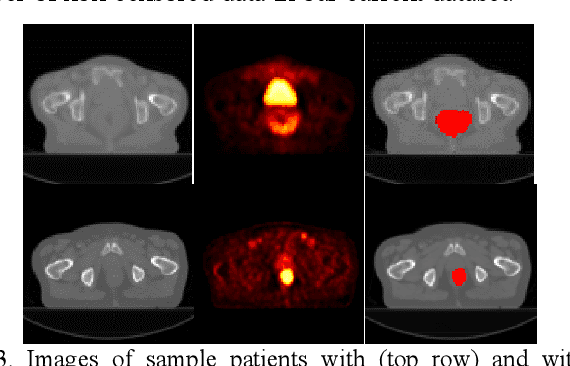
Recent radiomic studies have witnessed promising performance of deep learning techniques in learning radiomic features and fusing multimodal imaging data. Most existing deep learning based radiomic studies build predictive models in a setting of pattern classification, not appropriate for survival analysis studies where some data samples have incomplete observations. To improve existing survival analysis techniques whose performance is hinged on imaging features, we propose a deep learning method to build survival regression models by optimizing imaging features with deep convolutional neural networks (CNNs) in a proportional hazards model. To make the CNNs applicable to tumors with varied sizes, a spatial pyramid pooling strategy is adopted. Our method has been validated based on a simulated imaging dataset and a FDG-PET/CT dataset of rectal cancer patients treated for locally advanced rectal cancer. Compared with survival prediction models built upon hand-crafted radiomic features using Cox proportional hazards model and random survival forests, our method achieved competitive prediction performance.