 Add to Chrome
 Add to Firefox
 Add to Edge
Robust Principal Component Completion
Mar 26, 2026
Robust principal component analysis (RPCA) seeks a low-rank component and a sparse component from their summation. Yet, in many applications of interest, the sparse foreground actually replaces, or occludes, elements from the low-rank background. To address this mismatch, a new framework is proposed in which the sparse component is identified indirectly through determining its support. This approach, called robust principal component completion (RPCC), is solved via variational Bayesian inference applied to a fully probabilistic Bayesian sparse tensor factorization. Convergence to a hard classifier for the support is shown, thereby eliminating the post-hoc thresholding required of most prior RPCA-driven approaches. Experimental results reveal that the proposed approach delivers near-optimal estimates on synthetic data as well as robust foreground-extraction and anomaly-detection performance on real color video and hyperspectral datasets, respectively. Source implementation and Appendices are available at https://github.com/WongYinJ/BCP-RPCC.

A Generalized Tensor Formulation for Hyperspectral Image Super-Resolution Under General Spatial Blurring
Sep 27, 2024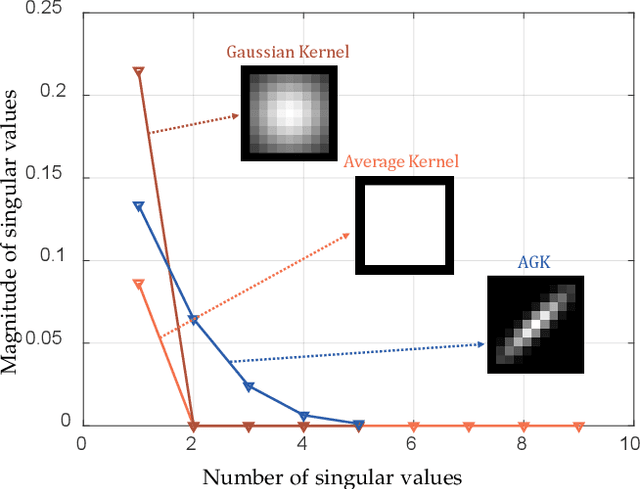
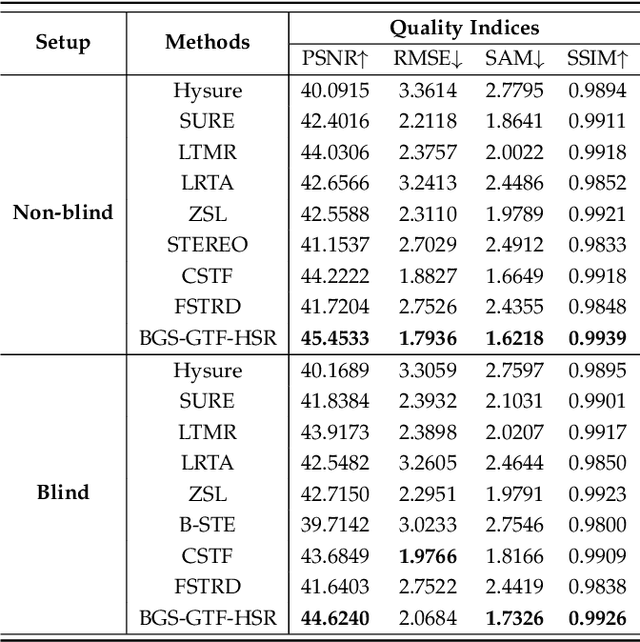
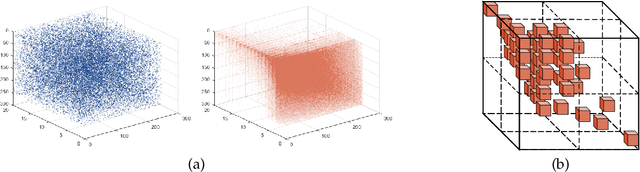
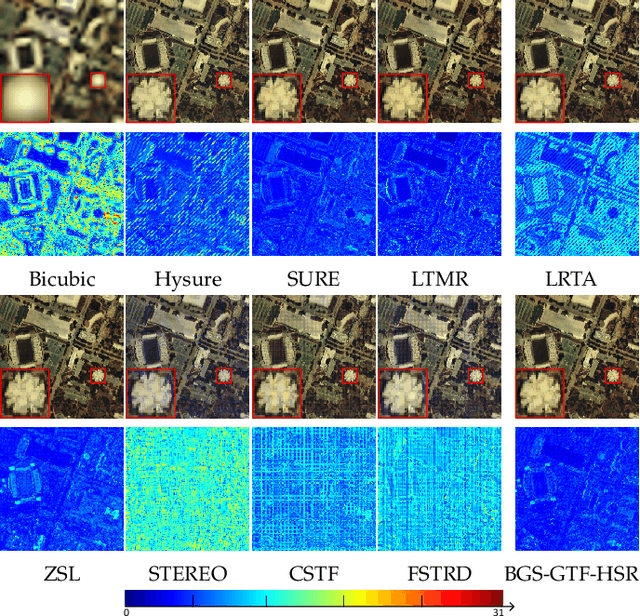
Hyperspectral super-resolution is commonly accomplished by the fusing of a hyperspectral imaging of low spatial resolution with a multispectral image of high spatial resolution, and many tensor-based approaches to this task have been recently proposed. Yet, it is assumed in such tensor-based methods that the spatial-blurring operation that creates the observed hyperspectral image from the desired super-resolved image is separable into independent horizontal and vertical blurring. Recent work has argued that such separable spatial degradation is ill-equipped to model the operation of real sensors which may exhibit, for example, anisotropic blurring. To accommodate this fact, a generalized tensor formulation based on a Kronecker decomposition is proposed to handle any general spatial-degradation matrix, including those that are not separable as previously assumed. Analysis of the generalized formulation reveals conditions under which exact recovery of the desired super-resolved image is guaranteed, and a practical algorithm for such recovery, driven by a blockwise-group-sparsity regularization, is proposed. Extensive experimental results demonstrate that the proposed generalized tensor approach outperforms not only traditional matrix-based techniques but also state-of-the-art tensor-based methods; the gains with respect to the latter are especially significant in cases of anisotropic spatial blurring.