 Add to Chrome
 Add to Firefox
 Add to Edge
Forest-Chat: Adapting Vision-Language Agents for Interactive Forest Change Analysis
Jan 21, 2026
The increasing availability of high-resolution satellite imagery, together with advances in deep learning, creates new opportunities for enhancing forest monitoring workflows. Two central challenges in this domain are pixel-level change detection and semantic change interpretation, particularly for complex forest dynamics. While large language models (LLMs) are increasingly adopted for data exploration, their integration with vision-language models (VLMs) for remote sensing image change interpretation (RSICI) remains underexplored, especially beyond urban environments. We introduce Forest-Chat, an LLM-driven agent designed for integrated forest change analysis. The proposed framework enables natural language querying and supports multiple RSICI tasks, including change detection, change captioning, object counting, deforestation percentage estimation, and change reasoning. Forest-Chat builds upon a multi-level change interpretation (MCI) vision-language backbone with LLM-based orchestration, and incorporates zero-shot change detection via a foundation change detection model together with an interactive point-prompt interface to support fine-grained user guidance. To facilitate adaptation and evaluation in forest environments, we introduce the Forest-Change dataset, comprising bi-temporal satellite imagery, pixel-level change masks, and multi-granularity semantic change captions generated through a combination of human annotation and rule-based methods. Experimental results demonstrate that Forest-Chat achieves strong performance on Forest-Change and on LEVIR-MCI-Trees, a tree-focused subset of LEVIR-MCI, for joint change detection and captioning, highlighting the potential of interactive, LLM-driven RSICI systems to improve accessibility, interpretability, and analytical efficiency in forest change analysis.

Vision-Language Agents for Interactive Forest Change Analysis
Jan 08, 2026Modern forest monitoring workflows increasingly benefit from the growing availability of high-resolution satellite imagery and advances in deep learning. Two persistent challenges in this context are accurate pixel-level change detection and meaningful semantic change captioning for complex forest dynamics. While large language models (LLMs) are being adapted for interactive data exploration, their integration with vision-language models (VLMs) for remote sensing image change interpretation (RSICI) remains underexplored. To address this gap, we introduce an LLM-driven agent for integrated forest change analysis that supports natural language querying across multiple RSICI tasks. The proposed system builds upon a multi-level change interpretation (MCI) vision-language backbone with LLM-based orchestration. To facilitate adaptation and evaluation in forest environments, we further introduce the Forest-Change dataset, which comprises bi-temporal satellite imagery, pixel-level change masks, and multi-granularity semantic change captions generated using a combination of human annotation and rule-based methods. Experimental results show that the proposed system achieves mIoU and BLEU-4 scores of 67.10% and 40.17% on the Forest-Change dataset, and 88.13% and 34.41% on LEVIR-MCI-Trees, a tree-focused subset of LEVIR-MCI benchmark for joint change detection and captioning. These results highlight the potential of interactive, LLM-driven RSICI systems to improve accessibility, interpretability, and efficiency of forest change analysis. All data and code are publicly available at https://github.com/JamesBrockUoB/ForestChat.
Investigating Temporal Convolutional Neural Networks for Satellite Image Time Series Classification
Apr 13, 2022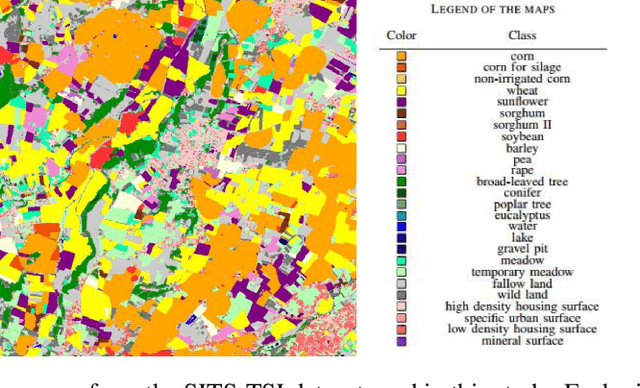
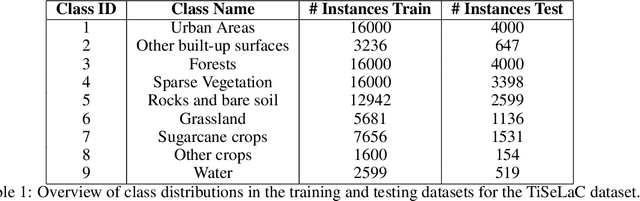
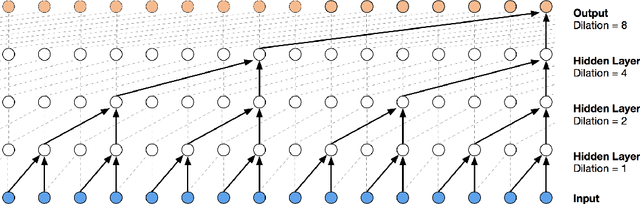
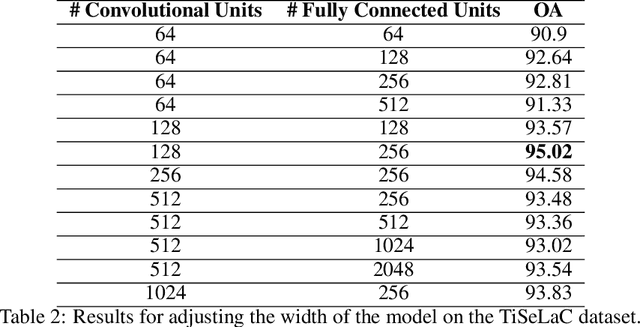
Satellite Image Time Series (SITS) of the Earth's surface provide detailed land cover maps, with their quality in the spatial and temporal dimensions consistently improving. These image time series are integral for developing systems that aim to produce accurate, up-to-date land cover maps of the Earth's surface. Applications are wide-ranging, with notable examples including ecosystem mapping, vegetation process monitoring and anthropogenic land-use change tracking. Recently proposed methods for SITS classification have demonstrated respectable merit, but these methods tend to lack native mechanisms that exploit the temporal dimension of the data; commonly resulting in extensive data pre-processing prohibitively long training times. To overcome these shortcomings, this paper seeks to study and enhance the newly proposed method for SITS classification from literature; namely Temporal CNNs. Comprehensive experiments are carried out on two benchmark SITS datasets with the results demonstrating that Temporal CNNs display a superior or competitive performance to the benchmark algorithms for both datasets. Investigations into the Temporal CNNs architecture also highlighted the non-trivial task of optimising the model for a new dataset.