 Add to Chrome
 Add to Firefox
 Add to Edge
Revisiting the Scaling Properties of Downstream Metrics in Large Language Model Training
Dec 09, 2025
While scaling laws for Large Language Models (LLMs) traditionally focus on proxy metrics like pretraining loss, predicting downstream task performance has been considered unreliable. This paper challenges that view by proposing a direct framework to model the scaling of benchmark performance from the training budget. We find that for a fixed token-to-parameter ratio, a simple power law can accurately describe the scaling behavior of log accuracy on multiple popular downstream tasks. Our results show that the direct approach extrapolates better than the previously proposed two-stage procedure, which is prone to compounding errors. Furthermore, we introduce functional forms that predict accuracy across token-to-parameter ratios and account for inference compute under repeated sampling. We validate our findings on models with up to 17B parameters trained on up to 350B tokens across two dataset mixtures. To support reproducibility and encourage future research, we release the complete set of pretraining losses and downstream evaluation results.

Joint MoE Scaling Laws: Mixture of Experts Can Be Memory Efficient
Feb 07, 2025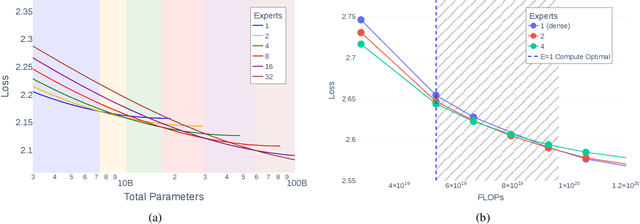

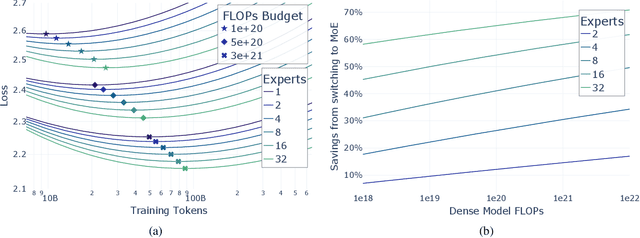

Mixture of Experts (MoE) architectures have significantly increased computational efficiency in both research and real-world applications of large-scale machine learning models. However, their scalability and efficiency under memory constraints remain relatively underexplored. In this work, we present joint scaling laws for dense and MoE models, incorporating key factors such as the number of active parameters, dataset size, and the number of experts. Our findings provide a principled framework for selecting the optimal MoE configuration under fixed memory and compute budgets. Surprisingly, we show that MoE models can be more memory-efficient than dense models, contradicting conventional wisdom. To derive and validate the theoretical predictions of our scaling laws, we conduct over 280 experiments with up to 2.7B active parameters and up to 5B total parameters. These results offer actionable insights for designing and deploying MoE models in practical large-scale training scenarios.
Scaling Laws for Fine-Grained Mixture of Experts
Feb 12, 2024


Mixture of Experts (MoE) models have emerged as a primary solution for reducing the computational cost of Large Language Models. In this work, we analyze their scaling properties, incorporating an expanded range of variables. Specifically, we introduce a new hyperparameter, granularity, whose adjustment enables precise control over the size of the experts. Building on this, we establish scaling laws for fine-grained MoE, taking into account the number of training tokens, model size, and granularity. Leveraging these laws, we derive the optimal training configuration for a given computational budget. Our findings not only show that MoE models consistently outperform dense Transformers but also highlight that the efficiency gap between dense and MoE models widens as we scale up the model size and training budget. Furthermore, we demonstrate that the common practice of setting the size of experts in MoE to mirror the feed-forward layer is not optimal at almost any computational budget.
Mixture of Tokens: Efficient LLMs through Cross-Example Aggregation
Oct 24, 2023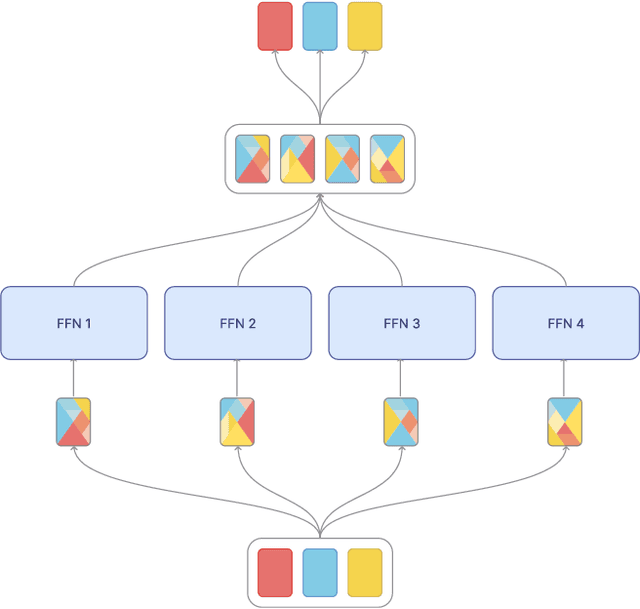

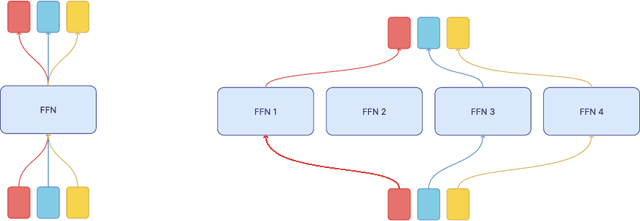
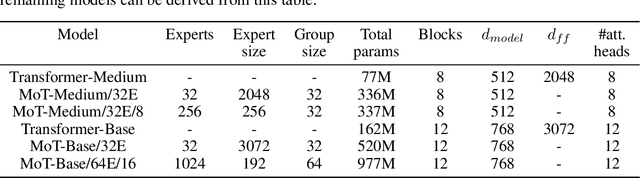
Despite the promise of Mixture of Experts (MoE) models in increasing parameter counts of Transformer models while maintaining training and inference costs, their application carries notable drawbacks. The key strategy of these models is to, for each processed token, activate at most a few experts - subsets of an extensive feed-forward layer. But this approach is not without its challenges. The operation of matching experts and tokens is discrete, which makes MoE models prone to issues like training instability and uneven expert utilization. Existing techniques designed to address these concerns, such as auxiliary losses or balance-aware matching, result either in lower model performance or are more difficult to train. In response to these issues, we propose Mixture of Tokens, a fully-differentiable model that retains the benefits of MoE architectures while avoiding the aforementioned difficulties. Rather than routing tokens to experts, this approach mixes tokens from different examples prior to feeding them to experts, enabling the model to learn from all token-expert combinations. Importantly, this mixing can be disabled to avoid mixing of different sequences during inference. Crucially, this method is fully compatible with both masked and causal Large Language Model training and inference.