 Add to Chrome
 Add to Firefox
 Add to Edge
Energy-Based Transformers as Predictors of Reading Difficulty
Jun 22, 2026
Transformer language models have become established tools for modeling human sentence processing, with measures such as surprisal and attention entropy serving as effective predictors of reading difficulty that together capture complementary aspects of processing load. Here, we explore a related class of transformer models: energy-based transformers, which provide a principled formal link to associative memory models, bringing processing research into direct contact with the broader literature on Hopfield networks and dense associative memory. To our knowledge, this is the first exploration of an energy-based transformer measure in computational psycholinguistics. Across reading-time corpora (Natural Stories, UCL eye-tracking, UCL self-paced reading), the energy measure is a robust predictor of reading times, providing significant fit beyond surprisal in all three. In a controlled experiment on relative clause processing, energy at a single layer captures the well-known object/subject asymmetry. We find evidence that it subsumes effects attributable to both attention entropy and surprisal, suggesting that energy may serve as a single unified predictor where multiple complementary measures have previously been required.

When Context Misleads: Surprisal, Energy and Attention Entropy as Metrics of Coherence Illusions in LLMs
Jun 19, 2026Psycholinguistics studies show that human readers fall for coherence illusions: an incoherent discourse can seem coherent simply because a distractor matches what comes next. We investigate whether Dutch language models (6 monolingual and 4 multilingual) show the same behavior on texts that link back to earlier context with words such as 'again' and 'too'. First, we find that surprisal at the critical word tracks human acceptability judgments and eye-tracking data. Models are more surprised by incoherent continuations, but a matching distractor in the prior context reduces this surprisal. Second, attention entropy at the critical position identifies heads that behave differently under coherence vs. incoherence. We find that ablating these heads shows transfer effects across experiments, suggesting a shared mechanism. Third, we introduce energy from the associative-memory literature as a metric to quantify discourse coherence. Taken together, our results show that coherence illusions arise in Dutch LLMs, with entropy and energy exposing mechanisms that operate across settings.
Model Merging to Maintain Language-Only Performance in Developmentally Plausible Multimodal Models
Oct 02, 2025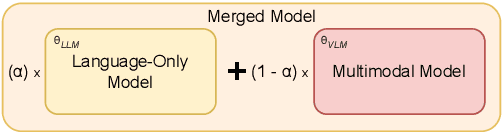
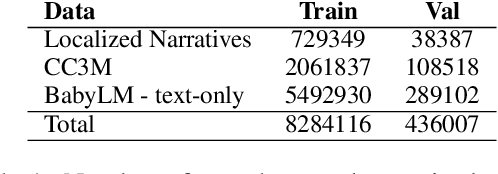

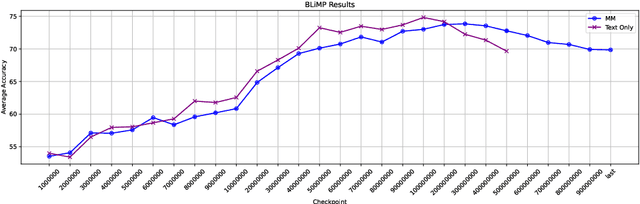
State-of-the-art vision-and-language models consist of many parameters and learn from enormous datasets, surpassing the amounts of linguistic data that children are exposed to as they acquire a language. This paper presents our approach to the multimodal track of the BabyLM challenge addressing this discrepancy. We develop language-only and multimodal models in low-resource settings using developmentally plausible datasets, with our multimodal models outperforming previous BabyLM baselines. One finding in the multimodal language model literature is that these models tend to underperform in \textit{language-only} tasks. Therefore, we focus on maintaining language-only abilities in multimodal models. To this end, we experiment with \textit{model merging}, where we fuse the parameters of multimodal models with those of language-only models using weighted linear interpolation. Our results corroborate the findings that multimodal models underperform in language-only benchmarks that focus on grammar, and model merging with text-only models can help alleviate this problem to some extent, while maintaining multimodal performance.