 Add to Chrome
 Add to Firefox
 Add to Edge
Low-Cost System for Automatic Recognition of Driving Pattern in Assessing Interurban Mobility using Geo-Information
Apr 16, 2026
Mobility in urban and interurban areas, mainly by cars, is a day-to-day activity of many people. However, some of its main drawbacks are traffic jams and accidents. Newly made vehicles have pre-installed driving evaluation systems, which can prevent accidents. However, most cars on our roads do not have driver assessment systems. In this paper, we propose an approach for recognising driving styles and enabling drivers to reach safer and more efficient driving. The system consists of two physical sensors connected to a device node with a display and a speaker. An artificial neural network (ANN) is included in the node, which analyses the data from the sensors, and then recognises the driving style. When an abnormal driving pattern is detected, the speaker will play a warning message. The prototype was assembled and tested using an interurban road, in particular on a conventional road with three driving styles. The gathered data were used to train and validate the ANN. Results, in terms of accuracy, indicate that better accuracy is obtained when the velocity, position (latitude and longitude), time, and turning speed for the 3-axis are used, offering an average accuracy of 83%. If the classification is performed considering just two driving styles, normal and aggressive, then the accuracy reaches 92%. When the geo-information and time data are included, the main novelty of this paper, the classification accuracy is improved by 13%.
* 18 pages, 10 figures, 3 tables

MLDAS: Machine Learning Dynamic Algorithm Selection for Software-Defined Networking Security
Apr 16, 2026Network security is a critical concern in the digital landscape of today, with users demanding secure browsing experiences and protection of their personal data. This study explores the dynamic integration of Machine Learning (ML) algorithms with Software-Defined Networking (SDN) controllers to enhance network security through adaptive decision mechanisms. The proposed approach enables the system to dynamically choose the most suitable ML algorithm based on the characteristics of the observed network traffic. This work examines the role of Intrusion Detection Systems (IDS) as a fundamental component of secure communication networks and discusses the limitations of SDN-based attack detection mechanisms. The proposed framework uses adaptive model selection to maintain reliable intrusion detection under varying network conditions. The study highlights the importance of analyzing traffic-type-based metrics to define effective classification rules and enhance the performance of ML models. Additionally, it addresses the risks of overfitting and underfitting, underscoring the critical role of hyperparameter tuning in optimizing model accuracy and generalization. The central contribution of this work is an automated mechanism that adaptively selects the most suitable ML algorithm according to real-time network conditions, prioritizing detection robustness and operational feasibility within SDN environments.
* 22 pages, 15 figures, 12 tables
Hybrid Convolution Neural Network Integrated with Pseudo-Newton Boosting for Lumbar Spine Degeneration Detection
Nov 17, 2025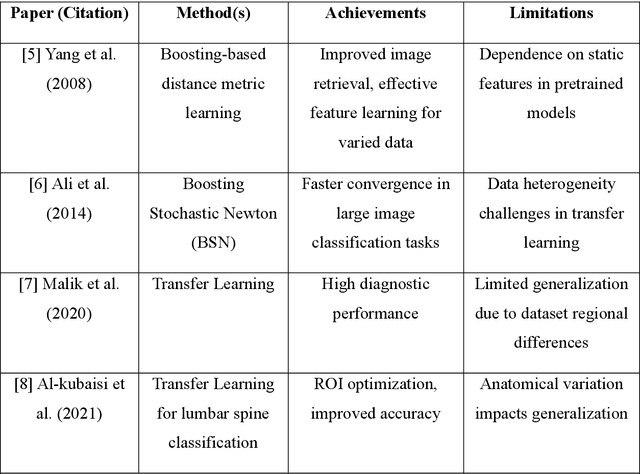
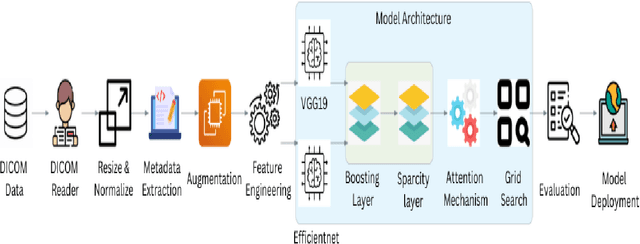
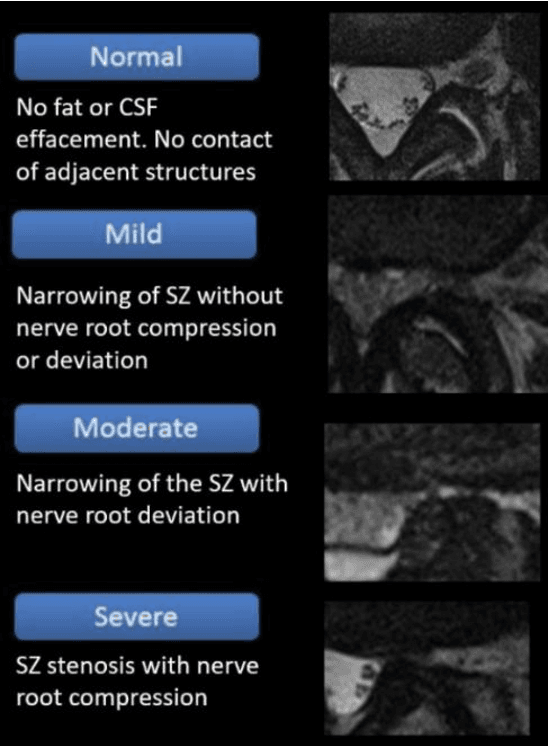
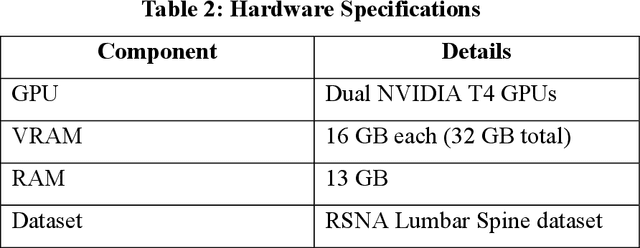
This paper proposes a new enhanced model architecture to perform classification of lumbar spine degeneration with DICOM images while using a hybrid approach, integrating EfficientNet and VGG19 together with custom-designed components. The proposed model is differentiated from traditional transfer learning methods as it incorporates a Pseudo-Newton Boosting layer along with a Sparsity-Induced Feature Reduction Layer that forms a multi-tiered framework, further improving feature selection and representation. The Pseudo-Newton Boosting layer makes smart variations of feature weights, with more detailed anatomical features, which are mostly left out in a transfer learning setup. In addition, the Sparsity-Induced Layer removes redundancy for learned features, producing lean yet robust representations for pathology in the lumbar spine. This architecture is novel as it overcomes the constraints in the traditional transfer learning approach, especially in the high-dimensional context of medical images, and achieves a significant performance boost, reaching a precision of 0.9, recall of 0.861, F1 score of 0.88, loss of 0.18, and an accuracy of 88.1%, compared to the baseline model, EfficientNet. This work will present the architectures, preprocessing pipeline, and experimental results. The results contribute to the development of automated diagnostic tools for medical images.