 Add to Chrome
 Add to Firefox
 Add to Edge
Longitudinal Digital Phenotyping for Early Cognitive-Motor Screening
Mar 26, 2026
Early detection of atypical cognitive-motor development is critical for timely intervention, yet traditional assessments rely heavily on subjective, static evaluations. The integration of digital devices offers an opportunity for continuous, objective monitoring through digital biomarkers. In this work, we propose an AI-driven longitudinal framework to model developmental trajectories in children aged 18 months to 8 years. Using a dataset of tablet-based interactions collected over multiple academic years, we analyzed six cognitive-motor tasks (e.g., fine motor control, reaction time). We applied dimensionality reduction (t-SNE) and unsupervised clustering (K-Means++) to identify distinct developmental phenotypes and tracked individual transitions between these profiles over time. Our analysis reveals three distinct profiles: low, medium, and high performance. Crucially, longitudinal tracking highlights a high stability in the low-performance cluster (>90% retention in early years), suggesting that early deficits tend to persist without intervention. Conversely, higher-performance clusters show greater variability, potentially reflecting engagement factors. This study validates the use of unsupervised learning on touchscreen data to uncover heterogeneous developmental paths. The identified profiles serve as scalable, data-driven proxies for cognitive growth, offering a foundation for early screening tools and personalized pediatric interventions.

ChildCI Framework: Analysis of Motor and Cognitive Development in Children-Computer Interaction for Age Detection
Apr 08, 2022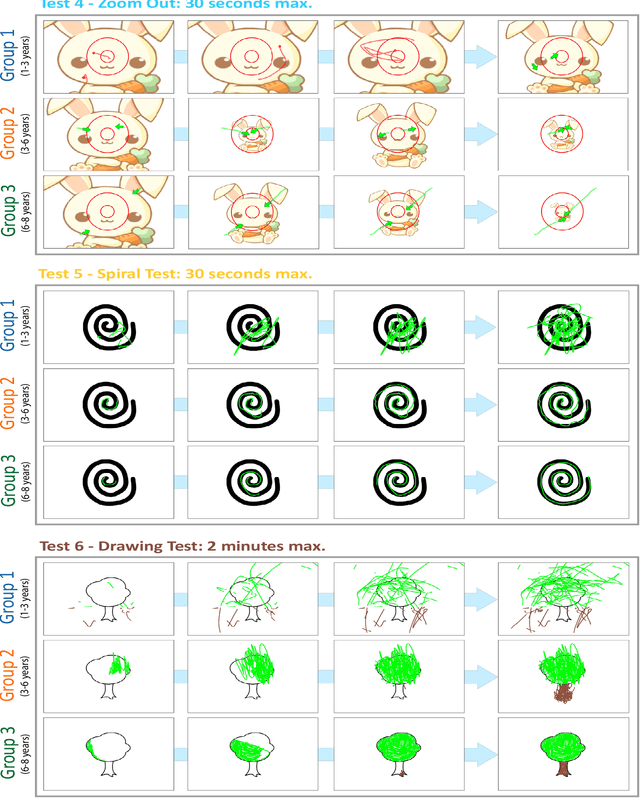
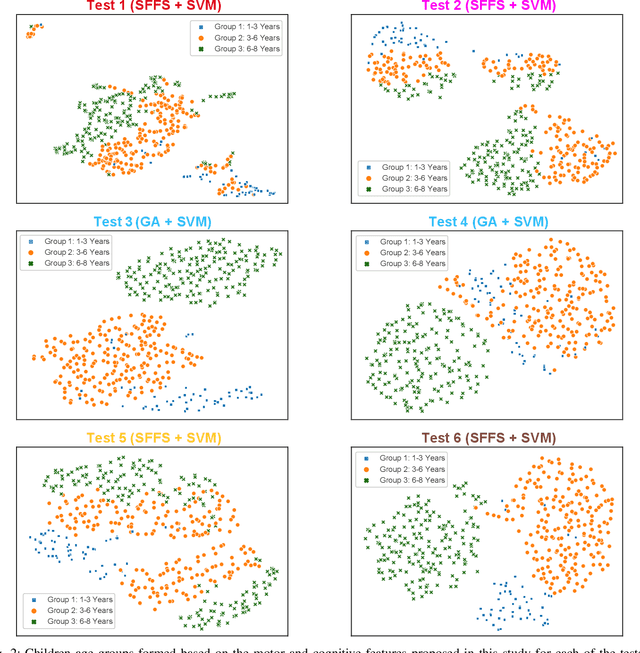
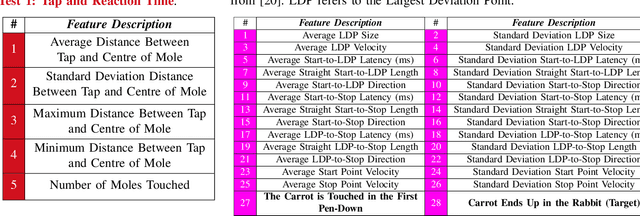
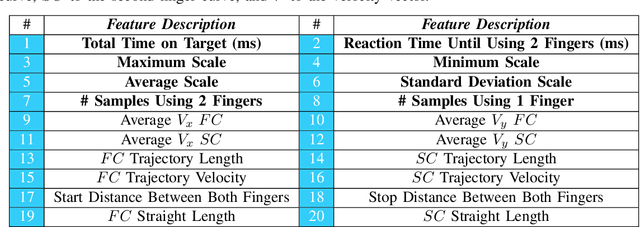
This article presents a comprehensive analysis of the different tests proposed in the recent ChildCI framework, proving its potential for generating a better understanding of children's neuromotor and cognitive development along time, as well as their possible application in other research areas such as e-Health and e-Learning. In particular, we propose a set of over 100 global features related to motor and cognitive aspects of the children interaction with mobile devices, some of them collected and adapted from the literature. Furthermore, we analyse the robustness and discriminative power of the proposed feature set including experimental results for the task of children age group detection based on their motor and cognitive behaviors. Two different scenarios are considered in this study: i) single-test scenario, and ii) multiple-test scenario. Results over 93% accuracy are achieved using the publicly available ChildCIdb_v1 database (over 400 children from 18 months to 8 years old), proving the high correlation of children's age with the way they interact with mobile devices.
Child-Computer Interaction: Recent Works, New Dataset, and Age Detection
Feb 02, 2021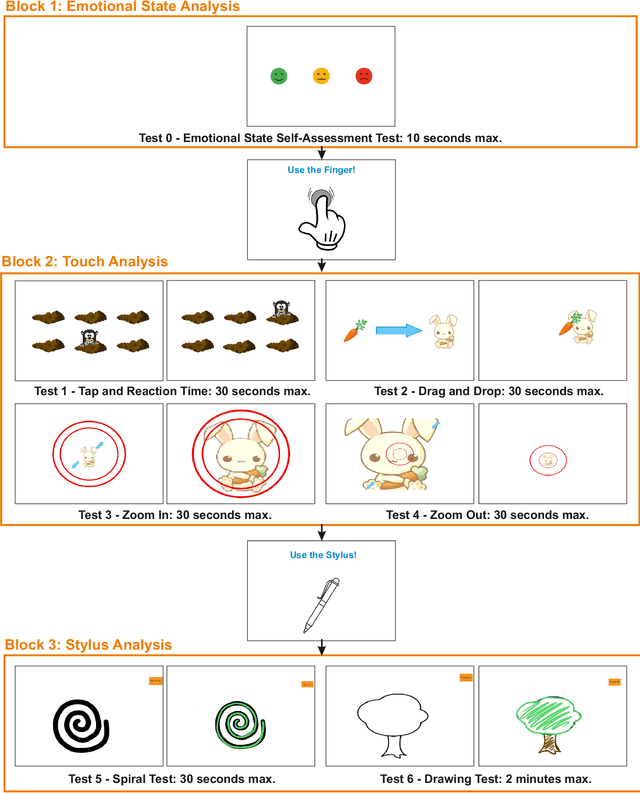
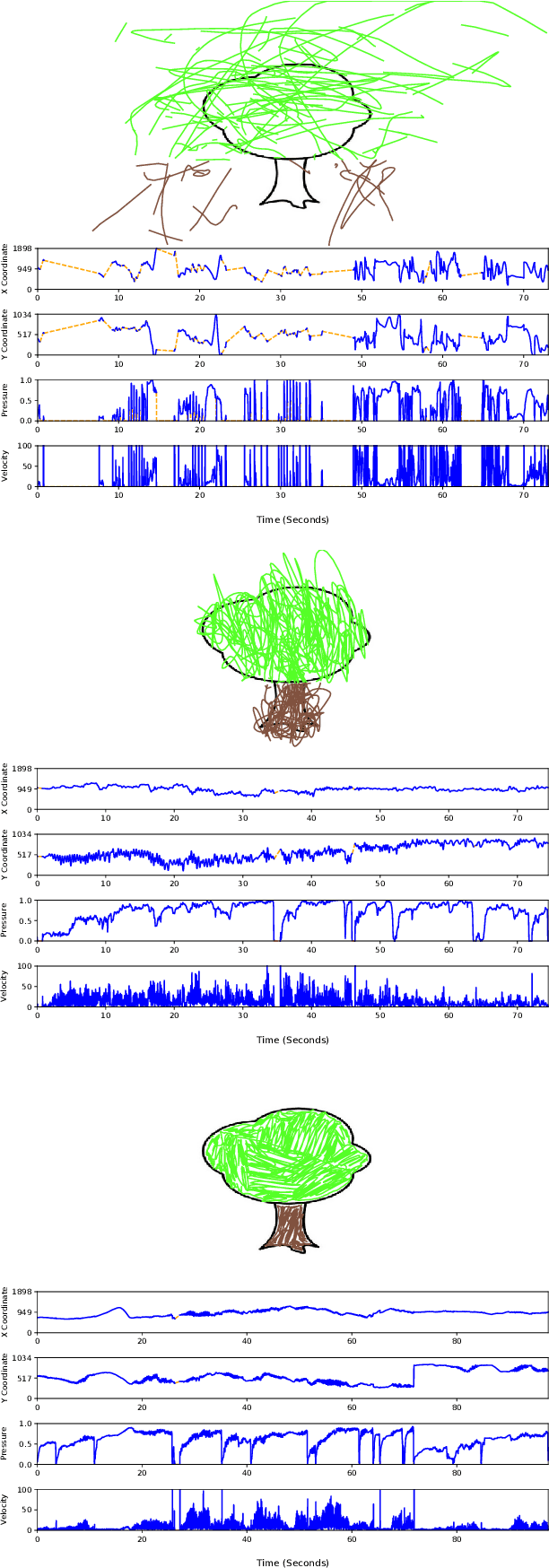
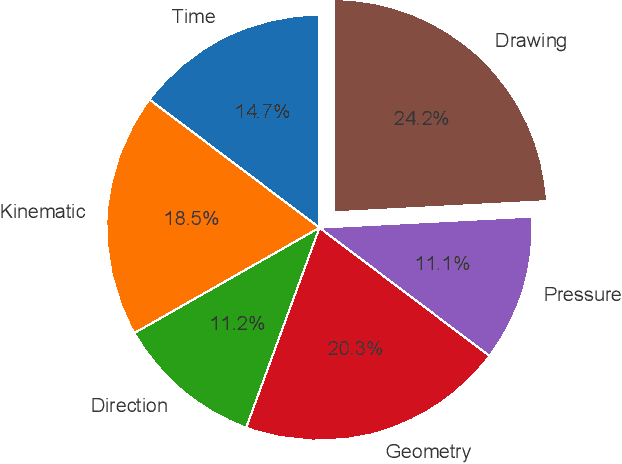
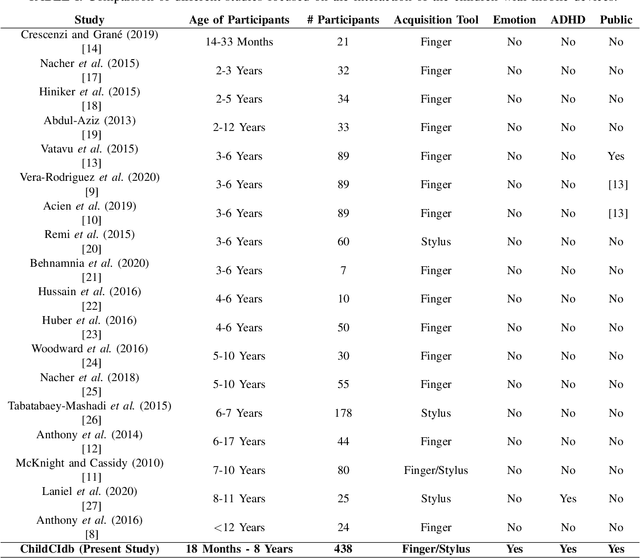
We overview recent research in Child-Computer Interaction and describe our framework ChildCI intended for: i) generating a better understanding of the cognitive and neuromotor development of children while interacting with mobile devices, and ii) enabling new applications in e-learning and e-health, among others. Our framework includes a new mobile application, specific data acquisition protocols, and a first release of the ChildCI dataset (ChildCIdb v1), which is planned to be extended yearly to enable longitudinal studies. In our framework children interact with a tablet device, using both a pen stylus and the finger, performing different tasks that require different levels of neuromotor and cognitive skills. ChildCIdb comprises more than 400 children from 18 months to 8 years old, considering therefore the first three development stages of the Piaget's theory. In addition, and as a demonstration of the potential of the ChildCI framework, we include experimental results for one of the many applications enabled by ChildCIdb: children age detection based on device interaction. Different machine learning approaches are evaluated, proposing a new set of 34 global features to automatically detect age groups, achieving accuracy results over 90% and interesting findings in terms of the type of features more useful for this task.