 Add to Chrome
 Add to Firefox
 Add to Edge
Residual-Guided Expert Specialization for Incomplete Multimodal Learning
Jun 29, 2026
As real-world prediction systems often face missing modalities at inference, incomplete multimodal learning (IML) remains a practical challenge. While prior methods aim to learn representations robust to missing inputs, representations from incomplete modalities inevitably deviate from their full-modality counterparts due to missing evidence. To explicitly leverage these deviations, we propose MARS (Missingness-Aware Residual-guided Specialization), a mixture-of-experts framework that guides expert specialization based on how representations are reshaped by missingness. By contrasting task representations derived from incomplete inputs with their complete counterparts during training, we derive a privileged residual signal that captures this representational gap. The residual signal guides a residual router to assign samples to experts specialized for the corresponding deviation patterns. In parallel, a feature router learns to imitate this routing behavior using only incomplete inputs, enabling deployment without access to full modalities. To mitigate this train-test router gap, we develop a discrepancy-aware noise regularization that adaptively perturbs the residual router's decisions when the feature router deviates, enhancing expert robustness under imperfect imitation. Experiments on multimodal classification (CASIA-SURF, CREMA-D, UPMC Food-101) and segmentation (MCubeS) under missing scenarios show that MARS consistently surpasses baselines while remaining efficient and extensible to diverse backbones and tasks.

Set-Inclusive Uncertainty Modeling for Robust Brain Tumor Segmentation
Jun 29, 2026Multimodal MRI is essential for accurate brain tumor segmentation. However, acquiring all modalities at inference is often challenging in practice, which causes intrinsic uncertainty due to unavoidable information loss. Without modeling this uncertainty, existing methods encode incomplete evidence into deterministic representations that appear plausible but lack reliability. In this regime, we propose a probabilistic representation framework that models representations as Gaussian distributions, where their mean captures task information and their variance measures uncertainty from missing evidence. To make variance reflect information deficiency, we regularize the mean from each partial configuration toward its full-modality counterpart, while scaling the variance with the discrepancy between their aligned means. We further introduce a set-inclusive strategy that exploits the hierarchical structure of modality subsets and enforces an ordering constraint to maintain their consistent uncertainty relationships. Extensive experiments on BraTS 2018 and 2020 demonstrate that our approach offers superior performance over baselines across diverse missing-modality scenarios. Code and model checkpoint are available at https://github.com/atlas-sky/SIUM.
Learning Multi-Scale Hypergraph for High-Order Brain Connectivity Analysis
Jun 02, 2026Understanding complex interactions between brain regions is critical for early neurodegenerative disease classification such as Alzheimer's Disease (AD) and Parkinson's Disease (PD). While graph-based models are widely used to analyze brain networks, most existing approaches primarily focus on pairwise interactions between directly connected nodes, limiting their ability to capture higher-order dependencies across multiple regions. Although hypergraph-based methods have been proposed to model higher-order relations, many rely on predefined hyperedges or restrict learning to hyperedge weights, reducing flexibility and limiting their capacity to capture multi-resolution structural patterns. In this regard, we introduce an adaptive multi-scale hyperedge learning framework, i.e., MuHL, which constructs hierarchical node features and dynamically learns high-order interactions through continuous hyperedge construction over multi-resolution graph signals. Extensive experiments on multiple brain network benchmarks demonstrate that MuHL consistently improves disease classification performance across different stages, and further identifies key regions of interest (ROIs) and their group-wise interactions from the learned hyperedges that are associated with disease progression, highlighting its potential as a powerful tool for brain network analysis in neurodegenerative disorders.
Multi-Modal Graph Neural Network with Transformer-Guided Adaptive Diffusion for Preclinical Alzheimer Classification
Jun 02, 2026The graphical representation of the brain offers critical insights into diagnosing and prognosing neurodegenerative disease via relationships between regions of interest (ROIs). Despite recent emergence of various Graph Neural Networks (GNNs) to effectively capture the relational information, there remain inherent limitations in interpreting the brain networks. Specifically, convolutional approaches ineffectively aggregate information from distant neighborhoods, while attention-based methods exhibit deficiencies in capturing node-centric information, particularly in retaining critical characteristics from pivotal nodes. These shortcomings reveal challenges for identifying disease-specific variation from diverse features from different modalities. In this regard, we propose an integrated framework guiding diffusion process at each node by a downstream transformer where both short- and long-range properties of graphs are aggregated via diffusion-kernel and multi-head attention respectively. We demonstrate the superiority of our model by improving performance of pre-clinical Alzheimer's disease (AD) classification with various modalities. Also, our model adeptly identifies key ROIs that are closely associated with the preclinical stages of AD, marking a significant potential for early diagnosis and prevision of the disease.
Modality-Agnostic Style Transfer for Holistic Feature Imputation
Mar 03, 2025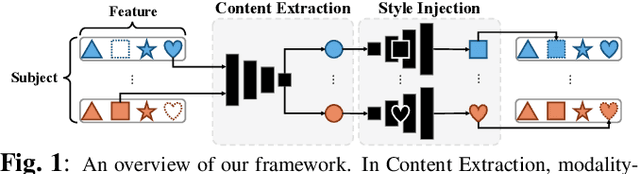
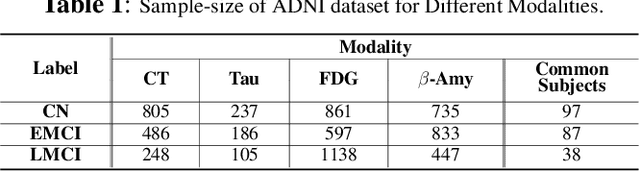
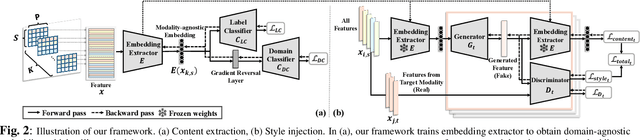
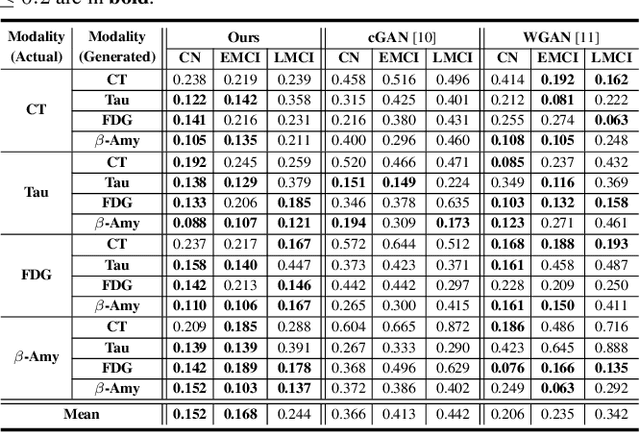
Characterizing a preclinical stage of Alzheimer's Disease (AD) via single imaging is difficult as its early symptoms are quite subtle. Therefore, many neuroimaging studies are curated with various imaging modalities, e.g., MRI and PET, however, it is often challenging to acquire all of them from all subjects and missing data become inevitable. In this regards, in this paper, we propose a framework that generates unobserved imaging measures for specific subjects using their existing measures, thereby reducing the need for additional examinations. Our framework transfers modality-specific style while preserving AD-specific content. This is done by domain adversarial training that preserves modality-agnostic but AD-specific information, while a generative adversarial network adds an indistinguishable modality-specific style. Our proposed framework is evaluated on the Alzheimer's Disease Neuroimaging Initiative (ADNI) study and compared with other imputation methods in terms of generated data quality. Small average Cohen's $d$ $< 0.19$ between our generated measures and real ones suggests that the synthetic data are practically usable regardless of their modality type.
OCL: Ordinal Contrastive Learning for Imputating Features with Progressive Labels
Mar 03, 2025Accurately discriminating progressive stages of Alzheimer's Disease (AD) is crucial for early diagnosis and prevention. It often involves multiple imaging modalities to understand the complex pathology of AD, however, acquiring a complete set of images is challenging due to high cost and burden for subjects. In the end, missing data become inevitable which lead to limited sample-size and decrease in precision in downstream analyses. To tackle this challenge, we introduce a holistic imaging feature imputation method that enables to leverage diverse imaging features while retaining all subjects. The proposed method comprises two networks: 1) An encoder to extract modality-independent embeddings and 2) A decoder to reconstruct the original measures conditioned on their imaging modalities. The encoder includes a novel {\em ordinal contrastive loss}, which aligns samples in the embedding space according to the progression of AD. We also maximize modality-wise coherence of embeddings within each subject, in conjunction with domain adversarial training algorithms, to further enhance alignment between different imaging modalities. The proposed method promotes our holistic imaging feature imputation across various modalities in the shared embedding space. In the experiments, we show that our networks deliver favorable results for statistical analysis and classification against imputation baselines with Alzheimer's Disease Neuroimaging Initiative (ADNI) study.
Learning to Approximate Adaptive Kernel Convolution on Graphs
Jan 22, 2024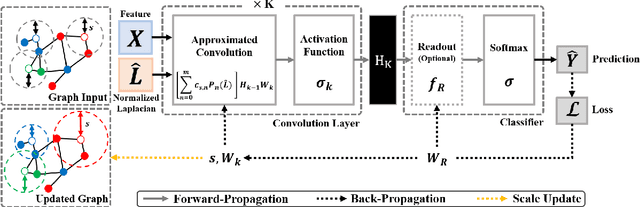
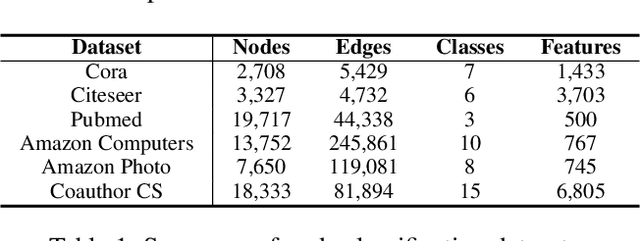
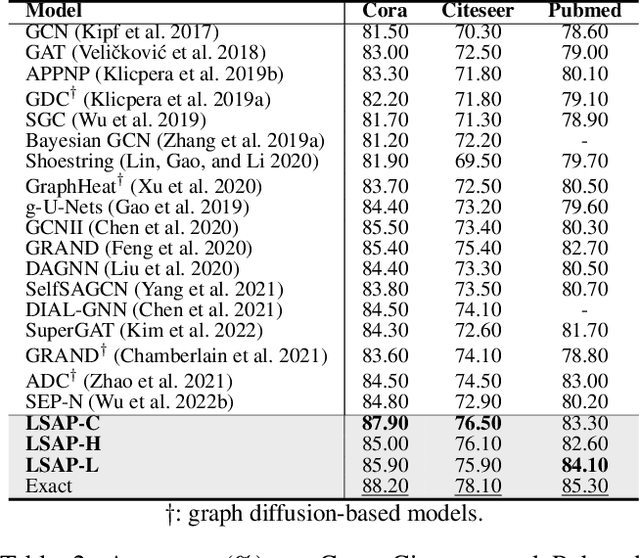
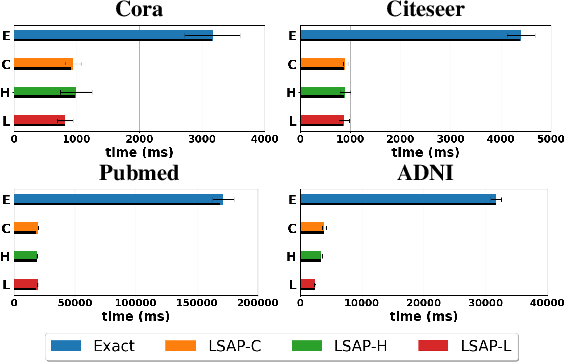
Various Graph Neural Networks (GNNs) have been successful in analyzing data in non-Euclidean spaces, however, they have limitations such as oversmoothing, i.e., information becomes excessively averaged as the number of hidden layers increases. The issue stems from the intrinsic formulation of conventional graph convolution where the nodal features are aggregated from a direct neighborhood per layer across the entire nodes in the graph. As setting different number of hidden layers per node is infeasible, recent works leverage a diffusion kernel to redefine the graph structure and incorporate information from farther nodes. Unfortunately, such approaches suffer from heavy diagonalization of a graph Laplacian or learning a large transform matrix. In this regards, we propose a diffusion learning framework, where the range of feature aggregation is controlled by the scale of a diffusion kernel. For efficient computation, we derive closed-form derivatives of approximations of the graph convolution with respect to the scale, so that node-wise range can be adaptively learned. With a downstream classifier, the entire framework is made trainable in an end-to-end manner. Our model is tested on various standard datasets for node-wise classification for the state-of-the-art performance, and it is also validated on a real-world brain network data for graph classifications to demonstrate its practicality for Alzheimer classification.