 Add to Chrome
 Add to Firefox
 Add to Edge
Environmental Understanding Vision-Language Model for Embodied Agent
Apr 21, 2026
Vision-language models (VLMs) have shown strong perception and reasoning abilities for instruction-following embodied agents. However, despite these abilities and their generalization performance, they still face limitations in environmental understanding, often failing on interactions or relying on environment metadata during execution. To address this challenge, we propose a novel framework named Environmental Understanding Embodied Agent (EUEA), which fine-tunes four core skills: 1) object perception for identifying relevant objects, 2) task planning for generating interaction subgoals, 3) action understanding for judging success likelihood, and 4) goal recognition for determining goal completion. By fine-tuning VLMs with EUEA skills, our framework enables more reliable task execution for instruction-following. We further introduce a recovery step that leverages these core skills and a group relative policy optimization (GRPO) stage that refines inconsistent skill predictions. The recovery step samples alternative actions to correct failure cases, and the GRPO stage refines inconsistent skill predictions. Across ALFRED tasks, our VLM significantly outperforms a behavior-cloning baseline, achieving an 8.86% improvement in average success rate. The recovery and GRPO stages provide an additional 3.03% gain, further enhancing overall performance. Finally, our skill-level analyses reveal key limitations in the environmental understanding of closed- and open-source VLMs and identify the capabilities necessary for effective agent-environment interaction.

Data Descriptions from Large Language Models with Influence Estimation
Nov 11, 2025
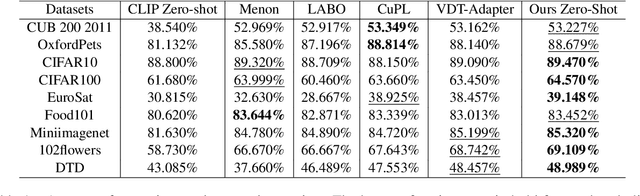
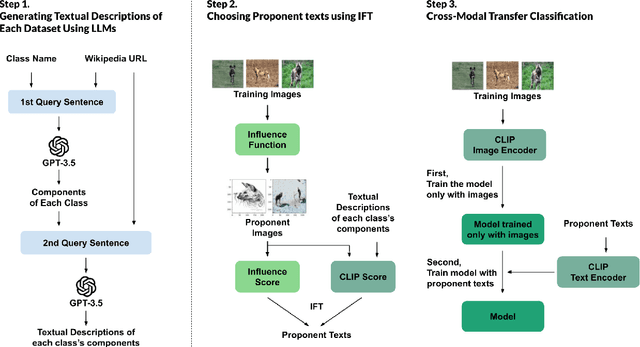
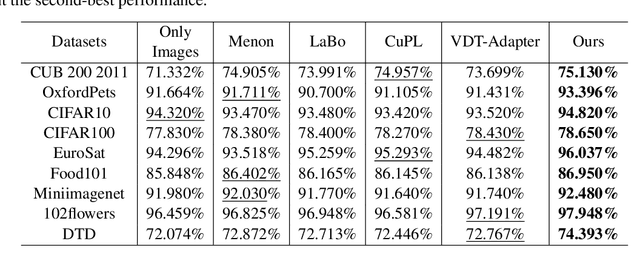
Deep learning models have been successful in many areas but understanding their behaviors still remains a black-box. Most prior explainable AI (XAI) approaches have focused on interpreting and explaining how models make predictions. In contrast, we would like to understand how data can be explained with deep learning model training and propose a novel approach to understand the data via one of the most common media - language - so that humans can easily understand. Our approach proposes a pipeline to generate textual descriptions that can explain the data with large language models by incorporating external knowledge bases. However, generated data descriptions may still include irrelevant information, so we introduce to exploit influence estimation to choose the most informative textual descriptions, along with the CLIP score. Furthermore, based on the phenomenon of cross-modal transferability, we propose a novel benchmark task named cross-modal transfer classification to examine the effectiveness of our textual descriptions. In the experiment of zero-shot setting, we show that our textual descriptions are more effective than other baseline descriptions, and furthermore, we successfully boost the performance of the model trained only on images across all nine image classification datasets. These results are further supported by evaluation using GPT-4o. Through our approach, we may gain insights into the inherent interpretability of the decision-making process of the model.
Sound of Story: Multi-modal Storytelling with Audio
Oct 30, 2023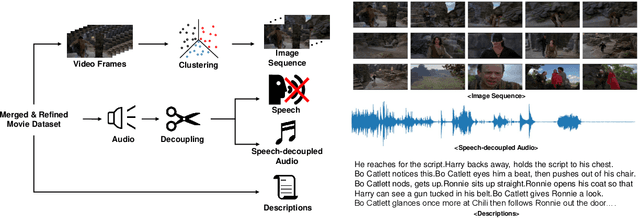


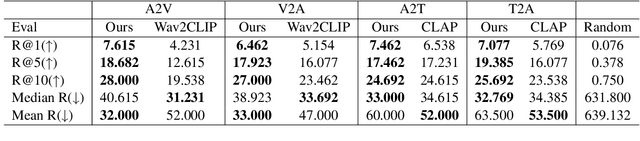
Storytelling is multi-modal in the real world. When one tells a story, one may use all of the visualizations and sounds along with the story itself. However, prior studies on storytelling datasets and tasks have paid little attention to sound even though sound also conveys meaningful semantics of the story. Therefore, we propose to extend story understanding and telling areas by establishing a new component called "background sound" which is story context-based audio without any linguistic information. For this purpose, we introduce a new dataset, called "Sound of Story (SoS)", which has paired image and text sequences with corresponding sound or background music for a story. To the best of our knowledge, this is the largest well-curated dataset for storytelling with sound. Our SoS dataset consists of 27,354 stories with 19.6 images per story and 984 hours of speech-decoupled audio such as background music and other sounds. As benchmark tasks for storytelling with sound and the dataset, we propose retrieval tasks between modalities, and audio generation tasks from image-text sequences, introducing strong baselines for them. We believe the proposed dataset and tasks may shed light on the multi-modal understanding of storytelling in terms of sound. Downloading the dataset and baseline codes for each task will be released in the link: https://github.com/Sosdatasets/SoS_Dataset.