 Add to Chrome
 Add to Firefox
 Add to Edge
Measuring the Depth of LLM Unlearning via Activation Patching
May 23, 2026
Large language model (LLM) unlearning has emerged as a crucial post-hoc mechanism for privacy protection and AI safety, yet auditing whether target knowledge is truly erased remains challenging. Existing output-level metrics fail to detect when this knowledge remains recoverable from internal representations. Recent white-box studies reveal such residual knowledge but often rely on auxiliary training or dataset-specific adaptations, leaving no generalizable metric. To address these limitations, we propose the Unlearning Depth Score (UDS), a metric that quantifies the mechanistic depth of unlearning via activation patching. UDS first identifies layers that encode the target knowledge using a retain model baseline, then measures how much of it is erased in the unlearned model on a 0-1 scale. In a meta-evaluation across 20 metrics on 150 unlearned models spanning 8 methods, UDS achieves the highest faithfulness and robustness, confirming our causal approach as the most reliable for unlearning evaluation. Case studies further reveal that white-box metrics can disagree at the layer level and that erasure depth varies across examples. We provide guidelines for integrating UDS into existing benchmarking frameworks and streamlining the evaluation pipeline. Code and data are available at https://github.com/gnueaj/unlearning-depth-score

HyperCLOVA X Technical Report
Apr 13, 2024We introduce HyperCLOVA X, a family of large language models (LLMs) tailored to the Korean language and culture, along with competitive capabilities in English, math, and coding. HyperCLOVA X was trained on a balanced mix of Korean, English, and code data, followed by instruction-tuning with high-quality human-annotated datasets while abiding by strict safety guidelines reflecting our commitment to responsible AI. The model is evaluated across various benchmarks, including comprehensive reasoning, knowledge, commonsense, factuality, coding, math, chatting, instruction-following, and harmlessness, in both Korean and English. HyperCLOVA X exhibits strong reasoning capabilities in Korean backed by a deep understanding of the language and cultural nuances. Further analysis of the inherent bilingual nature and its extension to multilingualism highlights the model's cross-lingual proficiency and strong generalization ability to untargeted languages, including machine translation between several language pairs and cross-lingual inference tasks. We believe that HyperCLOVA X can provide helpful guidance for regions or countries in developing their sovereign LLMs.
Centroid-aware feature recalibration for cancer grading in pathology images
Jul 26, 2023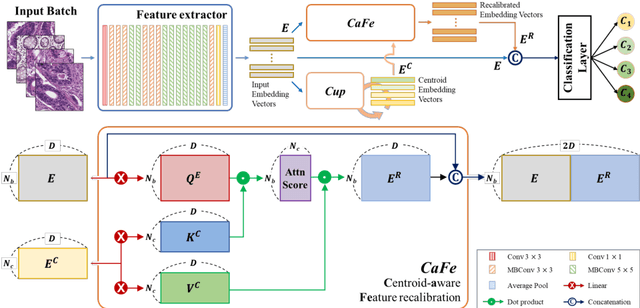
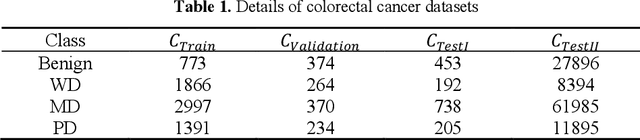
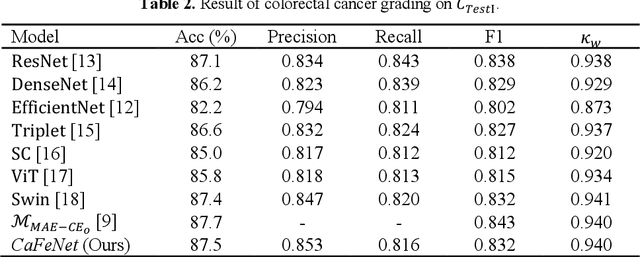
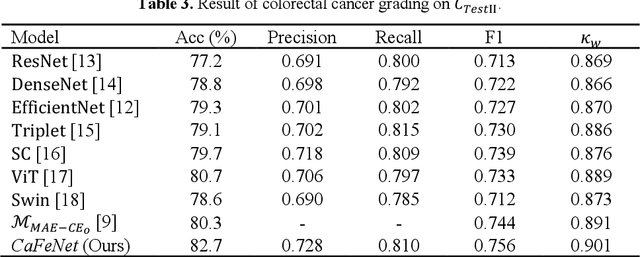
Cancer grading is an essential task in pathology. The recent developments of artificial neural networks in computational pathology have shown that these methods hold great potential for improving the accuracy and quality of cancer diagnosis. However, the issues with the robustness and reliability of such methods have not been fully resolved yet. Herein, we propose a centroid-aware feature recalibration network that can conduct cancer grading in an accurate and robust manner. The proposed network maps an input pathology image into an embedding space and adjusts it by using centroids embedding vectors of different cancer grades via attention mechanism. Equipped with the recalibrated embedding vector, the proposed network classifiers the input pathology image into a pertinent class label, i.e., cancer grade. We evaluate the proposed network using colorectal cancer datasets that were collected under different environments. The experimental results confirm that the proposed network is able to conduct cancer grading in pathology images with high accuracy regardless of the environmental changes in the datasets.