 Add to Chrome
 Add to Firefox
 Add to Edge
KineFuse: Kinematic-Aware Haptic Fusion for In-Hand Occluded-Object Pose Tracking
Jul 16, 2026
Dexterous in-hand manipulation requires continuous 6D pose tracking, yet the manipulating fingers inevitably occlude the object from the camera. We study how to structure the sparse haptic signals already available on multi-fingered hands, including proprioception, proximal force/torque, and binary contact, to complement a pretrained visual pose tracker under occlusion. We propose a kinematic-aware finger-level encoder and systematically compare it against four alternative designs through three levels of evaluation: per-frame refinement, sequential open-loop tracking, and closed-loop manipulation. Our experiments reveal that (i) per-frame evaluation cannot distinguish encoder quality, while sequential tracking amplifies architectural differences by up to 15 times; (ii) the structured encoder learns task-specific cross-modal gating, using vision exclusively for translation and dedicating one attention head to haptics for rotation, without explicit supervision; and (iii) compact finger-level tokenization with 4 tokens outperforms both flat fusion and joint-level representations, which suppress vision through norm dominance. We validate that improved tracking yields higher success in a downstream reorientation task and provide qualitative real-world demonstrations. Our project page is available at https://cold-young.github.io/kine-fuse/.

Probabilistic Physics-Informed Neural Networks for Estimating Heterogeneous Elastic Properties from Low-Resolution and Noisy Displacement Data
Jul 16, 2026Estimating spatially heterogeneous elastic properties from low-resolution displacement measurements is a severely ill-posed inverse elasticity problem because low resolution obscures spatial details needed to distinguish heterogeneous property variations, and small measurement perturbations or fitting errors are amplified through inverse estimation. Existing inverse methods often rely on high-fidelity observations and manually prespecified loss weights, limiting their adaptability and making them sensitive to noise and resolution degradation. We propose a Probabilistic Inverse Elasticity Physics-Informed Neural Network (PIE-PINN) framework for robust estimation of Young's modulus and Poisson's ratio from noisy, low-resolution displacement data. PIE-PINN models displacement observation, strain-discrepancy, and equilibrium residuals using Laplace distributions within a unified probabilistic model. To improve robustness, the framework combines a B-spline-guided displacement network with a hierarchical half-Cauchy model for displacement residual scales. The B-spline provides a smooth global representation of the displacement field, while the neural network correction captures local variations. The hierarchical scale model adaptively downweights severe displacement fitting errors, enabling more robust recovery of the latent mean displacement field. An alternating maximum-likelihood training strategy updates the mean through weighted residual minimization and updates the scales to adjust the loss weights. Systematic case studies across varying noise levels and observation resolutions demonstrate the robustness of PIE-PINN.
Interactive 3D Tangible Display with a High-Speed Stiffness-Variable Jamming Module
Jul 16, 2026Multisensory integration, particularly through visual and tactile feedback, plays a crucial role in enhancing audience engagement with artworks. Although recent research has increasingly explored tactile experiences in art, existing systems often lack real-time variable stiffness modulation and depend on bulky mechanical infrastructures. In this work, we propose a novel tangible display based on a magnetic jamming mechanism, enabling real-time, low-noise, and low-voltage stiffness modulation integrated into traditional sculptural artworks. Our system combines visual motion and dynamic tactile feedback within a compact standalone module, allowing audiences to interactively experience variations in the rigidity and form of features such as those found in the traditional Korean mask Hahoetal. This approach offers a new paradigm for interactive art, enabling more immersive, multisensory engagement through the fusion of cultural artifacts and modern technology. Our project page is available at https://cold-young.github.io/jamming_tangible/.
Efficient Bayesian Deep Ensembles via Analytic Predictive Inference
Jul 07, 2026We introduce an efficient Bayesian deep ensemble method for predictive regression designed to enhance interpretability while maintaining competitive predictive performance and computational efficiency. Our method combines the statistical rigor of Bayesian inference with the scalability of deep ensembles, providing calibrated uncertainty estimates that enable its use not only for standalone prediction but also as a component within broader learning systems. To achieve these goals, our work relies on three key design components: (i) low-dimensional ensemble representation: predictions are expressed as a combination of a small number of trained neural predictors, enabling scalable inference whose cost depends on ensemble size rather than dataset size; (ii) closed-form Bayesian aggregation: ensemble predictions are combined using Bayesian linear regression, yielding interpretable posterior weights and calibrated uncertainty without approximate inference; and (iii) Independent ensemble training: multiple neural networks are trained separately, producing diverse predictive representations that improve robustness and uncertainty calibration. Empirical results on standard regression benchmarks demonstrate that the proposed approach achieves competitive predictive performance while maintaining reliable uncertainty estimates across settings.
Critical Patch-Aware Sparse Prompting with Decoupled Training for Continual Learning on the Edge
Apr 08, 2026Continual learning (CL) on edge devices requires not only high accuracy but also training-time efficiency to support on-device adaptation under strict memory and computational constraints. While prompt-based continual learning (PCL) is parameter-efficient and achieves competitive accuracy, prior work has focused mainly on accuracy or inference-time performance, often overlooking the memory and computational costs of on-device training. In this paper, we propose CPS-Prompt, a critical patch-aware sparse prompting framework that explicitly targets training-time memory usage and computational cost by integrating critical patch sampling (CPS) for task-aware token reduction and decoupled prompt and classifier training (DPCT) to reduce backpropagation overhead. Experiments on three public benchmarks and real edge hardware show that CPS-Prompt improves peak memory, training time, and energy efficiency by about 1.6x over the balanced CODA-Prompt baseline, while maintaining accuracy within 2% of the state-of-the-art C-Prompt on average and remaining competitive with CODA-Prompt in accuracy. The code is available at https://github.com/laymond1/cps-prompt.
Polyp Segmentation Using Wavelet-Based Cross-Band Integration for Enhanced Boundary Representation
Mar 04, 2026Accurate polyp segmentation is essential for early colorectal cancer detection, yet achieving reliable boundary localization remains challenging due to low mucosal contrast, uneven illumination, and color similarity between polyps and surrounding tissue. Conventional methods relying solely on RGB information often struggle to delineate precise boundaries due to weak contrast and ambiguous structures between polyps and surrounding mucosa. To establish a quantitative foundation for this limitation, we analyzed polyp-background contrast in the wavelet domain, revealing that grayscale representations consistently preserve higher boundary contrast than RGB images across all frequency bands. This finding suggests that boundary cues are more distinctly represented in the grayscale domain than in the color domain. Motivated by this finding, we propose a segmentation model that integrates grayscale and RGB representations through complementary frequency-consistent interaction, enhancing boundary precision while preserving structural coherence. Extensive experiments on four benchmark datasets demonstrate that the proposed approach achieves superior boundary precision and robustness compared to conventional models.
Suppressing Final Layer Hidden State Jumps in Transformer Pretraining
Jan 26, 2026This paper discusses the internal behavior of Transformer language models. Many recent pre-trained models have been reported to exhibit only slight changes in the angular distance between the input and output hidden state vectors in the middle Transformer layers, despite a disproportionately large ``jump'' in the angular distance occurring in or around the final Transformer layer. To characterize this, we first introduce a quantitative metric for the jump strength around the final layer, and then demonstrate its prevalence across many open-weight models, as well as its amplification throughout pre-training. Assuming such jumps indicate an undesirable property, we propose the jump-suppressing regularizer (JREG) which penalizes this jump during pre-training, thereby encouraging more balanced capability usage across the middle layers. Empirical evaluations of three model sizes of Llama-based models, trained with the proposed JREG method, reveal improved task performance compared to the baseline without altering the model architecture.
On Evaluation of Unsupervised Feature Selection for Pattern Classification
Jan 13, 2026Unsupervised feature selection aims to identify a compact subset of features that captures the intrinsic structure of data without supervised label. Most existing studies evaluate the performance of methods using the single-label dataset that can be instantiated by selecting a label from multi-label data while maintaining the original features. Because the chosen label can vary arbitrarily depending on the experimental setting, the superiority among compared methods can be changed with regard to which label happens to be selected. Thus, evaluating unsupervised feature selection methods based solely on single-label accuracy is unreasonable for assessing their true discriminative ability. This study revisits this evaluation paradigm by adopting a multi-label classification framework. Experiments on 21 multi-label datasets using several representative methods demonstrate that performance rankings differ markedly from those reported under single-label settings, suggesting the possibility of multi-label evaluation settings for fair and reliable comparison of unsupervised feature selection methods.
Layerwise Importance Analysis of Feed-Forward Networks in Transformer-based Language Models
Aug 25, 2025This study investigates the layerwise importance of feed-forward networks (FFNs) in Transformer-based language models during pretraining. We introduce an experimental approach that, while maintaining the total parameter count, increases the FFN dimensions in some layers and completely removes the FFNs from other layers. Furthermore, since our focus is on the importance of FFNs during pretraining, we train models from scratch to examine whether the importance of FFNs varies depending on their layer positions, rather than using publicly available pretrained models as is frequently done. Through comprehensive evaluations of models with varying sizes (285M, 570M, and 1.2B parameters) and layer counts (12, 24, and 40 layers), we demonstrate that concentrating FFNs in 70% of the consecutive middle layers consistently outperforms standard configurations for multiple downstream tasks.
Exploiting Fine-Grained Skip Behaviors for Micro-Video Recommendation
Apr 04, 2025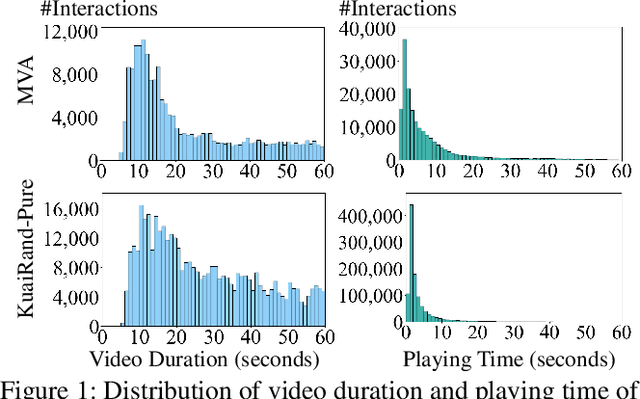


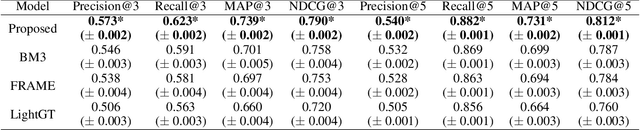
The growing trend of sharing short videos on social media platforms, where users capture and share moments from their daily lives, has led to an increase in research efforts focused on micro-video recommendations. However, conventional methods oversimplify the modeling of skip behavior, categorizing interactions solely as positive or negative based on whether skipping occurs. This study was motivated by the importance of the first few seconds of micro-videos, leading to a refinement of signals into three distinct categories: highly positive, less positive, and negative. Specifically, we classify skip interactions occurring within a short time as negatives, while those occurring after a delay are categorized as less positive. The proposed dual-level graph and hierarchical ranking loss are designed to effectively learn these fine-grained interactions. Our experiments demonstrated that the proposed method outperformed three conventional methods across eight evaluation measures on two public datasets.