 Add to Chrome
 Add to Firefox
 Add to Edge
RVN-Bench: A Benchmark for Reactive Visual Navigation
Mar 04, 2026
Safe visual navigation is critical for indoor mobile robots operating in cluttered environments. Existing benchmarks, however, often neglect collisions or are designed for outdoor scenarios, making them unsuitable for indoor visual navigation. To address this limitation, we introduce the reactive visual navigation benchmark (RVN-Bench), a collision-aware benchmark for indoor mobile robots. In RVN-Bench, an agent must reach sequential goal positions in previously unseen environments using only visual observations and no prior map, while avoiding collisions. Built on the Habitat 2.0 simulator and leveraging high-fidelity HM3D scenes, RVN-Bench provides large-scale, diverse indoor environments, defines a collision-aware navigation task and evaluation metrics, and offers tools for standardized training and benchmarking. RVN-Bench supports both online and offline learning by offering an environment for online reinforcement learning, a trajectory image dataset generator, and tools for producing negative trajectory image datasets that capture collision events. Experiments show that policies trained on RVN-Bench generalize effectively to unseen environments, demonstrating its value as a standardized benchmark for safe and robust visual navigation. Code and additional materials are available at: https://rvn-bench.github.io/.

Towards Defensive Autonomous Driving: Collecting and Probing Driving Demonstrations of Mixed Qualities
Sep 18, 2021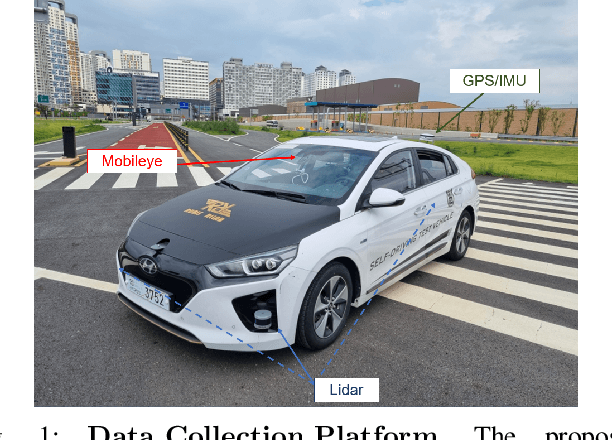
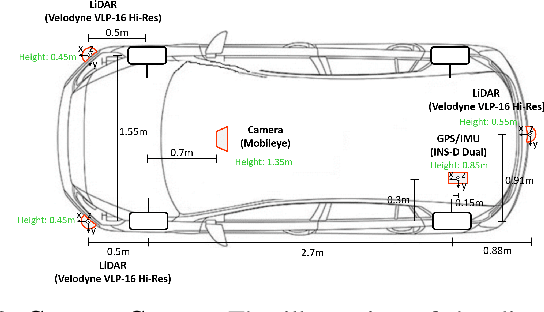
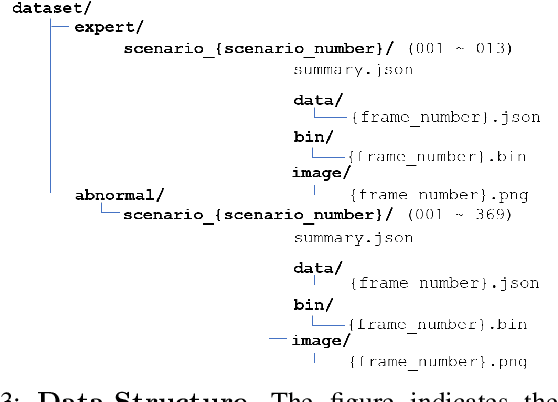
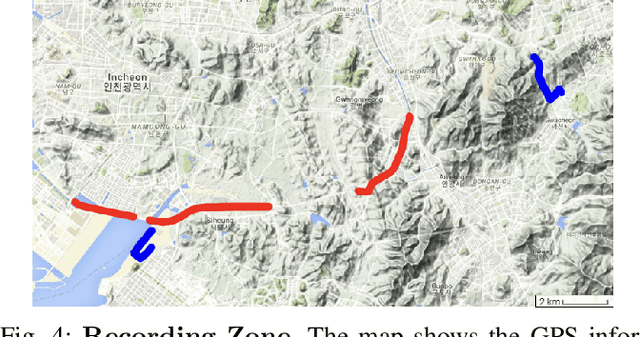
Designing or learning an autonomous driving policy is undoubtedly a challenging task as the policy has to maintain its safety in all corner cases. In order to secure safety in autonomous driving, the ability to detect hazardous situations, which can be seen as an out-of-distribution (OOD) detection problem, becomes crucial. However, most conventional datasets only provide expert driving demonstrations, although some non-expert or uncommon driving behavior data are needed to implement a safety guaranteed autonomous driving platform. To this end, we present a novel dataset called the R3 Driving Dataset, composed of driving data with different qualities. The dataset categorizes abnormal driving behaviors into eight categories and 369 different detailed situations. The situations include dangerous lane changes and near-collision situations. To further enlighten how these abnormal driving behaviors can be detected, we utilize different uncertainty estimation and anomaly detection methods to the proposed dataset. From the results of the proposed experiment, it can be inferred that by using both uncertainty estimation and anomaly detection, most of the abnormal cases in the proposed dataset can be discriminated. The dataset of this paper can be downloaded from https://rllab-snu.github.io/projects/R3-Driving-Dataset/doc.html.