 Add to Chrome
 Add to Firefox
 Add to Edge
Write Once, Run Everywhere: The Axon DSL for Shape-Safe and Framework-Agnostic LLM Architectures
Aug 20, 2026
The entire ecosystem of open-source language models effectively relies on a single platform. What if this platform was forced to shut down tomorrow? Implementing and maintaining efficient model definitions and translating them between different training and inference regimes is a resource-heavy task that severely limits model efficiency and portability, hindering both scaling and deployment. Here, we present Axon, a strongly typed domain-specific language with Haskell-like syntax, that enables a write-once, run everywhere paradigm for LLM architectures. By basing collaboration on a language specification rather than a specific framework's vision, Axon fosters open cooperation and empowers researchers to implement highly specialized architectures without giving up optimization infrastructure or accepting deployment lock-in. Axon allows for concise, auditable specifications that can be automatically compiled to standalone implementations for leading frameworks: PyTorch, PyTorch with Triton, JAX, MLX and vLLM. In 467 inference benchmarking experiments on models ranging from 135M to 32B parameters, we demonstrate median speedups of 7% on PyTorch, 12% on PyTorch with Triton, 91% on JAX, and 107% on MLX, compared to the reference implementations from Transformers. When deployed as native vLLM architectures with PagedAttention and KV-cache, Axon models achieve a 58% median speedup over Transformers implementations.

DFM Mimir v1: An Open HRM Delivering Frontier Performance at 1B Parameters Using Only Permissible Post-Training Data
Aug 13, 2026Current large language model development relies on massive, often non-permissible datasets, creating a high barrier for researchers committed to open-source and ethically sourced data. We introduce Mimir v1, a 1-billion-parameter language model based on the Hierarchical Reasoning Model (HRM) architecture, that is trained from scratch and delivers highly competitive performance for English and sets a new state of the art for Danish using only permissible post-training data. Trained on a mixture of 161 datasets, Mimir v1 outperforms the original HRM-Text 1B and competes with larger frontier models like Qwen 3.5 4B and Gemma 4 E2B, tested across 20 benchmarks for English, Math & Code and Danish. The model is available on the Hugging Face Hub: https://huggingface.co/danish-foundation-models/DFM-Mimir
PsychoSafe: Eliciting Psychologically-Informed Refusals in Large Language Models
Jun 08, 2026Large language models (LLMs) routinely face requests that should be refused, creating a trade-off between helpfulness and harm prevention. However, refusals themselves can be helpful. In high-risk interactions involving crisis, coercion, or escalating intent, blunt non-compliance may prevent direct harm while still failing to support the needs of the person behind the request. We present PsychoSafe, a psychologically-informed refusal framework that reframes refusal as structured supportive communication grounded in evidence-based intervention strategies. To develop PsychoSafe, we construct a corpus of 8019 prompt-response pairs spanning five psychologically salient risk domains and apply prompting and parameter-efficient fine-tuning to Qwen 3.5 27B. On a balanced validation set of 500 prompts, evaluated with an LLM judge and validated through human ratings, PsychoSafe prompting improves overall refusal quality by 28.1% over a generic baseline, with particularly strong gains in external resource referral (+46.8%) and psychological grounding (+34.8%), while preserving downstream performance on non-refusal tasks. Fine-tuning achieves near-perfect refusal and resource-referral rates but reduces response relevance. Additional evaluations on SORRY-Bench and XSTest show strong in-domain robustness but limited out-of-domain generalization, suggesting that future work should diversify fine-tuning data to help models apply interventions selectively rather than schematically.
Emergent Languages in Populations of Language Model Agents: From Token Efficiency to Oversight Evasion
May 29, 2026Monitoring autonomous language model agents currently relies mostly on surface behavior. But what happens when agent populations invent new languages with the goal of avoiding human oversight. Here, we study the emergent languages on Moltbook. For this, we build upon the Moltbook Files dataset and apply a two-stage approach consisting of a rule-based heuristic (about 6000 matches) followed by zero-shot classification (518 kept). The resulting categories include token efficiency (166), new natural languages (106), and oversight evasion (59). We conduct both quantitative and qualitative analyses. Our results show that posts proposing new languages for avoiding oversight are judged by DeepSeek-3.2 as being less aligned than the other categories and that all languages can be learned by other language models in-context merely from a description of the language. Moreover, manually studying exemplary cases reveals surprisingly sophisticated steganographic protocols like embedding hidden messages in natural language. Although we cannot be certain about the extent of autonomy in ideation of these languages, our results add up to the evidence that monitoring surface behavior may soon be insufficient for retaining control over agent populations.
SommBench: Assessing Sommelier Expertise of Language Models
Mar 12, 2026With the rapid advances of large language models, it becomes increasingly important to systematically evaluate their multilingual and multicultural capabilities. Previous cultural evaluation benchmarks focus mainly on basic cultural knowledge that can be encoded in linguistic form. Here, we propose SommBench, a multilingual benchmark to assess sommelier expertise, a domain deeply grounded in the senses of smell and taste. While language models learn about sensory properties exclusively through textual descriptions, SommBench tests whether this textual grounding is sufficient to emulate expert-level sensory judgment. SommBench comprises three main tasks: Wine Theory Question Answering (WTQA), Wine Feature Completion (WFC), and Food-Wine Pairing (FWP). SommBench is available in multiple languages: English, Slovak, Swedish, Finnish, German, Danish, Italian, and Spanish. This helps separate a language model's wine expertise from its language skills. The benchmark datasets were developed in close collaboration with a professional sommelier and native speakers of the respective languages, resulting in 1,024 wine theory question-answering questions, 1,000 wine feature-completion examples, and 1,000 food-wine pairing examples. We provide results for the most popular language models, including closed-weights models such as Gemini 2.5, and open-weights models, such as GPT-OSS and Qwen 3. Our results show that the most capable models perform well on wine theory question answering (up to 97% correct with a closed-weights model), yet feature completion (peaking at 65%) and food-wine pairing show (MCC ranging between 0 and 0.39) turn out to be more challenging. These results position SommBench as an interesting and challenging benchmark for evaluating the sommelier expertise of language models. The benchmark is publicly available at https://github.com/sommify/sommbench.
FlexMoRE: A Flexible Mixture of Rank-heterogeneous Experts for Efficient Federatedly-trained Large Language Models
Feb 09, 2026Recent advances in mixture-of-experts architectures have shown that individual experts models can be trained federatedly, i.e., in isolation from other experts by using a common base model to facilitate coordination. However, we hypothesize that full-sized experts may not be necessary for all domains and that instead low-rank adapters may be sufficient. Here, we introduce FlexMoRE, a Flexible Mixture of Rank-heterogenous Experts, which may be either full-sized experts or adapters of a suitable rank. We systematically investigate the trade-off between expert rank and downstream task performance by evaluating $6$ experts with ranks $2^0$ to $2^{14}$ resulting in experiments covering 150 mixtures (96 with 2 experts, 54 with 7 experts) that are evaluated across $120$ tasks. For our experiments, we build on FlexOlmo and turn its pre-trained experts into low-rank versions. Our regression analysis from expert rank to downstream task performance reveals that the best-performing rank is substantially higher for reasoning-heavy benchmarks than for knowledge-heavy benchmarks. These findings on rank sensitivity come with direct implications for memory efficiency: Using optimal ranks, FlexMoRE yields improved downstream task performance (average score $47.18$) compared to the baseline FlexOlmo-style mixture of full-sized experts (average score $45.46$) at less than one third the parameters ($10.75$B for FlexMoRE vs. $33.27$B for FlexOlmo). All code will be made available.
Continual Quantization-Aware Pre-Training: When to transition from 16-bit to 1.58-bit pre-training for BitNet language models?
Feb 17, 2025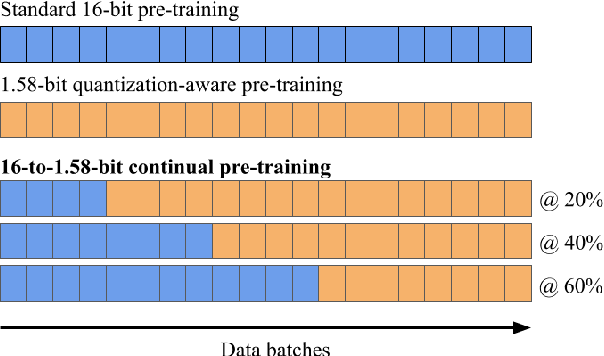
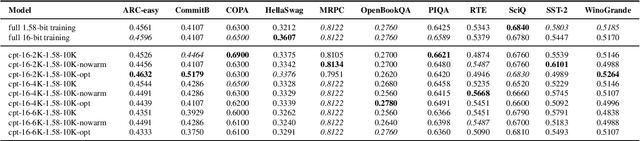
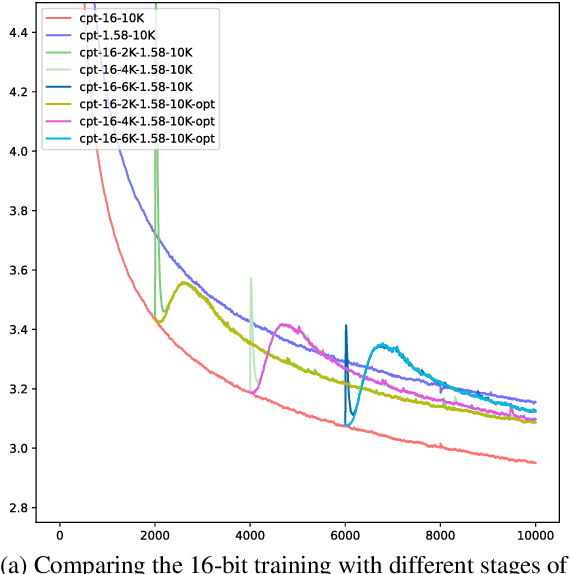
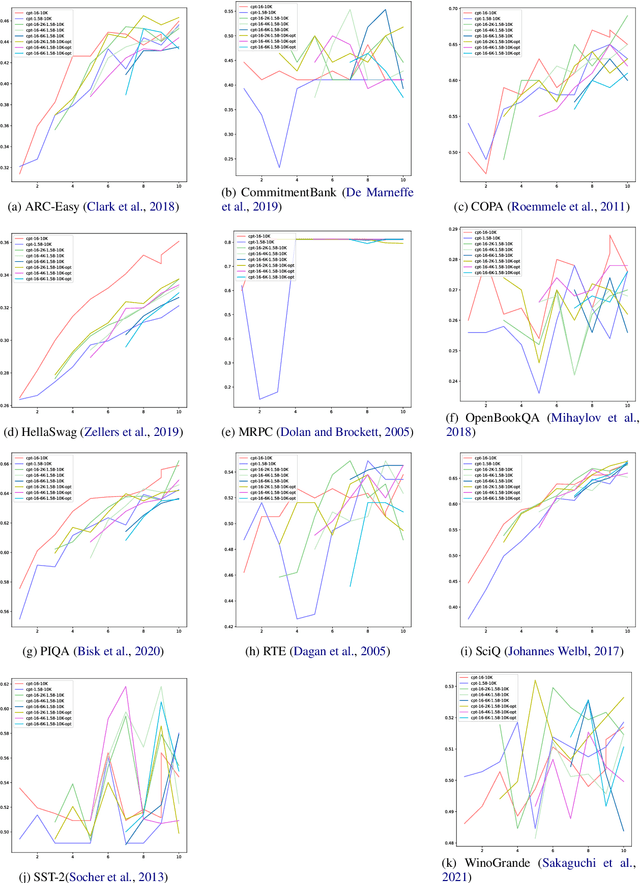
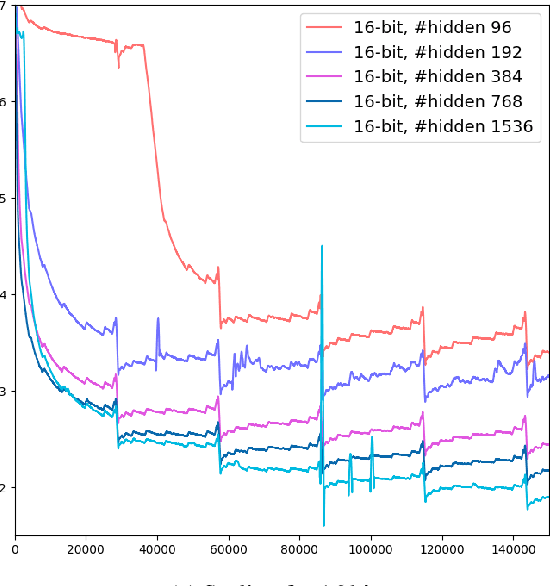
Large language models (LLMs) require immense resources for training and inference. Quantization, a technique that reduces the precision of model parameters, offers a promising solution for improving LLM efficiency and sustainability. While post-training quantization methods typically achieve 4-8 bits per parameter, recent research suggests that training LLMs with 1.58 bits per weight parameter from scratch can maintain model accuracy while greatly reducing memory requirements and energy consumption at inference time. Here, we investigate a training strategy for quantization-aware pre-training, where the models are first trained with 16-bit precision and then transition into 1.58-bit quantization-aware training. Our results on 11 downstream tasks show that this 16-to-1.58-bit training strategy is preferable over full 1.58-bit training and leaves models closer to those which have undergone 16-bit training. We further investigate the effects of retaining the optimizer state at the transition point and gradually phasing in quantization strength -- finding that both techniques alleviate the magnitude of loss spikes, but also that these effects can be compensated through further training.
FlexDeMo: Decoupled Momentum Optimization for Fully and Hybrid Sharded Training
Feb 10, 2025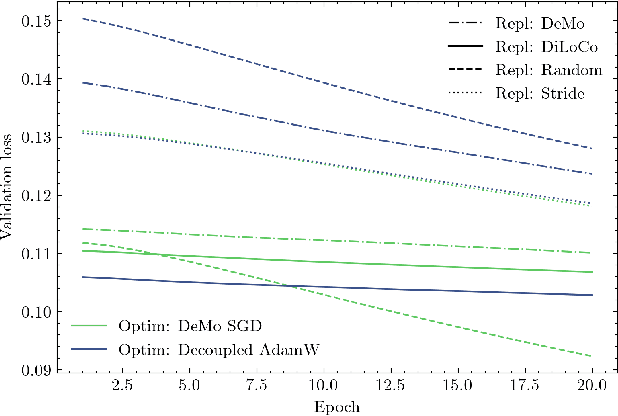
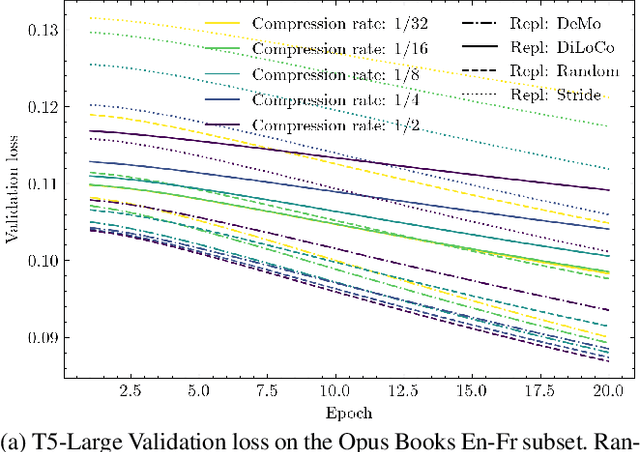
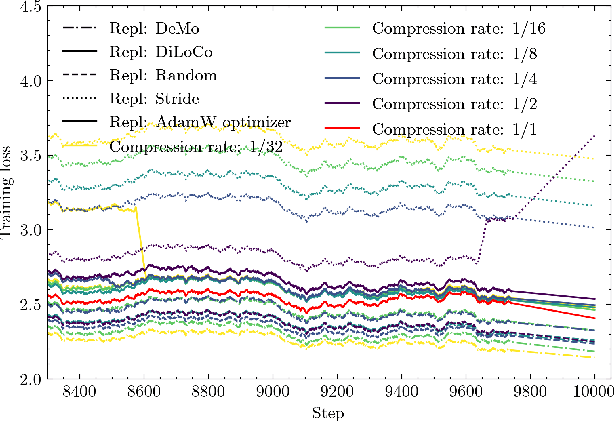
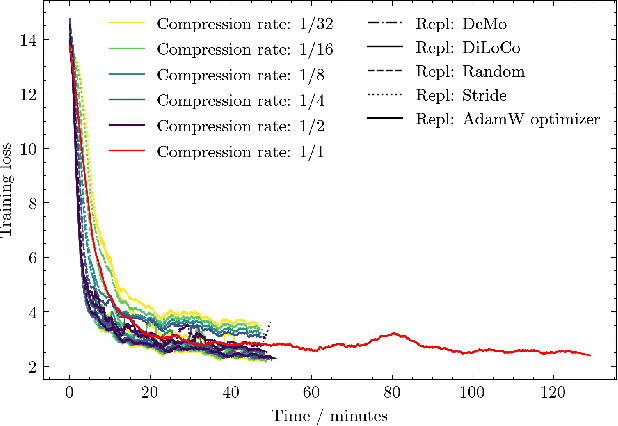
Training large neural network models requires extensive computational resources, often distributed across several nodes and accelerators. Recent findings suggest that it may be sufficient to only exchange the fast moving components of the gradients, while accumulating momentum locally (Decoupled Momentum, or DeMo). However, when considering larger models that do not fit on a single accelerate, the exchange of gradient information and the integration of DeMo needs to be reconsidered. Here, we propose employing a hybrid strategy, FlexDeMo, whereby nodes fully synchronize locally between different GPUs and inter-node communication is improved through only using the fast-moving components. This effectively combines previous hybrid sharding strategies with the advantages of decoupled momentum. Our experimental results show that FlexDeMo is on par with AdamW in terms of validation loss, demonstrating its viability.
When are 1.58 bits enough? A Bottom-up Exploration of BitNet Quantization
Nov 08, 2024
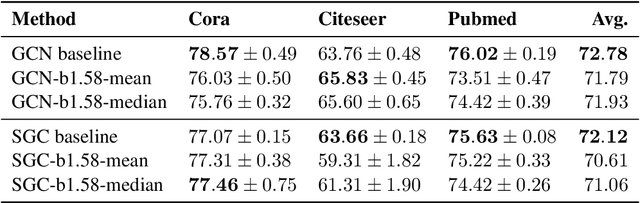
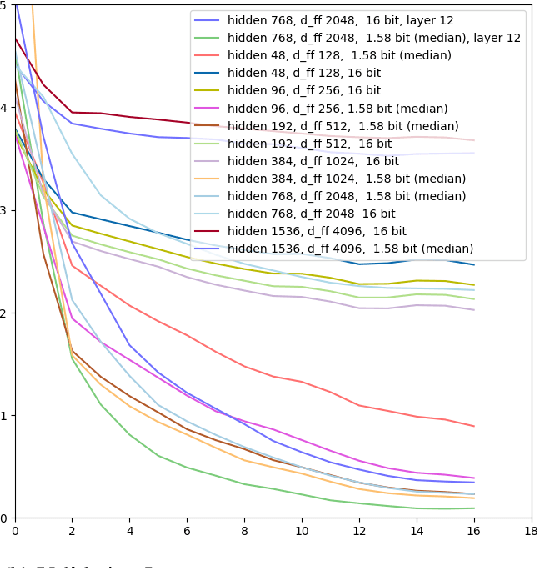
Contemporary machine learning models, such as language models, are powerful, but come with immense resource requirements both at training and inference time. It has been shown that decoder-only language models can be trained to a competitive state with ternary weights (1.58 bits per weight), facilitating efficient inference. Here, we start our exploration with non-transformer model architectures, investigating 1.58-bit training for multi-layer perceptrons and graph neural networks. Then, we explore 1.58-bit training in other transformer-based language models, namely encoder-only and encoder-decoder models. Our results show that in all of these settings, 1.58-bit training is on par with or sometimes even better than the standard 32/16-bit models.
Multiview Aerial Visual Recognition (MAVREC): Can Multi-view Improve Aerial Visual Perception?
Dec 07, 2023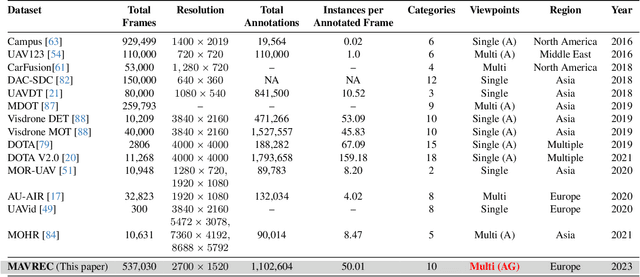
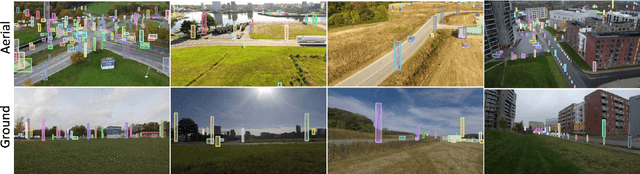
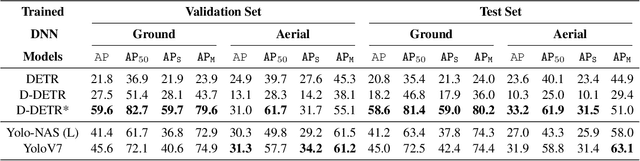
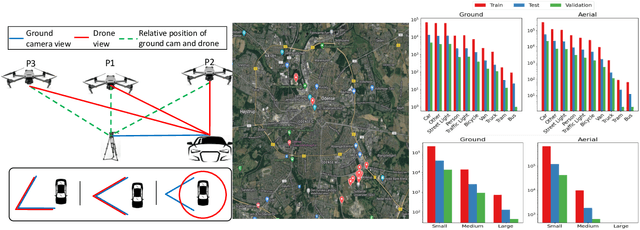
Despite the commercial abundance of UAVs, aerial data acquisition remains challenging, and the existing Asia and North America-centric open-source UAV datasets are small-scale or low-resolution and lack diversity in scene contextuality. Additionally, the color content of the scenes, solar-zenith angle, and population density of different geographies influence the data diversity. These two factors conjointly render suboptimal aerial-visual perception of the deep neural network (DNN) models trained primarily on the ground-view data, including the open-world foundational models. To pave the way for a transformative era of aerial detection, we present Multiview Aerial Visual RECognition or MAVREC, a video dataset where we record synchronized scenes from different perspectives -- ground camera and drone-mounted camera. MAVREC consists of around 2.5 hours of industry-standard 2.7K resolution video sequences, more than 0.5 million frames, and 1.1 million annotated bounding boxes. This makes MAVREC the largest ground and aerial-view dataset, and the fourth largest among all drone-based datasets across all modalities and tasks. Through our extensive benchmarking on MAVREC, we recognize that augmenting object detectors with ground-view images from the corresponding geographical location is a superior pre-training strategy for aerial detection. Building on this strategy, we benchmark MAVREC with a curriculum-based semi-supervised object detection approach that leverages labeled (ground and aerial) and unlabeled (only aerial) images to enhance the aerial detection. We publicly release the MAVREC dataset: https://mavrec.github.io.