 Add to Chrome
 Add to Firefox
 Add to Edge
Beyond Memorization: Gradient Projection Enables Selective Learning in Diffusion Models
Dec 12, 2025
Memorization in large-scale text-to-image diffusion models poses significant security and intellectual property risks, enabling adversarial attribute extraction and the unauthorized reproduction of sensitive or proprietary features. While conventional dememorization techniques, such as regularization and data filtering, limit overfitting to specific training examples, they fail to systematically prevent the internalization of prohibited concept-level features. Simply discarding all images containing a sensitive feature wastes invaluable training data, necessitating a method for selective unlearning at the concept level. To address this, we introduce a Gradient Projection Framework designed to enforce a stringent requirement of concept-level feature exclusion. Our defense operates during backpropagation by systematically identifying and excising training signals aligned with embeddings of prohibited attributes. Specifically, we project each gradient update onto the orthogonal complement of the sensitive feature's embedding space, thereby zeroing out its influence on the model's weights. Our method integrates seamlessly into standard diffusion model training pipelines and complements existing defenses. We analyze our method against an adversary aiming for feature extraction. In extensive experiments, we demonstrate that our framework drastically reduces memorization while rigorously preserving generation quality and semantic fidelity. By reframing memorization control as selective learning, our approach establishes a new paradigm for IP-safe and privacy-preserving generative AI.

MCAD: Multimodal Context-Aware Audio Description Generation For Soccer
Nov 12, 2025Audio Descriptions (AD) are essential for making visual content accessible to individuals with visual impairments. Recent works have shown a promising step towards automating AD, but they have been limited to describing high-quality movie content using human-annotated ground truth AD in the process. In this work, we present an end-to-end pipeline, MCAD, that extends AD generation beyond movies to the domain of sports, with a focus on soccer games, without relying on ground truth AD. To address the absence of domain-specific AD datasets, we fine-tune a Video Large Language Model on publicly available movie AD datasets so that it learns the narrative structure and conventions of AD. During inference, MCAD incorporates multimodal contextual cues such as player identities, soccer events and actions, and commentary from the game. These cues, combined with input prompts to the fine-tuned VideoLLM, allow the system to produce complete AD text for each video segment. We further introduce a new evaluation metric, ARGE-AD, designed to accurately assess the quality of generated AD. ARGE-AD evaluates the generated AD for the presence of five characteristics: (i) usage of people's names, (ii) mention of actions and events, (iii) appropriate length of AD, (iv) absence of pronouns, and (v) overlap from commentary or subtitles. We present an in-depth analysis of our approach on both movie and soccer datasets. We also validate the use of this metric to quantitatively comment on the quality of generated AD using our metric across domains. Additionally, we contribute audio descriptions for 100 soccer game clips annotated by two AD experts.
Spectrum from Defocus: Fast Spectral Imaging with Chromatic Focal Stack
Mar 26, 2025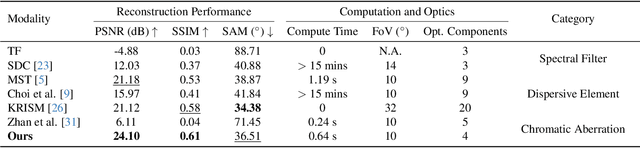
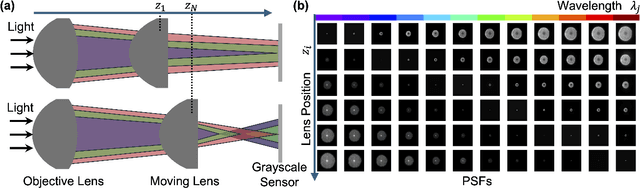
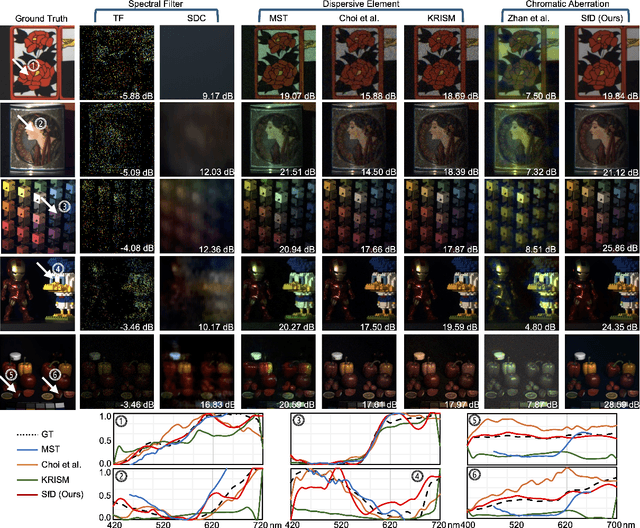
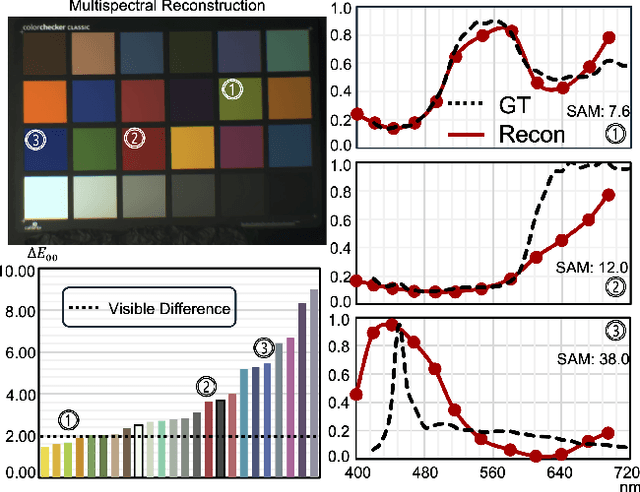
Hyperspectral cameras face harsh trade-offs between spatial, spectral, and temporal resolution in an inherently low-photon regime. Computational imaging systems break through these trade-offs with compressive sensing, but require complex optics and/or extensive compute. We present Spectrum from Defocus (SfD), a chromatic focal sweep method that recovers state-of-the-art hyperspectral images with a small system of off-the-shelf optics and < 1 second of compute. Our camera uses two lenses and a grayscale sensor to preserve nearly all incident light in a chromatically-aberrated focal stack. Our physics-based iterative algorithm efficiently demixes, deconvolves, and denoises the blurry grayscale focal stack into a sharp spectral image. The combination of photon efficiency, optical simplicity, and physical modeling makes SfD a promising solution for fast, compact, interpretable hyperspectral imaging.