 Add to Chrome
 Add to Firefox
 Add to Edge
Federated Variational Preference Alignment with Gumbel-Softmax Prior for Personalized User Preferences
May 29, 2026
Federated Learning (FL) offers a privacy-preserving pathway for aligning Large Language Models (LLMs); however, existing frameworks typically enforce a monolithic reward model, inevitably averaging out inherently conflicting user preferences (e.g., helpfulness vs. harmlessness). While Variational Preference Learning (VPL) offers a pathway to personalization, adapting it to decentralized settings presents a fundamental challenge: posterior collapse driven by severe local data scarcity and heterogeneity. In this paper, we propose Federated Variational Preference Alignment with Gumbel-Softmax Prior (FedVPA-GP), a framework designed to disentangle diverse preferences without compromising privacy. To stabilize variational inference, we introduce a Federated Mixture Prior that enables clients to leverage the aggregate population distribution as a dynamic prior. Furthermore, we incorporate an Orthogonal Loss that explicitly enforces the separation of preference prototypes in the latent space. Experiments on the HH-RLHF dataset demonstrate that FedVPA-GP significantly outperforms monolithic baselines, successfully disentangling conflicting user intents and enabling dynamic preference switching.

ChimeraLoRA: Multi-Head LoRA-Guided Synthetic Datasets
Feb 23, 2026Beyond general recognition tasks, specialized domains including privacy-constrained medical applications and fine-grained settings often encounter data scarcity, especially for tail classes. To obtain less biased and more reliable models under such scarcity, practitioners leverage diffusion models to supplement underrepresented regions of real data. Specifically, recent studies fine-tune pretrained diffusion models with LoRA on few-shot real sets to synthesize additional images. While an image-wise LoRA trained on a single image captures fine-grained details yet offers limited diversity, a class-wise LoRA trained over all shots produces diverse images as it encodes class priors yet tends to overlook fine details. To combine both benefits, we separate the adapter into a class-shared LoRA~$A$ for class priors and per-image LoRAs~$\mathcal{B}$ for image-specific characteristics. To expose coherent class semantics in the shared LoRA~$A$, we propose a semantic boosting by preserving class bounding boxes during training. For generation, we compose $A$ with a mixture of $\mathcal{B}$ using coefficients drawn from a Dirichlet distribution. Across diverse datasets, our synthesized images are both diverse and detail-rich while closely aligning with the few-shot real distribution, yielding robust gains in downstream classification accuracy.
Making Models Unmergeable via Scaling-Sensitive Loss Landscape
Jan 29, 2026The rise of model hubs has made it easier to access reusable model components, making model merging a practical tool for combining capabilities. Yet, this modularity also creates a \emph{governance gap}: downstream users can recompose released weights into unauthorized mixtures that bypass safety alignment or licensing terms. Because existing defenses are largely post-hoc and architecture-specific, they provide inconsistent protection across diverse architectures and release formats in practice. To close this gap, we propose \textsc{Trap}$^{2}$, an architecture-agnostic protection framework that encodes protection into the update during fine-tuning, regardless of whether they are released as adapters or full models. Instead of relying on architecture-dependent approaches, \textsc{Trap}$^{2}$ uses weight re-scaling as a simple proxy for the merging process. It keeps released weights effective in standalone use, but degrades them under re-scaling that often arises in merging, undermining unauthorized merging.
Towards Robust and Efficient Federated Low-Rank Adaptation with Heterogeneous Clients
Oct 30, 2024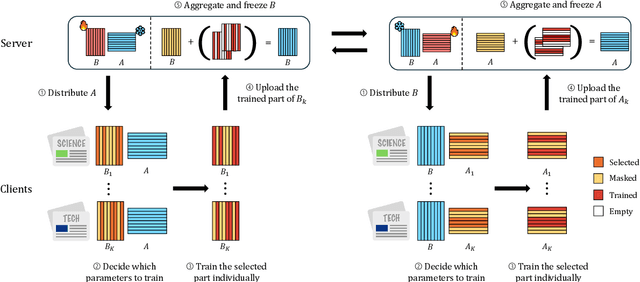
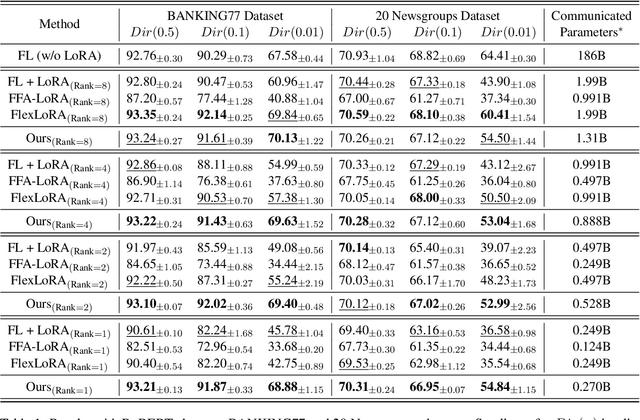
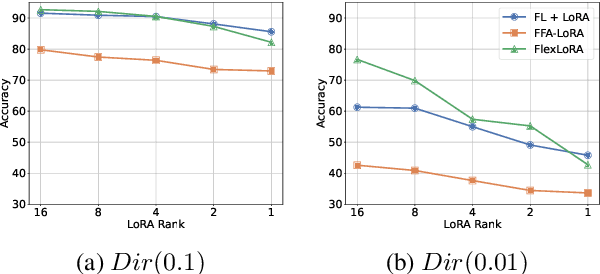
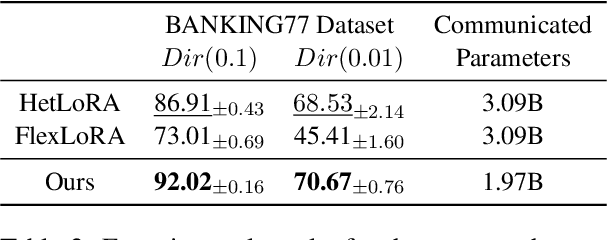
Federated fine-tuning for Large Language Models (LLMs) has recently gained attention due to the heavy communication overhead of transmitting large model updates. Low Rank Adaptation (LoRA) has been proposed as a solution, yet its application in federated learning is complicated by discordance in aggregation. Existing methods addressing this discordance often suffer from performance degradation at low ranks in heterogeneous data settings. In response, we introduce LoRA-A2 (Low Rank Adaptation with Alternating freeze and Adaptive rank selection), which demonstrates robustness in challenging settings with low ranks and high data heterogeneity. Our experimental findings reveal that LoRA-A2 maintains performance even under extreme heterogeneity and low rank conditions, achieving up to a 99.8% reduction in uploaded parameters compared to full fine-tuning without compromising performance. This adaptive mechanism boosts robustness and communication efficiency in federated fine-tuning, enabling the practical deployment of LLMs in resource-constrained environments.